Advanced Technology Uncovers Ancient Medical Secrets
Modern science is now providing unprecedented insights into the lives of people who walked the earth more than two millennia ago. Researchers are discovering not just basic biographical details, but intimate information about their health struggles, aging processes, and even potential medical treatments they received during their lifetimes.
Groundbreaking Discovery Through Non-Invasive Scanning
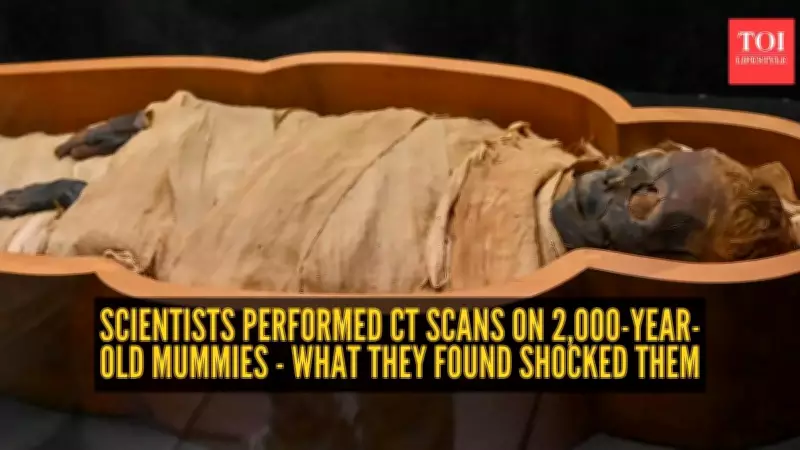
Researchers at the University of Southern California have employed cutting-edge CT scanning technology to examine two Egyptian mummies without disturbing their ancient remains. The findings reveal deeply human stories of pain, aging, and possibly early medical intervention that challenge our understanding of ancient healthcare practices.
Nes-Min: Evidence of Potential Ancient Surgery
One of the mummies, identified as Nes-Min, lived approximately 2,300 years ago during the Ptolemaic period around 330 BCE. The high-resolution CT scans revealed that this individual likely died in his forties with significant spinal and rib injuries. Most remarkably, researchers discovered unusual markings that suggest possible surgical intervention.

Summer Decker, who leads the 3D imaging program at Keck Medicine of USC, explained the significance of these findings. "We actually see what we think could be potentially tool marks or some kind of holes that are not necessarily natural," she stated. "We're trying to investigate that right now, but what we're thinking it could be is potentially some sort of early surgical intervention."
This discovery suggests that ancient Egyptians may have practiced forms of surgery thousands of years before modern medicine developed sophisticated surgical techniques.
Nes-Hor: Chronic Pain in Ancient Times
The second mummy, named Nes-Hor, lived around 190 BCE and provides a different perspective on ancient health challenges. Analysis indicates he died in his sixties after suffering from severe dental problems and significant hip degeneration. The wear on his hip joint suggests he likely experienced considerable pain while walking during his later years.
These findings demonstrate that ancient Egyptians faced many of the same age-related health issues that affect people today, including joint deterioration and dental problems that would have caused chronic discomfort in daily life.
Revolutionary Imaging Technology
The research team utilized a powerful 320-slice CT scanner capable of capturing images as thin as half a millimeter. This advanced equipment allowed them to create detailed digital models while the mummies remained safely enclosed within the lower portions of their sarcophagi.
Through this non-invasive approach, scientists constructed complete three-dimensional digital representations of both priests, essentially creating virtual versions of their bodies that can be studied without physical disturbance to the ancient remains.
Ethical Considerations in Modern Archaeology
Not all experts are comfortable with this type of technological investigation of ancient human remains. Professor Christina Riggs from Durham University raised important ethical questions about the practice.
"Ancient Egyptian burials – and the wrapped, embalmed bodies that are reduced to the term 'mummy' – were based on sacred rites and materials, conducted in secret, that emphasized the divine, eternal qualities of the deceased and created a hidden, sacred, secret place in which their cyclical regeneration could recur," she explained.
Professor Riggs further noted that "There is no 'non-invasive' technology or entirely respectful museum display of the dead if we consider what ancient Egyptian belief systems sought to create for the deceased."
However, other perspectives emphasize the scientific value of such research. Diane Perlov from the California Science Center offered a different viewpoint, stating that "This modern scientific technology offers us a powerful window into the world of ancient people and past civilizations that might otherwise be lost."
This ongoing debate highlights the complex intersection between modern scientific inquiry, cultural respect, and our understanding of ancient belief systems.