Did you realize that the delicate lace trimmings you might search for in Delhi's bustling markets to adorn traditional kurtas, elegant saris, vibrant lehngas, flowing dupattas, or crisp shirts are far more than mere decorative fabrics? These intricate pieces are actually living remnants of a profound 400-year-old cultural and commercial exchange between France and India. This historical connection was initiated when French missionaries established convents in southern India centuries ago, setting the stage for a rich tapestry of shared textile heritage.
The Deep French Imprint on Indian Textiles
Even denim, a fabric where India now ranks among the world's largest producers, carries a distinct French legacy. The very name "denim" originates from "de Nîmes," referencing the French city of Nîmes where this durable cloth was first manufactured. This etymological link underscores the deep-seated French influence woven into India's textile narrative.
Consider the exquisite soft Bengal muslin, the foundational fabric behind the renowned Jamdani and Dhakai saris. Historically, this fine material was highly favored by French aristocracy for undergarments. As corsetry gradually fell out of fashion, Bengal muslin transitioned into outerwear, celebrated for its exceptional fluidity and lightness. This shift played a pivotal role in reshaping contemporary ideals of elegance and comfort in fashion.

From Bans to Adaptation: The Paisley Story
Indian chintz and the iconic paisley textiles, most famously displayed on handwoven Kashmiri shawls, became so immensely coveted in France that the French courts imposed a ban on them between 1686 and 1759. This protectionist measure aimed to shield domestic wool and silk industries from foreign competition. Archival records vividly detail how smuggling operations flourished in response to this prohibition.
This clandestine trade ultimately compelled French textile houses to create their own interpretations of these Indian designs. This creative adaptation eventually crystallized into the distinctive pattern now globally recognized as "French paisley," showcasing a fascinating fusion of Indian inspiration and French artistry.
Textile Matters: A Groundbreaking Exhibition in Paris
These captivating historical insights were central to the recently concluded month-long exhibition titled Textile Matters: Woven Stories between India and France, held in Paris. The show, which is scheduled to travel to India next year, is perhaps the first of its kind to meticulously explore the deep creative ties between India and France exclusively through the prism of textiles.
The exhibition offered profound insights into the intertwined history of fashion between the two nations by showcasing over 60 archival garments, textiles, and embroidered fabrics. It also compellingly demonstrated how both countries continue to actively shape and influence global fashion trends today.
Challenging Stereotypes with a Contemporary Curatorial Vision
A unique and significant aspect of the show, curated by Mayank Mansingh Kaul, was its deliberate emphasis on a contemporary approach to fashion and textile. The curatorial stance consciously rejected the oft-repeated and stereotypical imagery of India—such as maharajas, elephants, the Kama Sutra, yoga, Bollywood, and the Himalayas—that is frequently presented in Western contexts.
"I was keen to challenge the stereotypical ways through which Indian textiles and fashion are often perceived in Europe and North America," explained Kaul. He successfully brought together this expansive exhibition, spread across two floors of the Galleries of the Gibelins within the iconic Mobilier National building, in less than a year.
While renowned designer Christian Louboutin served as the creative director, overseeing the artistic direction and scenography by drawing from his personal experiences of India, Kaul was responsible for developing the conceptual narrative and selecting the pieces on display. "We know less about Indian textile collections in France, and that's a gap that I wanted to address," Kaul noted, highlighting the exhibition's educational mission.

Exploring Four Centuries of Artistic Exchange
The exhibition was thoughtfully divided into seven segments, tracing four centuries of artistic exchange—from the opulent palaces of 17th-century India to the cutting-edge 2025 Paris haute couture runways. It featured participation from prestigious ateliers and organizations including the Sutrakala Foundation, le19M, Lesage Intérieurs, Pierre Frey, Perrine, Atelier 2M, Nila House, and Villa Swagatam.
One notable installation was the denim-draped room. This space was not only an aesthetic nod to the architectural elegance of a traditional Indian salon but also served as a reminder of how India became the most significant destination for the legendary architect Le Corbusier's projects.
Dialogues Between Tradition and Modernity
At the exhibition's entrance, a reproduction of an 18th-century French antechamber, draped in Indian textiles created by artisans at the House of Kandadu using techniques like block printing and natural dyeing, helped viewers visually comprehend how the textiles of the two nations intersected, diverged, and mutually influenced each other over time.
In alignment with the theme of showcasing a contemporary design language through timeless embroidery techniques and fabrics, the exhibition proudly included works by celebrated Indian couturiers Rahul Mishra, Gaurav Gupta, and Manish Arora. All three designers have been integral participants in Paris Couture Week over the years.
Manish Arora's contribution was a hand-woven brocade piece crafted in 2006-07 at the atelier of Hashim Mohammad in Varanasi. Gaurav Gupta's "Golden Ascendant" elegantly referenced the classic drape of the sari. Meanwhile, Rahul Mishra's work offered a deep journey into the realm of rich embroidery and intricate surface embellishments.
Juxtaposing Historical and Contemporary Masterpieces
The contemporary language of Indian couture was elegantly juxtaposed with historical French pieces. This included a Christian Dior sari from the 1950s, representing the label's creative output of that era, placed alongside a sari-inspired gown from the 1990s drawn from the Saint Laurent archives.
Another standout piece was a tunic in a rich marigold color, selected from Chanel's 1968 haute couture collection. Interestingly, the marigold flower, which feels quintessentially Indian, was actually introduced to India during the 16th century by European traders, adding another layer of cross-cultural history.
Installations and a Met Gala Showstopper
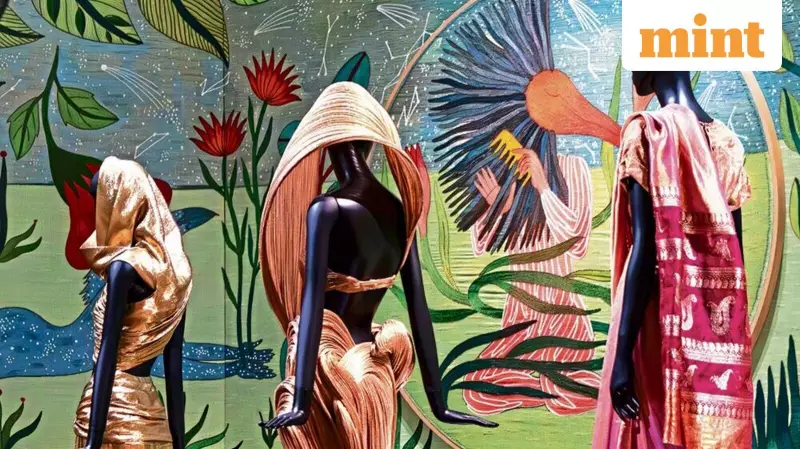
The first floor featured a site-specific textile installation by the designer brand Raw Mango that poetically evoked the timeless elegance of the sari. Titled The Flowers We Grew, these tapestries dressed the gallery walls and were created by the Chanakya School of Craft in collaboration with Mumbai-based artist Rithika Merchant, Maria Chiuri, and Christian Dior. Merchant's work drew inspiration from the stories of her ancestors, particularly the matriarchs from Kerala.
In the fashion section, a "hero work," as Kaul described it, was the stunning gold metallic corset and embroidered sari encircled by Saturn-inspired rings. This extraordinary ensemble was designed by Schiaparelli and Sabyasachi for Natasha Poonawalla for the Met Gala. It compellingly urged viewers to perceive fashion as nothing less than a sculptural work of art.
When a version of this groundbreaking exhibition arrives in India next year, it will undoubtedly provoke a compelling discussion: should we treat it as a display of fashion, as an art exhibition, or as a powerful fusion of both? The answer may lie in the rich, woven stories it continues to tell.