Gandhi's Hinduism: Beyond Godse's Accusations of Muslim Favoritism
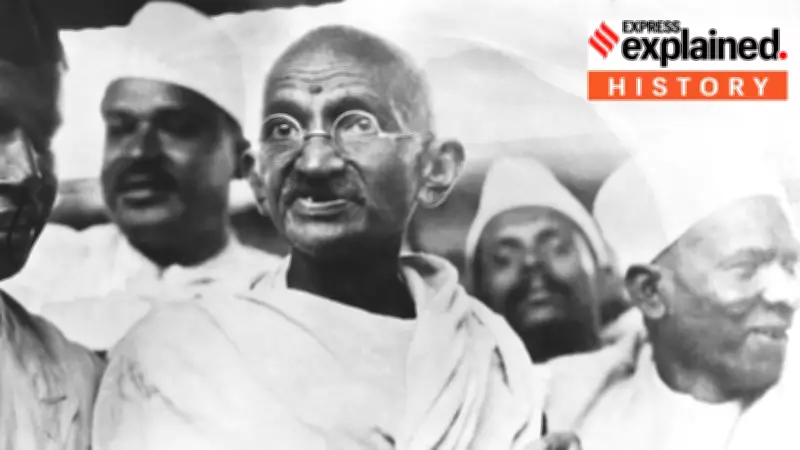
Nathuram Godse assassinated Mahatma Gandhi on January 30, 1948, citing two primary reasons that reflected a broader Hindu nationalist critique. The first was Gandhi's fast to ensure India paid Rs 55 crore to Pakistan as its remaining share of British India's assets, amidst Kashmir hostilities. The second was his acceptance of Partition, despite earlier vows against vivisection. Godse's charge—that Gandhi showed partiality towards Muslims—was a familiar accusation, even as Muhammad Ali Jinnah viewed him as a Hindu leader. However, this perspective overlooks Gandhi's profound and nuanced engagement with Hinduism, which he deeply loved while advocating for religious equality.
Gandhi's Personal Faith in Hinduism
Gandhi publicly expressed his belief in Hinduism, stating at the 1926 Gauhati Congress, "I am a Hindu by birth, and I find peace in the Hindu religion. Whenever peace seemed to elude me, it was in the Hindu religion that I found it." He described himself as a Sanatani Hindu, emphasizing that despite studying other faiths, Hinduism alone resonated with him. In South Africa, he defined Hinduism as an ethical religion, asserting that all religions are equally true when grounded in ethics. This belief informed his moral philosophy, where he saw different faiths as paths to the same divine goal.
Defending Hindu Practices and Beliefs
Gandhi defended key Hindu practices that were often criticized during colonial times. He supported idol worship, explaining in a 1933 correspondence that it aided those who needed tangible representations to contemplate divinity, such as Rama. He stated, "I would not disturb that simple faith," highlighting his respect for diverse forms of devotion. Additionally, Gandhi upheld the belief in reincarnation, considering it essential to Hinduism. As noted in Margaret Chatterjee's Gandhi's Religious Thought, he believed that disbelief in reincarnation disqualified one from being Hindu.

Ram Rajya: An Inclusive Ideal
Gandhi frequently invoked "Ram Rajya" as a model for ideal governance, describing it at the 1925 Kathiawar Political Conference as an inclusive state. He praised Lord Ram for intuitive understanding of public opinion, beyond modern voting systems. Historian Ravi K Mishra's paper Gandhi and Religion argues that Gandhi emphasized Ram Rajya was not exclusive to Hindus; he translated it as the "Kingdom of God on Earth" and noted that in Muslim-majority areas, he would use "Khudai Raj." Gandhi clarified that his Ram was synonymous with Khuda or God, reinforcing his inclusive vision.
Orthodox Hindu and Social Reformer
Gandhi described himself as an orthodox Hindu, but with a reformist twist. In a 1927 address in Jaffna, he distinguished between orthodoxy based on caste practices and one focused on living Hinduism earnestly. He said, "If orthodox Hinduism can mean an incessant striving to live Hinduism to the best of one's lights, then I claim to be an orthodox Hindu." This stance allowed him to advocate for social reforms while maintaining legitimacy within Hindu traditions. His opposition to religious conversion stemmed from his belief in religious equality, famously telling a Christian missionary that conversion was a "spiritual impossibility" akin to wishing all were children of one mother.
Controversial Stances and Legacy
Gandhi's support for the Khilafat movement in 1919, aimed at integrating Muslims into the freedom struggle, drew criticism from Hindu associates who saw it as backing pan-Islamism. He responded that Hindus should not fear pan-Islamism if it wasn't anti-Hindu. Similarly, his reverence for cows led him to oppose violent protection efforts, arguing in Hind Swaraj that such actions increased retaliation. His fast-unto-death against separate electorates for Dalits, resulting in the Poona Pact, was seen as preserving Hindu unity but criticized by B.R. Ambedkar. Post-Partition, Gandhi's insistence on protecting Muslims and Pakistan's dues fueled perceptions of anti-Hindu bias, culminating in his assassination by Godse, with Gandhi's last words being "Hey Ram."