The Giant Anteater: Nature's Imaginative Masterpiece
The giant anteater is one of those creatures that seems almost fictional, as if crafted by imagination rather than the slow hand of evolution. With its elongated snout, sweeping bushy tail, and deliberate, slow-paced walk, it stands out strikingly in the forests and grasslands of Latin America. Yet, its most astonishing feature remains hidden in plain sight—a tongue so extraordinarily long that it defies belief upon first description.
Record-Breaking Tongue: A Marvel of Proportions
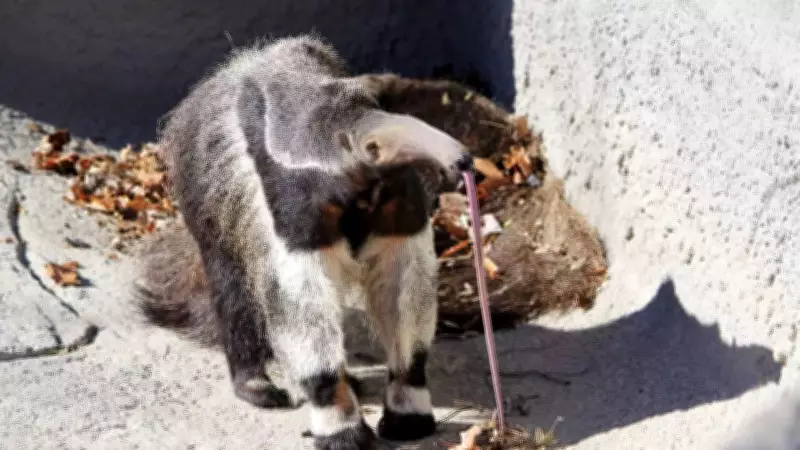
Experts reveal that the giant anteater can extend its tongue at least 45 centimetres beyond its mouth, with some reports suggesting it reaches up to 61 centimetres. This alone makes it one of the longest tongues relative to body size among land mammals. However, the visible extension is just part of the story. Researchers estimate that this extended section accounts for roughly one-third of the tongue's total length when at rest. If accurate, the full length could be approximately 135 centimetres, and based on the upper 61-centimetre extension, it might even approach 183 centimetres. Considering the animal's total length, including its large tail, ranges from 1.2 to 2 metres, the tongue's proportion is nothing short of astonishing.
Specialized Anatomy: More Than Just Length
The tongue is not merely long; it is a highly specialized organ. Coated in sticky saliva and lined with tiny backward-facing barbs known as papillae, these structures efficiently trap insects as the tongue flicks rapidly in and out of nests. Observations indicate it can move up to 150 times per minute. Surprisingly, the giant anteater lacks teeth, relying instead on powerful forelimbs to break open ant and termite mounds. Once exposed, the tongue slips into tunnels, collecting insects in large numbers, which are swallowed whole and crushed in a muscular stomach. This adaptation allows a single anteater to consume up to 30,000 ants and termites daily, underscoring the tongue's critical role in survival.

Evolutionary Roots: The Vermilingua Legacy
True anteaters belong to the suborder Vermilingua, meaning "worm tongue," a name that highlights their defining feature. This group includes four living species, all characterized by elongated snouts and highly developed tongues. Over millions of years, evolution has fine-tuned this organ, making the giant anteater a quiet yet highly specialized predator, perfectly adapted to its niche lifestyle in Latin America's ecosystems.