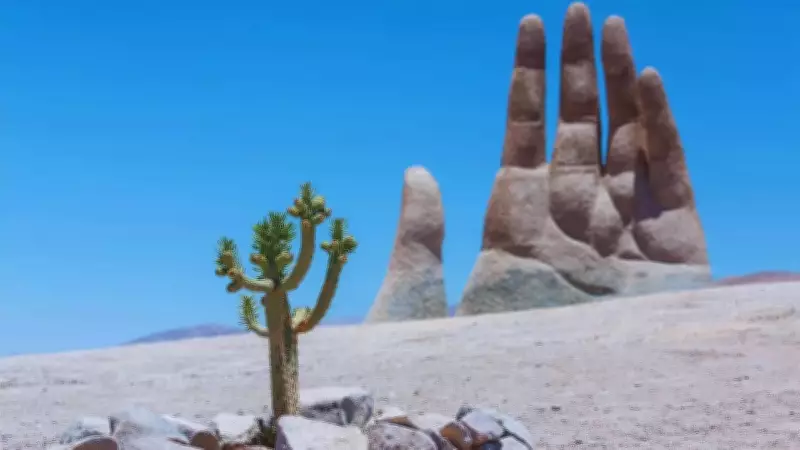
The Giant Hand Emerging from Chile's Atacama Desert
Driving along Route 5 in northern Chile, through miles of rust-coloured earth and endless horizon, the last thing you would expect to see is a colossal human hand rising from the sand. Yet that's precisely what appears in the heart of the Atacama Desert, creating one of South America's most surreal and photographed landmarks.
A Monument in the Barren Landscape
Approximately 75 kilometers south of the coastal city of Antofagasta, five enormous fingers stretch upward from the barren landscape. This sculpture, known as Mano del Desierto (Hand of the Desert), stands about 11 meters (36 feet) tall and is constructed from reinforced concrete over an iron framework. Since its inauguration in 1992, it has become an iconic symbol of Chile's northern region.
The Atacama Desert provides a dramatic backdrop for this artwork. Recognized as one of the driest non-polar deserts in the world, its arid climate, vast open terrain, and minimal vegetation create a stark environment that contrasts powerfully with the human form of the sculpture. The location was not chosen randomly—the immense scale of the open desert amplifies the effect of the giant hand emerging from the ground.

The Artist's Vision and Interpretation
The statue was created by Chilean artist Mario Irarrázabal, who has gained international recognition for creating giant hand sculptures in various locations worldwide. According to the artist, the sculpture represents themes related to human vulnerability, suffering, and injustice. However, Irarrázabal has deliberately avoided providing a fixed, official explanation, encouraging viewers to interpret the work in their own way.
This openness to interpretation has fueled ongoing public discussion about the sculpture's meaning for over three decades. Some see it as a memorial to the region's mining and industrial history, while others view it as a statement about human isolation or environmental concerns.
Why the Atacama Desert?
The emptiness of the Atacama provides a powerful contrast to the human form of the sculpture. The region around Antofagasta has a rich history of mining and industrialization that has shaped northern Chile's identity. While the sculpture isn't strictly a memorial, its presence in such a barren landscape adds emotional resonance to its message.
The desert's unique lighting conditions enhance the sculpture's visual impact. During sunrise and sunset hours, the ever-changing desert light creates long shadows across the hand, adding to its dramatic effect. Against the clear sky and with no buildings or infrastructure in the vicinity, the hand appears profoundly isolated.
A Roadside Landmark and Tourist Destination
Strategically located near the Pan-American Highway, the sculpture has become easily accessible to tourists traveling through northern Chile. Despite its isolated location, it has grown into a popular destination for both domestic and international visitors.
The statue has faced challenges with vandalism and graffiti over the years, requiring periodic restoration work to maintain its appearance. Nevertheless, it continues to draw visitors who make the journey into the desert specifically to experience this unique artwork firsthand.
A Global Symbol
Since its creation, Mano del Desierto has become one of Chile's most recognized statues. Its unique shape and harsh surroundings have made it world-famous, particularly in travel photography and cultural documentation. The sculpture's message may be interpreted in multiple ways, but its physical presence is undeniable: a giant human hand emerging from one of the driest places on Earth.
More than three decades after its inauguration, the Hand of the Desert continues to captivate those who encounter it, serving as both an artistic statement and a testament to human creativity in even the most challenging environments.