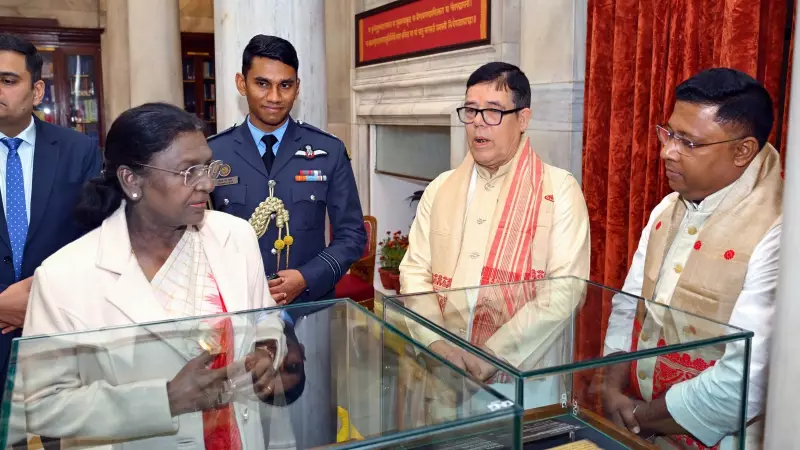
President Droupadi Murmu Inaugurates 'Granth Kutir' Library at Rashtrapati Bhavan
President Droupadi Murmu inaugurated 'Granth Kutir', a significant new library at Rashtrapati Bhavan in New Delhi on Friday, January 24, 2026. This library houses an impressive collection of 2,300 books and manuscripts in 11 classical Indian languages, marking a pivotal step in promoting India's rich cultural heritage.
A Repository of Classical Indian Knowledge
The collection at Granth Kutir includes works in Tamil, Sanskrit, Kannada, Telugu, Malayalam, Odia, Marathi, Pali, Prakrit, Assamese, and Bengali. According to a statement from the President's Office, the library features manuscripts and books covering diverse subjects such as:
- Epics and mythology
- Philosophy and spiritual texts
- Linguistics and grammar
- Historical accounts
- Governance and political theory
- Scientific treatises
- Devotional literature
Notably, the collection also includes the Constitution of India translated into classical languages, along with approximately 50 manuscripts handwritten on traditional materials like palm leaf, paper, bark, and cloth.

Replacing Colonial Legacy with Indigenous Heritage
Granth Kutir represents a conscious effort to shed colonial influences at Rashtrapati Bhavan. The library has replaced colonial-era works that previously occupied the space, including:
- 'A Catalogue of the Original Works of William Hogarth'
- 'Speeches of Lord Curzon of Kedleston'
- 'Summary of the Administration of Lord Curzon of Kedleston'
- 'Life of Lord Curzon'
- Historical issues of 'Punch' magazines
These colonial texts have been relocated to a separate space within the Rashtrapati estate and have been digitized for online access by research scholars.
Part of Broader Cultural Renaissance
This initiative follows recent changes at Rashtrapati Bhavan, including the replacement of British Aide-De-Camp portraits with 21 portraits of Param Vir Chakra awardees in the Param Vir Dirgha gallery. The statement emphasized that "the objective of Granth Kutir is to enhance public awareness about India's cultural and literary heritage and align with the national resolve to shed colonial influences."
The library supports the Union government's Gyan Bharatam Mission, which aims to preserve, digitize, and disseminate India's vast manuscript heritage by integrating tradition with technology. The Indira Gandhi National Centre for the Arts (IGNCA) is providing professional expertise for the conservation, documentation, and display of manuscripts.
President Murmu's Vision for Classical Languages
Addressing the gathering at the inauguration, President Murmu highlighted the enduring relevance of classical languages. She stated that these languages have laid the foundation of Indian culture and have guided the world for centuries through knowledge in science, yoga, ayurveda, and literature.
The President specifically mentioned that texts like the Tirukkural and Arthashastra remain relevant today, while contributions such as Panini's grammar, Aryabhata's mathematics, and the medical sciences of Charaka and Sushruta continue to inspire global scholarship.
Granth Kutir stands as a testament to India's commitment to preserving and promoting its intellectual legacy while consciously moving away from colonial symbols and narratives.