The Quiet Courage of Hasrat Mohani: A Legacy for Modern India
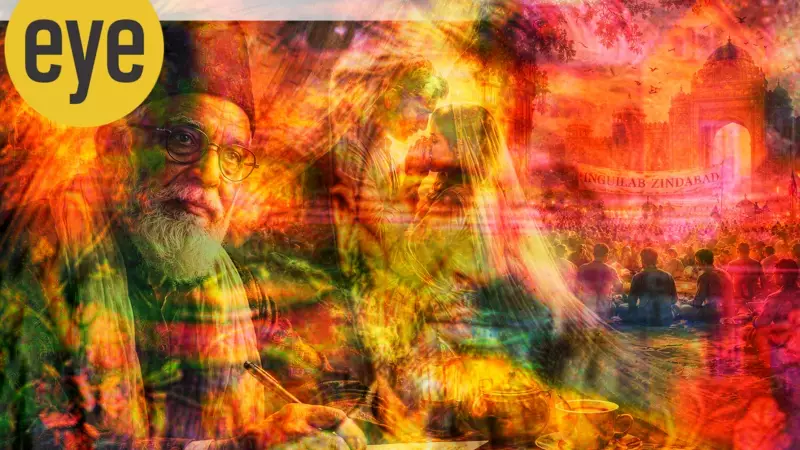
In an era dominated by loud declarations and binary choices, the voice of freedom fighter Hasrat Mohani arrives not as a distant echo from history, but as a gentle yet firm reminder of what it means to be truly human. Mohani, who lived between empires and awakenings, between prayer mats and prison cells, crafted a legacy that blends the soft grammar of love with the hard consonants of revolt. His relevance today lies not in nostalgia for a bygone era, but in his refusal to abandon a future where feeling and freedom coexist.
The Discipline of Sorrow and the Power of Restraint
Mohani's poetry begins quietly, as all dangerous truths often do. In lines like "Chupke chupke raat din / aansū bahānā yād hai"—quietly, night and day, I remember weeping—he reveals a private discipline of sorrow that modern society has largely forgotten. In our age of real-time emotional leaks and curated confessions, Mohani teaches that restraint does not dilute feeling; it distills it. His tears are not mere content for consumption but a carefully saved currency, spent with intention and care.
This approach to emotion is a form of resistance. To remember tenderness in an age of coercion, as Mohani did, is to refuse the narrowing of human experience. His India was colonized, censored, and surveilled; ours is hyper-connected, accelerated, and quantified. He wrote by hand, risking imprisonment; we write to be seen, risking only being unfollowed. Yet, the ache he names remains familiar, a testament to the timeless nature of his insights.

Intimate Bravery and the Choreography of Desire
Mohani's concept of bravery is intimate, unfolding in proximity rather than performance. In verses such as "Tujh se milte hī wo kuchh / bebāk ho jānā merā"—meeting you, how suddenly fearless I became—he redefines courage as something that happens when the self loosens its armor and steps closer. This stands in stark contrast to a world where courage is often mistaken for volume and fearlessness for aggression.
His poetry also offers a choreography of desire that modern culture has largely mislaid. Images like "Aur tirā dāntoñ meñ / wo ungliyāñ dabānā yād hai"—and I remember your fingers pressed between your teeth—are electric yet modest, charged without spectacle. They invite us to slow down, to look again, and to allow the erotic to be precise rather than loud. In an age of saturation, where everything is explicit but little is truly felt, Mohani's eros teaches that intimacy deepens when it is allowed to hover, with edges and pauses that give desire its shape.
Political Clarity Without Emotional Evacuation
Mohani lived amid movements that demanded clear allegiances and oppositions. He provided that clarity, coining the iconic slogan "Inquilab Zindabad", a phrase that still resonates globally. Yet, he refused to let politics evacuate feeling. In lines like "Tujh se kuchh kahnā thā dil meñ / par kahā kuchh aur thā"—there was something I wanted to say from the heart, but I said something else—he acknowledges that language is often a poor substitute for sensation, and sincerity arrives obliquely.
His appreciation for silence as agreement, as seen in "Aur hameñ wo kuchh na kah kar / tirā chhup jānā yād hai"—and how you said nothing, and fell silent—contrasts sharply with today's culture of speed and certainty. Mohani's time featured mushairas instead of metrics, listening instead of logging on, reminding us that being stirred emotionally is different from being inflamed reactively.
A Grammar of Integrity and a Manual for Attention
Mohani's life itself was a grammar of integrity. He chose poverty over patronage, endured prison without bitterness, and his art—ghazals that breathe between syllables—serves as a manual for attention. He provokes by lowering his voice, heals by naming what we avoid, and inspires by refusing to simplify complex human experiences.

He poses profound questions without packaging easy answers: What would politics look like if it protected vulnerability? What would love feel like if it allowed time? What would freedom mean if it included the right to feel deeply, privately, without witnesses? These inquiries challenge the contemporary confusion of exposure with truth and provocation with thought.
Recovering Capacity in a Loud World
Mohani's poetry circles back to its beginnings, not out of stagnation, but because remembrance is a continuous process. Lines like "Chupke chupke raat din / aansū bahānā yād hai" and "Hum ko ab tak āshiqī / wo zamānā yād hai" do not urge a return to the past but ask us to recover essential capacities: to be subtle in a loud world, to be brave in small rooms, to let eros and ethics share a table, and to trust that intelligence can be gentle.
Hasrat Mohani's relevance does not stem from belonging to our era; it arises from his refusal to do so entirely. He stands slightly apart, reminding us that what might seem irrelevant—global, glamorous, liberating irrelevance—could be the last sanctuary where thought can breathe, where feeling can teach, and where the human spirit can remain whole. In a time of binaries and applause for certainty, his quiet courage offers a sanctuary for depth and integrity.