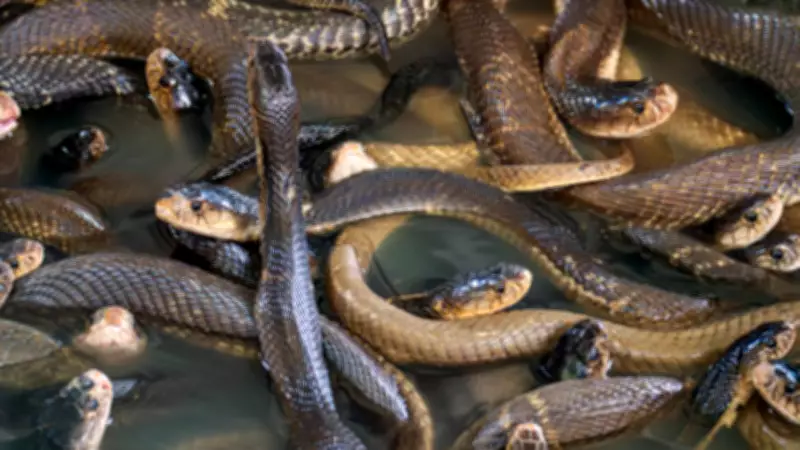
Most people assume snakes are solitary creatures, cold and asocial. However, a growing body of research is challenging this assumption. Certain snake species not only tolerate each other but actively seek companionship, form bonds, and organize into communities with social structures.
Garter Snakes: Social Networks and Friendships
The most extensive field study of snake sociality revealed that garter snakes form clear communities built around preferred individuals. Older females often act as leaders, tying groups together and guiding movements. This is not incidental clustering but a genuine social structure, similar to that seen in elephants or orcas.
Lab research confirmed that young garter snakes prefer shelters already occupied by others and coordinate their exploration times. They show strong preferences for specific individuals, colloquially described as "friends." Snakes within social networks exhibited better body condition than loners, suggesting evolutionary benefits such as shared predator protection, temperature regulation, and information sharing about shelter spots.

Rattlesnakes: Distinct Social Groups
Rattlesnakes are among the most reliably social serpents in North America. Studies on western diamondback rattlesnakes found they form distinct social groups of frequently interacting individuals, even when other rattlesnakes with overlapping home ranges are nearby. These associations are consistent, preferential, and maintained across seasons.
Timber rattlesnakes take it further: genetic studies confirm that related individuals preferentially share hibernation sites and basking locations, even after years of separation. If you encounter a rattlesnake sunning itself, chances are several more are nearby, known to that snake personally.
In Manitoba, Canada, red-sided garter snakes gather in communal dens holding up to 10,000 snakes, the largest overwintering population of any terrestrial vertebrate in North America. Research suggests snakes return to the same dens annually, forming site fidelity that implies recognition of familiar individuals from season to season.
Cottonmouths and Pythons: Pairing and Grouping
Researchers at the University of Florida observed male and female cottonmouth snakes pairing off for extended periods and foraging together, a pattern that defies the solitary template. Ball pythons in the lab spent over 60 percent of their time crowded together in a single shelter, repeatedly choosing to group up even when individual spaces were available.
Herpetologist Melissa Amarello, executive director of Advocates for Snake Preservation, stated: "Social behavior is not limited to a single site, single species, or even single family of snakes." The reptile you spotted under your porch probably did not come alone.