Hyderabad's Armenian Cemetery: A Shared Historical Burial Site
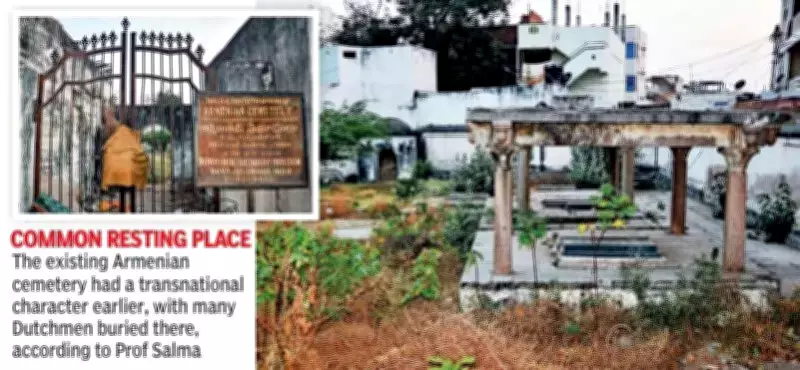
In a fascinating historical discovery, the 400-year-old Armenian cemetery located at Uppuguda near Falaknuma in Hyderabad has been revealed to have served as a common burial ground for both Armenian and Dutch communities. This significant finding comes from new research conducted by Professor Salma Ahmed Farooqui, director of the HK Sherwani Centre for Deccan Studies at Moulana Azad National Urdu University in Hyderabad.
The Transnational Character of the Cemetery
According to Professor Farooqui's research, the Dutch East India Company maintained a factory—essentially a warehouse or trade post—near the iconic Charminar. Employees of this company who passed away during that period were initially interred at the Armenian cemetery before a separate Dutch burial ground was established in the immediate neighborhood.
"It can be surmised that the existing Armenian cemetery earlier had transnational character with many more Dutchmen buried there," Professor Farooqui stated. "The bodies were then reinterred to the new Dutch cemetery in the immediate neighbourhood."

The Armenian cemetery contains epitaphs dating from 1645 CE to 1807 CE, providing tangible evidence of its historical significance. Among these graves is that of Stephen Ysbrantson Visser, a Dutch book-keeper for the Dutch East India Company who died on May 20, 1662. His grave features an epitaph written in Dutch, offering a direct connection to the cemetery's multinational past.
Historical Documentation and Evidence
Professor Farooqui, who is currently conducting extensive research on the Armenian cemetery, recently uncovered several important historical documents that shed light on this shared burial practice. One crucial source is "Op en Ondergangh van Koromandel" (The Rise and Fall of Coromandel) by Dutchman Daniel Havart, who served as treasurer at the Hyderabad factory.
Havart's writings indicate that English and Dutch merchants in Hyderabad originally shared a single cemetery located near the Dutch factory close to Charminar. However, following the Mughal annexation of Hyderabad in 1687 CE, the factory was closed down. Professor Farooqui notes that no graves of Englishmen exist in Hyderabad to verify this particular claim.
The presence of Stephen Ysbrantson Visser's grave in the Armenian cemetery strongly suggests that Dutch and Armenian communities utilized a common burial site. Havart further documented that Johannes van Nijendaal, chief of the Dutch factory in 1678 CE, took significant steps to establish a new Dutch graveyard.
The Establishment of a Separate Dutch Cemetery
According to historical records, Nijendaal planted a hedge of milk trees around the newly created Dutch graveyard, which also featured a stone gate and a small house for mourners. More remarkably, Havart makes a startling claim that Nijendaal collected the bones of all Dutch individuals who had been buried in the Armenian cemetery and reinterred them in two stone tombs within the new cemetery.
"Stephen Ysbrantson Visser's tombstone is particularly mentioned as being too heavy to have been relocated," Professor Farooqui explained. "For this reason, he still rests in the old Armenian cemetery."
Rediscovery and Documentation
The Armenian cemetery itself had largely faded from public awareness until its rediscovery was facilitated by a 1907 letter unearthed by historian Ziauddin Ahmed Shakeb in 1970 at the State Archives and Research Institute in Hyderabad. This letter, described as a formal colonial-era administrative correspondence, helped officials locate and identify the previously neglected cemetery.
The correspondence was likely written by Thomas Wolseley Haig (1865-1938), a British civil servant and scholar in British India. Haig was responsible for having the Armenian and Dutch epitaphs read and translated, further documenting the cemetery's historical significance.

Professor Farooqui's research suggests that the Armenian cemetery originally had a more extensive transnational character than previously understood, with significantly more Dutch individuals buried there before the establishment of the separate Dutch cemetery. This discovery adds an important chapter to Hyderabad's rich multicultural history and the complex interactions between different communities during the colonial period.