India's Mid-January: A Time of Layered Celebrations
India's calendar remains packed throughout the year. Few periods carry as much layered meaning as mid-January. Every significant day or event in the Indian calendar holds its special place. This stretch of the year proves no exception.
Rooted in astronomy and agriculture, mid-January marks a decisive seasonal shift. Winter begins easing its grip. Harvest cycles complete themselves. Longer days promise warmth ahead.
This period also ranks among the earliest major festival times of the year. It arrives with near-universal observance across the nation. Yet expressions differ strikingly from region to region.

While dates remain broadly shared, each state interprets the season through unique rituals and memories. For many communities, it signals the end of winter harvest. Others welcome the Sun's northward journey with holy dips and prayer.
Among tribal and pastoral communities, the same period becomes a time to honour cattle, ancestry, and cultural continuity. Migration and movement ensure these celebrations no longer stay confined to single geographies. They overlap, coexist, and travel across boundaries.
Lohri: Punjab's Bonfire Celebration
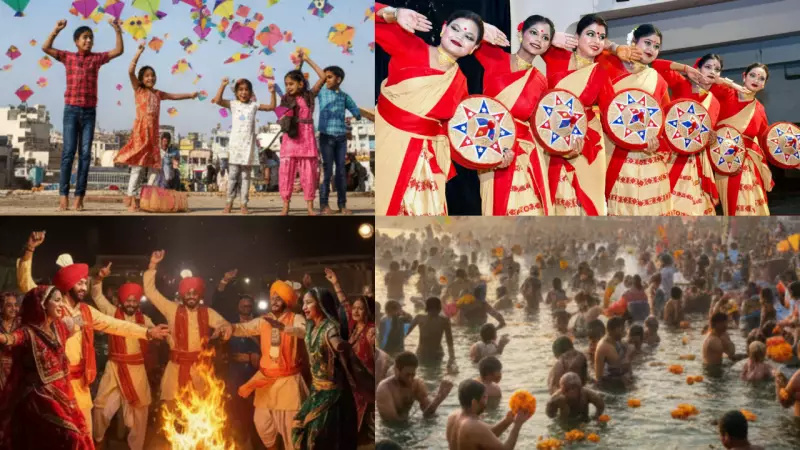
Lohri lights up Punjab, Haryana and Punjabi pockets across North India. Winter hits its peak during this celebration. At its heart, Lohri represents a harvest festival. In practice, it feels like a cultural block party built around a single glowing symbol: the bonfire.
Families celebrate Lohri the night before Makar Sankranti. Neighbors spill outdoors together. They toss sesame, jaggery, puffed rice, and peanuts into the flames. People trade warmth and wishes around the fire.
The fire symbolises the sun itself. It serves as a source of warmth and light during winter's coldest phase. Tossing traditional food into sacred flames becomes an offering of gratitude. People thank nature and the sun god for prosperous harvests.
The soundtrack remains unmistakably Punjabi. Dhol beats fill the air. Folk songs, gidda, bhangra, and stories drawn from agrarian life create the night's atmosphere. Lohri stands apart from wider Sankranti celebrations. It doesn't stretch over multiple days. It avoids elaborate kitchen rituals.
Instead, Lohri knits communities together around winter bonfires. The fire transforms into an altar of closeness and shared warmth.
Makar Sankranti: Solar Transition Festival
The main astronomical event marks the Sun's entry into Capricorn. Makar refers to Capricorn. Sankranti means movement or transition. The day also carries the name Uttarayan. This literally translates to "entry into the north." It hints at the Sun's apparent shift that signals longer days.
This solar transition acts as the umbrella under which many regional celebrations unfold. The Sun's movement heralds longer daylight hours. The festival symbolically marks winter's end and spring's approach.
Unlike most Indian festivals following lunar calendars, Makar Sankranti arrives with near-perfect punctuality yearly. Celebrated on January 14 or 15, it remains one of rare festivals tied firmly to the solar calendar.
Across North India, the day takes on spiritual and reflective tones. In Uttar Pradesh, Bihar, Rajasthan and parts of Madhya Pradesh, devotees take holy dips in rivers at dawn. The Ganga at Prayagraj, Varanasi, Haridwar, Patna, and Buxar see particular devotion.
The transition ritual believes to wash away negativity. It ushers in renewal. Pilgrims perform similar rituals in rural river ghats, ponds, and canals. Early mornings transform into quiet seas of shawls, copper pots, and soft chanting.
Kites fill the sky during these celebrations. Food traditions in this belt skew warm, simple, and seasonal. In Bihar and eastern Uttar Pradesh, families typically cook khichdi. This dish uses new rice, moong dal, and ghee. It often comes served with chokha, pickles, or curd.
The menu also includes sweets made of white and black sesame seeds and jaggery. Locals know these as tilkut. In Jammu, the day marks river rituals and temple visits along the Tawi and Chenab. The same spiritual rhythm extends into the hills.

These northern and central rituals create a Sankranti layer that feels quiet, earthy, and devotional. Holy water at dawn, flames in temple courtyards, steaming bowls of khichdi at noon define the experience.
Tusu Parab: Jharkhand's Tribal Festival
Head east into Jharkhand's Adivasi belts. Sankranti transforms into Tusu Parab here. This tribal harvest festival carries its own poetic language.
Throughout December, girls craft clay Tusu idols. These symbols represent fertility, virtue, and hope. Then comes what makes any Indian celebration feel complete: folk songs.
Rich with indigenous storytelling, these songs accompany dances, feasts, and finally river immersions on January 14. Here, you find no kites or bonfires. Tusu Parab defines itself through women-led rituals, music, and narratives.
These elements centre Adivasi identity rather than mainstream Hindu iconography.
Uttarayani Fair: Uttarakhand's Cultural Confluence
In Uttarakhand's Kumaon region, Makar Sankranti reshapes itself into the Uttarayani Fair. The celebration becomes a confluence of pilgrimage, cultural exhibition, and village fair. Bageshwar emerges as the epicentre.
It draws devotees, traders, folk performers, and travellers into one dense swirl. Unlike domestic, kitchen-centric Sankranti celebrations people often imagine, this one lives outdoors.
Crowded lanes, temple bells, street snacks, shopping stalls, and river rituals define the experience. It feels communal, historical, and deliberately noisy.
The holy dip here isn't merely symbolic. It becomes a ritual of renewal. Pilgrims line riverbanks before sunrise. They wait to step into icy waters believed to cleanse sins. The ritual sets the year on a spiritually auspicious path.
Families travel from across the hills to take the Magh Snan. This tradition has survived centuries. It binds faith, folklore, and landscape into one cold yet deeply cherished rite.
Sakraat: Maharashtra and Rajasthan's Social Celebration
Move westward. Sankranti becomes Sakraat or Sankrant here. Widely observed in Maharashtra and Rajasthan, Sakraat represents a quieter, social celebration. It anchors itself in sesame-jaggery sweets and house-to-house exchanges.
Sakraat arrives on January 14 yearly. What sets it apart isn't spectacle; it's restraint. Til-gul laddoos dominate the day. Warming winter snacks and familiar reminders fill homes.
"Til-gul ghya, aani goad-goad bola" means "take this sweet, and speak sweetly." Women often lead these exchanges. They visit neighbors and reinforce social bonds through food.
In many ways, Sakraat functions as a social reset. It symbolises new beginnings, repaired relationships, and a softer start to the year.
Uttarayan: Gujarat's Kite Festival
In Gujarat, Makar Sankranti turns into the high-energy, big-sky spectacle known as Uttarayan. Rooftops fill with people. Music spills from balconies. Entire cityscapes get swallowed by battling kites.
Ahmedabad, Surat, Vadodara and Rajkot transform into open-air arenas. "Kai Po Che!" echoes across neighborhoods. Kite strings snap and victories get claimed.
Uttarayan usually falls on January 14. Celebrations stretch far beyond a single day. International Kite Festival events host themselves across the state.
Here, the festival becomes sport, performance, and tourism rolled into one spectacular experience.
Magh Bihu: Assam's Harvest Celebration
In Assam, the season unfolds as Magh Bihu. People also call it Bhogali Bihu. Celebrations span several days. They mark the end of harvest cycles when granaries fill completely. Agricultural labour finally eases.
The lead-up begins with Uruka. This evening features collective feasting where families cook together. Bonfires called Meji, fishing in local ponds, and shared breakfasts define the rhythm.
While bonfires may visually echo Lohri, Magh Bihu carries a distinct cultural signature. The broader Bihu tradition shapes it, especially through dance.
Bihu Nritya remains fast, youthful, and expressive. Hip sways, brisk steps, and rhythmic arm movements mark it. These movements mirror courtship and nature.
Music relies on folk instruments like the dhol, pepa, gogona, and toka. This creates a soundscape that feels both agricultural and celebratory.
Magh Bihu feels less like a single festival day. It becomes more of a cultural season. It celebrates abundance, completion, and simple relief that fields have yielded their promise.
Pongal: Tamil Nadu's Four-Day Festival
Further south, Tamil Nadu observes Pongal as a four-day celebration. Bhogi on January 14, Thai Pongal on January 15, Mattu Pongal on January 16, and Kanum Pongal on January 17 form a ritual arc. Each day marks distinct customs.
Surya Pongal centres on Sakkarai Pongal. This dish uses freshly harvested rice. People offer it to the Sun in gratitude for good harvests.
Mattu Pongal places cattle at the celebration's heart. Bulls and cows receive adornment with paint, garlands, bells, and special feed. This recognises their role as agricultural partners.
No other mid-January celebration elevates cattle quite like Pongal does. For a full day, they move from fields into ritual life's centre.
Kanum Pongal closes the festival with community visits, picnics, and riverside outings.
Pedda Panduga: Andhra and Telangana's Big Festival
Across Andhra Pradesh and Telangana, the Sankranti season peaks with Pedda Panduga. This literally means "the big festival."
Homes receive thorough cleaning. Families buy new clothes. They decorate thresholds with muggulu. Sugarcane stalks and turmeric plants set up as prosperity symbols.
Alongside celebration, Pedda Panduga carries a quieter ritual layer. Many households observe shraddha. They offer food to honour ancestors and seek blessings.
Traditional dishes like ariselu, boorelu, sakkara pongali, and seasonal curries appear on banana leaves. Ceremonial distribution of sesame mixtures follows. These echo warmth and fertility.
Tsungkamnyo: Nagaland's Cultural Fair
In Nagaland, Sankranti itself doesn't dominate the calendar. The same winter period marks itself through Tsungkamnyo. This appears particularly in areas like Pungro in Kiphire district.
Here, the focus isn't solar movement or harvest rituals. Tsungkamnyo functions as a cultural fair. It showcases Naga heritage, crafts, oral traditions, and performance.
Open grounds turn into stages for dances, folk songs, and indigenous music. Craft stalls display handwoven textiles, bamboo products, beadwork, and everyday artefacts.
Younger generations participate through sports and competitions. Elders preside as custodians of memory and custom.
Tsungkamnyo uses the same mid-winter timing as Sankranti elsewhere. But it repurposes this timing as an identity assertion rather than a transition ritual.
A Shared Pause in Time
Mid-January unfolds across India not as a single festival, but as a shared pause in time. One solar shift gives birth to many ways of belonging. The period remains rich in meaning, rich in food, and rich in culture.
From bonfires in Punjab to kite battles in Gujarat, from cattle worship in Tamil Nadu to cultural fairs in Nagaland, India's diversity shines brightly. Each celebration carries its unique flavor while sharing common roots in harvest and renewal.
These festivals remind us how geography, history, and community shape traditions. They show how a single astronomical event can inspire countless expressions of gratitude, joy, and cultural pride across a vast nation.