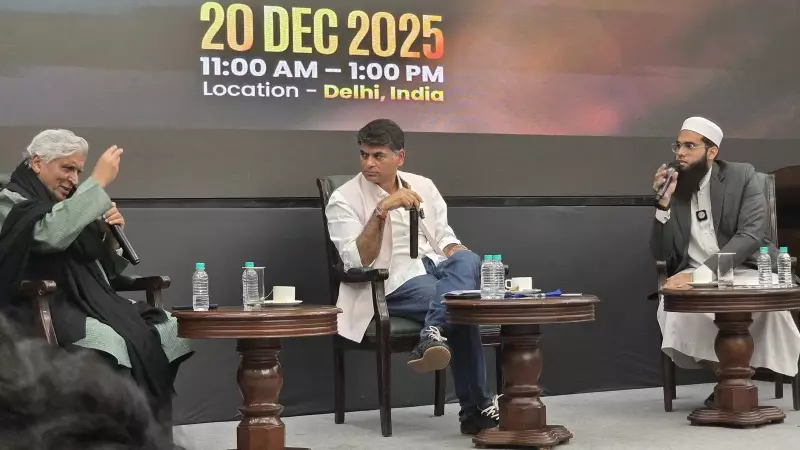
In an event that underscored the enduring power of civil discourse, a packed audience at New Delhi's Constitution Club witnessed a profound academic debate on Saturday, December 21, 2025. The central question was as ancient as human thought itself: does God exist? On the stage were two prominent but ideologically opposed figures: celebrated poet and lyricist Javed Akhtar and Islamic scholar and social media personality Mufti Shamail Nadwi.
A Clash of Worldviews: Logic vs. Ethical Inquiry
Moderated by Saurabh Dwivedi, editor of The Lallantop, the nearly two-hour dialogue saw both participants employ distinct methodologies to advance their positions. Mufti Shamail Nadwi, arguing for theism, anchored his case in logic and philosophical reasoning. He presented the cosmological argument, contending that a contingent universe necessitates a first cause, which he identified as God. He warned that rejecting this premise leads to an infinite regress, an intellectual dead end. For Nadwi, the divine is a metaphysical reality accessible primarily through reason, beyond the mere scope of empirical science.
In contrast, Javed Akhtar, identifying as an atheist, approached the question through ethical frameworks and real-world observations. He pointed to historical and contemporary suffering, specifically citing the horrors of conflicts like Gaza, where children perish. “What kind of God allows this?” he questioned, arguing that such tragedies challenge the concept of a benevolent, omnipotent deity. For Akhtar, faith often functions as an unnecessary barrier to pressing moral and philosophical questions.
More Than Theology: Politics, Free Speech, and Polarization
The debate, however, transcended pure theology. It became a microcosm of discussions on religion, politics, and the shrinking space for free speech in India. The event's genesis was itself rooted in controversy. In August 2025, the West Bengal Urdu Academy cancelled an event featuring Akhtar after protests from some Islamic groups. This cancellation was widely condemned as an attack on free expression. In its wake, Nadwi publicly challenged Akhtar to this debate on the existence of God.
Organized by The Academic Dialogue Forum and co-organized by the Wahyain Foundation associated with Nadwi, the dialogue was deliberately framed around the general concept of a Supreme Being, not any single religion's doctrine. As noted by organizer Shabnam Hashmi, the event showcased a rare civility. “India is still one of the few countries where we can have such a conversation on religion, and a fierce debate can be civil,” she remarked.
Resonance and the Real Victory: The Conversation Itself
The public response was immense. While Nadwi's typical YouTube videos garner thousands of views, the live-stream of this debate amassed over 1.5 million views within just six hours of going live. The audience, comprising both theists and atheists, was engaged and respectful, applauding points from both sides even when discussions touched raw nerves like Gaza or gender-based violence.
Ultimately, as with most philosophical debates, both sides believed their champion had prevailed. Yet, for observers like Prof. Purushottam Agrawal, former JNU chairperson, the true victory lay elsewhere. “The point of this debate was to have it,” he stated, emphasizing its significance in an era of deep polarization. Scholar Mufti Yasir Nadeem al Wajidi saw it as part of a vital global conversation. Nadwi himself defended the exercise of debate, stating logic is a tool to guide people toward a meaningful life.
The event served as a powerful reminder, as a Delhi-based PhD scholar noted, that respectful disagreement and free speech remain cherished values in the Indian public sphere. In a world often divided by dogma, the simple act of conversation, as demonstrated in the national capital, became the most profound statement of all.