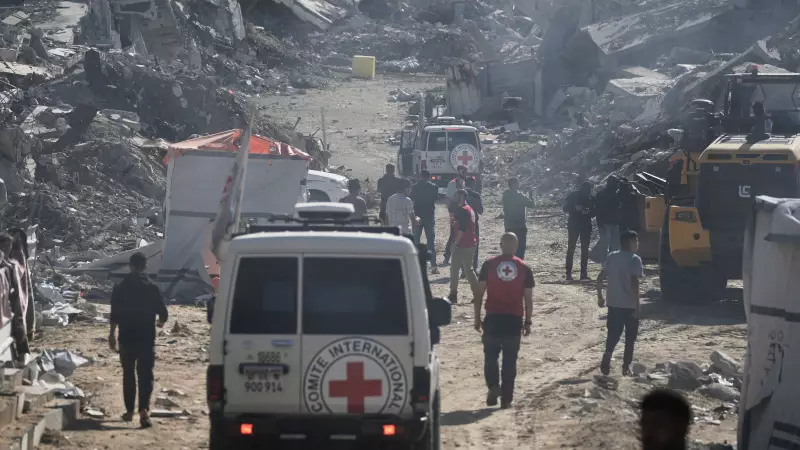
The Jaipur Literature Festival hosted a powerful session that stood out starkly among discussions of fiction and memoir. A panel directly confronted the situation in Gaza as genocide, a term often used with hesitation in public forums.
Historians Shift Stance on Genocide Label
Moderator Navdeep Suri opened by recalling how, just months earlier at a military literature event, an audience member demanded someone finally use the word genocide for Gaza. "Today, we are saying it," Suri declared.
Avi Shlaim, an emeritus professor at Oxford University, explained his reluctant change of opinion. Shlaim, author of 'Genocide in Gaza: Israel's Long War on Palestine,' stated that facts compelled his shift. "The facts change and therefore I changed my opinion," said Shlaim, who is of Iraqi Jewish descent.

He identified the turning point as Israel stopping humanitarian aid. Shlaim described this as using starvation as a weapon of war. He called genocide "the crime of all crimes" but argued it formed part of a broader destructive system.
Shlaim detailed this system with specific terms: "domicide" for the destruction of homes, "ecocide" for environmental damage, "econocide" for economic collapse, and "scholasticide" for the targeting of education.
Poetry Bears Witness to Catastrophe
Poet Lena Khalaf Tuffaha, whose collection 'Something About Living' recently won a National Book Award, spoke about her explicit mention of Gaza during her acceptance speech. "I don't know if it was an opportunity," Tuffaha reflected. "It felt like the only speech possible."
She named the date, time, and duration of what she termed "the ongoing genocide." Tuffaha emphasized this was a "bipartisan, American-funded" project. She critiqued cultural preferences for ambiguity, advocating instead for stark clarity.
Tuffaha recited her poem "Running Orders," written during Israel's 2014 assault on Gaza. The poem builds on Israeli military warnings to civilians before airstrikes. Its devastating refrain repeats: It doesn't matter.
The poem recounts a phone call giving residents 58 seconds to flee before their home is bombed. This warning appears humane, yet borders remain sealed, making escape impossible.
Journalists Detail Interception and Censorship
Journalist and activist Noa Avishag Schnall shared her experience aboard the Freedom Flotilla Coalition boat, the Conscience. The mission aimed to break the siege of Gaza. Schnall described a pre-dawn interception by Israeli forces involving helicopters and naval commandos.
"Our boat in specific was a medics and journalist boat," Schnall stated. "We were responding to targeted assassination... of doctors, medical professionals and journalists." She detailed being zip-tied and subjected to harsh restraint techniques she called the Palestine hold.
Documentary filmmaker Ramita Navai discussed her film 'Doctors Under Attack,' which investigates the detention and alleged torture of Palestinian medical personnel. The BBC originally commissioned the film but later dropped it.
"Finally, they released a press statement saying they were worried about the perception of partiality," Navai revealed. With decades of reporting from over 40 countries, Navai claimed a "completely different set of rules" applies when covering Israel-Palestine.
She cited editorial restrictions, including a ban on using terms like "ethnic cleansing," even when properly attributed to sources.
Legal Definitions and Cultural Prescriptions
Shlaim returned to the legal definition, asserting Israel's actions fit the 1948 Genocide Convention. "The lesson of the Holocaust was never again," he stated. "Not just for Jews, never again for anyone... today the Palestinians are the defenceless victims."
Tuffaha and Schnall clearly distinguished between Judaism and Zionism. "Criticising a political ideology is fundamentally a right that we all have," Tuffaha argued. "That is not the same thing as criticising the Jewish people for being Jewish."
Tuffaha framed the issue as domestic for all nations supporting Israel. "What you allow to take place overseas ultimately comes back to affect you in your own country," she warned. Her cultural prescription was direct: "Say Palestine. Read Palestinian literature... A genocide is made possible first by erasure."

The JLF session provided a rare, unfiltered platform for these voices. It challenged narratives and documented what panelists described as systematic destruction and media censorship surrounding the Gaza conflict.