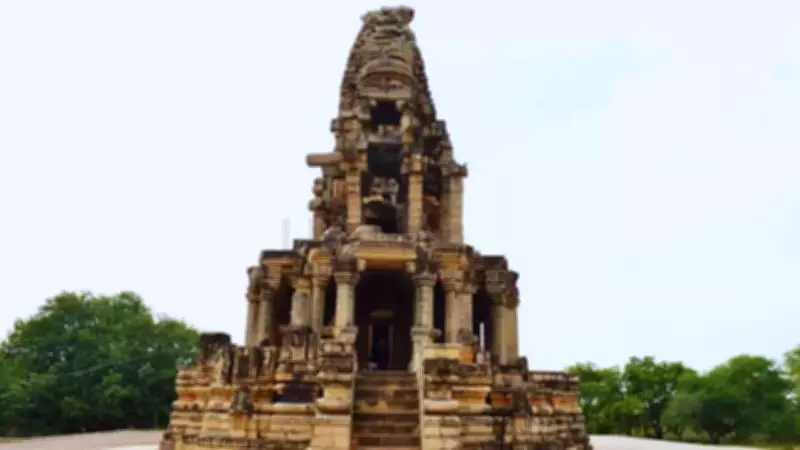
The Gravity-Defying Wonder of Sihoniya: Kakanmath Temple
In the serene village of Sihoniya, nestled within Morena district of Madhya Pradesh, stands an architectural marvel that challenges conventional engineering principles. The Kakanmath Temple rises dramatically from the landscape, its tall, narrow form appearing as though it might crumble at any moment. Constructed from massive stones that seem precariously balanced atop one another, this ancient structure has captivated visitors and historians alike for centuries.
A Temple Built Without Mortar or Cement
What makes the Kakanmath Temple truly extraordinary is its construction methodology. Unlike traditional buildings that rely on binding materials, this temple employs dry stone masonry - an ancient technique where massive stones are carefully stacked without the use of cement, lime, or mortar. At first glance, the arrangement appears haphazard, as if the stones were randomly thrown together, creating the illusion of imminent collapse. Yet, this 11th-century structure has withstood the test of time, earthquakes, and natural elements, standing as a testament to the engineering prowess of its creators.
Commissioned by King Kirtiraj of the Kachchhapaghata dynasty, the temple was originally dedicated to Lord Shiva and formed part of a much larger temple complex. Archaeological evidence reveals that the main temple was surrounded by several smaller shrines arranged in the traditional Panchayatana pattern. Over centuries, these surrounding structures succumbed to natural disasters and the passage of time, leaving the main temple standing in solitary grandeur above the ruins.

Legends of Supernatural Construction
The temple's unusual appearance has spawned numerous legends that have been passed down through generations. According to one popular local folklore, the Kakanmath Temple was not built by human hands at all. Instead, supernatural beings - often described as spirits or ghosts - constructed the entire edifice in a single night. The legend claims these mysterious builders worked feverishly through the darkness, stacking stone upon stone with supernatural precision.
However, as dawn approached and the first rays of sunlight touched the horizon, the spirits vanished abruptly, leaving the temple incomplete. Proponents of this tale point to the temple's seemingly unstable structure as evidence of this supernatural interruption, suggesting that the spirits' sudden departure prevented proper completion of their work.
Another version of the legend introduces King Kirtiraj more directly into the narrative. According to this account, the king wished to build a magnificent temple for Lord Shiva but faced numerous construction challenges. In a dream, Lord Shiva appeared to the monarch and promised that a glorious temple could be erected in one night, provided no human witnessed the construction process. The king immediately ordered all villagers to remain indoors throughout the following night.
Despite this royal decree, a curious young boy could not resist peeking through his window. The moment the mysterious builders realized they had been observed, all construction ceased immediately, resulting in the incomplete structure that stands today. This legend explains both the temple's unfinished appearance and its seemingly miraculous stability against all odds.
Historical Context and Archaeological Significance
While the supernatural tales provide colorful explanations, historians offer more grounded perspectives on the temple's origins and survival. The Kachchhapaghata dynasty, which ruled substantial portions of central India during medieval times, was responsible for commissioning this architectural wonder during the 11th century. Their patronage of temple construction reflected both religious devotion and political authority.
Archaeological studies conducted at the site have revealed sophisticated understanding of weight distribution and structural balance among the temple's builders. The dry stone masonry technique, while appearing precarious, actually creates a stable interlocking system where each stone supports those around it. This ancient engineering approach has proven remarkably resilient against seismic activity and weathering over a millennium.

The temple's current isolated appearance results from the gradual destruction of surrounding structures over centuries. Earthquakes, environmental factors, and the passage of time have reduced what was once a thriving temple complex to ruins, with only the main sanctuary remaining relatively intact. This isolation enhances the temple's dramatic visual impact, making it appear even more precarious than it actually is.
A Timeless Architectural Marvel
Whether one subscribes to the supernatural legends or historical explanations, the Kakanmath Temple remains one of central India's most impressive temple ruins. Its unique construction, towering height, and dramatic setting combine to create an unforgettable visual experience. The temple serves as a powerful reminder of India's rich architectural heritage and the engineering innovations of ancient civilizations.
The structure's enduring stability despite its appearance of imminent collapse continues to baffle modern observers. Perhaps this very contradiction between appearance and reality has fueled the supernatural legends surrounding its construction. After all, when something has stood for a thousand years despite looking like it might collapse at any moment, people naturally seek extraordinary explanations.
Today, the Kakanmath Temple stands not just as a religious site but as a monument to human ingenuity and the enduring power of legend. It represents a fascinating intersection of history, architecture, and folklore that continues to draw visitors, researchers, and devotees to the quiet village of Sihoniya. As both an engineering marvel and a cultural treasure, this 'Lego temple' of Madhya Pradesh remains one of India's most unique and mysterious historical sites.