Kalighat Temple: A Sacred Legacy of Devotion and Architectural Marvel
The Kalighat Temple in Kolkata stands as a profound symbol of centuries-old devotion, with many historians and devotees believing that the city's name itself evolved from Kalikshetra, meaning the sacred land of the goddess Kali. This connection to ancient times is further supported by the Greek geographer Claudius Ptolemy, who referenced a place called Kaligram in his seminal work Geographia around 150 CE.
Historical Roots and Mythological Significance
Medieval Bengali texts, such as the Manasamangal Kabya, weave tales of the merchant Chand Saudagar and his son Shrimanta. According to these stories, they traveled on a saptadinga along the Adi Ganga and paused to pray at a Kali shrine, believed to be the precursor to the current Kalighat Temple. The temple's idol, crafted from Koshtipathor, gold, and silver, is attributed to the ascetics Brahmananda Giri and Atmaram Brahmachari. Over time, patronage from influential families like the Sabarna Roy Chowdhurys and the Halders, who owned the temple land, helped sustain and enhance this sacred site.
Nestled in a bustling commercial neighborhood, Kalighat remains one of the most revered Shakti Peeths, where legend holds that the toes of Sati's right foot fell. This spiritual significance draws thousands of devotees daily, making it a vibrant center of faith and culture.

Architectural Evolution and Patronage
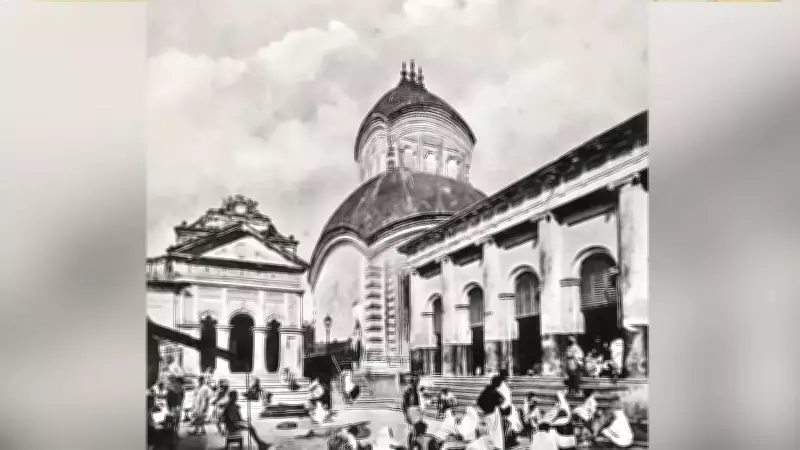
The present structure of the Kalighat Temple was constructed in 1809 under the generous patronage of the Sabarna Roy Chowdhurys. This marked the beginning of a series of expansions that shaped the complex over the decades. In 1835, Kashinath Ray contributed by building the natmandir, followed by members of the Bawali Rajbari who constructed the Shyam-Rai temple near the main shrine in 1843.
A standout feature of the temple is the Art Nouveau tiles that line the walls of the main shrine, a rare decorative style in such a context. Terracotta work appears only under the eaves, showcasing traditional Bengali motifs. Tamal Bhattacharya, a ceramic expert involved in the temple's restoration, explains, "The motifs – birds, flowers, and hanging tiles – all represent Bengali terracotta. We discovered these pieces during renovation, with old photographs confirming they predated the Art Nouveau tiles."
Hidden Treasures Unveiled During Restoration
During recent restoration efforts, a remarkable fresco emerged above the sanctum ceiling, hidden behind layers of soot and dust. Tamal describes it, "There are motifs of leaves, hibiscus, lotuses, and peacocks. The peacock suggests Rajasthani influence, which is unusual in Bengali temple imagery. The fresco rises about 25–30 feet high from the first chala of the sanctum and is now visible from inside."
The Art Nouveau tiles are not confined to the main shrine; they also adorn the walls and pillars of the Shyam-Rai temple within the complex, extending this distinctive decorative style across multiple structures.
The Art of Reviving a Historic Shrine
Tamal Bhattacharya recalls his initial visit for the restoration project, expressing amazement at the designs. The Art Nouveau tile replicas were meticulously designed at his Studio Calyx in Baruipur, with production taking place in Gujarat. For the terracotta elements, design development occurred locally, but pieces for the upper chala were produced in Bankura using the same mould due to time constraints. Tamal insisted on firing the pieces at 1,000°C to ensure durability.
The entire restoration of tiles and terracotta was completed by March 2024, with broken elements replaced by cast tiles achieving 80–90% fidelity to the originals. Tamal acknowledges his team members Sanjay, Abhijit, Ankush, Jayanta, and Lalit for their invaluable assistance in this endeavor.

Why Kalighat Temple Captivates Hearts
- Rare Architectural Blend: The temple complex uniquely combines terracotta eaves, Art Nouveau tiles, and a hidden fresco, offering a visual feast of diverse artistic traditions.
- Cultural Heritage: The terracotta eave motifs, featuring birds, flowers, and hanging tiles, are deeply rooted in Bengali tradition, preserving local craftsmanship.
- Enduring Faith: Despite centuries of change and restoration challenges, Kalighat remains a dynamic hub of spirituality, art, and community, continuing to inspire devotion and admiration.