

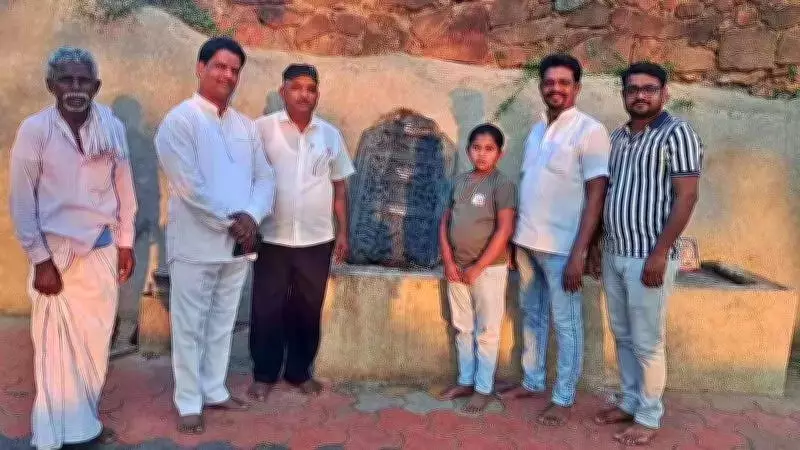
Schoolgirl's Curiosity Reveals Historical Treasure in Karnataka Village
In a remarkable discovery that has captivated historians and locals, an 11-year-old schoolgirl from Mallammana Belawadi village in Bailhongal taluk, Belagavi district, has brought to light a centuries-old hero stone that was mistakenly worshipped as a local deity for generations.
From Deity to Historical Artifact
For decades, residents of the village had offered prayers to a stone near the Hanuman temple, believing it to be an idol of Shani. The transformation in understanding came when Lakshmi Prakash Humbi, a Class 5 student, noticed unusual carvings on the stone during a temple visit. Her keen observation prompted elders to reexamine the artifact, leading to the realization that it was actually a historical hero stone.
"I often heard stories about Veera Rani Belawadi Mallamma, who fought bravely to rescue cattle," Lakshmi explained. "When I looked closely at the stone recently, I noticed carvings of a warrior protecting cows and told my father."

Detailed Carvings Tell a Heroic Tale
The hero stone is divided into three distinct panels, each depicting a different phase of the hero's journey:
- The first panel shows a warrior engaged in combat, fighting enemies to protect cattle—a theme that resonates with regional legends.
- The second panel depicts celestial nymphs escorting the fallen hero to Kailash with dance and musical instruments, symbolizing his passage to the divine realm.
- The third panel portrays the hero attaining heaven, where a Shivalinga and Nandi are shown, with two celestial beings worshipping the Shivalinga. Images of the sun and moon on either side symbolize eternal remembrance of the hero's sacrifice.
Village Response and Historical Significance
Initially, Lakshmi's father assumed the stone was merely a Shani idol. However, after her repeated observations, village elders examined it closely and recognized its historical importance. Temple priest Balamma Poojeri acknowledged, "Lakshmi's keen observation helped us understand that the stone had an important historical background."
The stone originally stood near the old Hanuman temple and was moved outside when the temple was rebuilt, remaining largely unnoticed until Lakshmi drew attention to it. Villagers have since cleaned the stone and initiated discussions about further study and preservation.
Expert Analysis and Dating Controversy
Local historian Professor Mahantesh Uppin described the discovery as significant, noting the cattle protection theme common in regional legends. Former GP president Chandrakant Karimani revealed that experts are being consulted to verify whether the stone depicts scenes related to Belawadi Mallamma's battles with the Marathas.
Historians and epigraphists from Dharwad, including researcher Balappa Irappa Chinagudi, believe the sculpture may be a ‘Turugol Veeragallu’—a hero stone commemorating someone who died protecting cattle. Such memorial stones typically feature three panels depicting battle, death, and heavenly ascent.
Chinagudi suggested that stylistically, the stone could date back to the 12th or 13th century, potentially predating the era associated with Belawadi Mallamma. This discrepancy highlights the complexity of historical interpretation and the need for thorough examination.
Broader Implications for Heritage Preservation
The discovery has underscored the urgent need to identify and preserve historical artifacts scattered across rural areas. Karimani emphasized, "If such stones found in the region are collected and preserved in a museum, it will greatly aid research on Mallamma's history."
This incident demonstrates how community awareness and individual curiosity can play crucial roles in uncovering historical treasures. Lakshmi's sharp eye has not only revealed a piece of Karnataka's rich heritage but also sparked a renewed interest in local history and archaeology among villagers and scholars alike.






