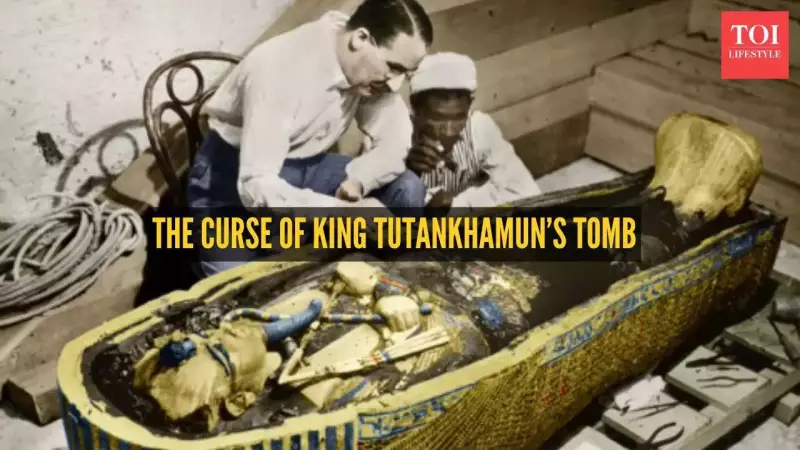
In November 1922, British archaeologist Howard Carter made a discovery that would captivate the world and spawn one of history's most enduring supernatural legends. After years of searching, he found the intact tomb of the boy king Tutankhamun in Egypt's Valley of the Kings. Little did he know that the golden treasures within would ignite not just global Egyptomania, but also a chilling tale of a pharaoh's revenge that persists a century later.
The Discovery and the First Tragic Deaths
The excavation was financed by Lord Carnarvon (George Herbert), who rushed from England to witness the opening. The tomb, packed with over 5,000 artifacts including the iconic gold funerary mask, was a time capsule sealed for over 3,000 years. Carter assembled a team, including archaeologist Arthur Mace from the Metropolitan Museum, to catalog the finds.
However, the celebration was short-lived. The narrative of "King Tut's curse" began with the sudden death of Lord Carnarvon on April 5, 1923. He died from blood poisoning and pneumonia after a mosquito bite became infected. The press and public, hungry for mystery, quickly linked his death to the disturbance of the pharaoh's rest.

This theory was amplified by famous author Arthur Conan Doyle, who suggested an "evil elemental" from the tomb was responsible. The curse seemed to gain credibility as others connected to the tomb died in quick succession:
- Aubrey Herbert, Carnarvon's half-brother, died in September 1923 from blood poisoning after a dental procedure.
- George Jay Gould, an American magnate who visited the tomb, died of pneumonia in May 1923.
- Arthur Mace left Egypt in 1924 due to poor health and died in 1928 from pleurisy and pneumonia.
The Curse Expands: Suicide and Strange Events
The legend grew far beyond those who entered the burial chamber. Archaeologist Hugh Evelyn-White, who had entered the tomb, hanged himself in 1924. Reports claimed his suicide note read, "I have succumbed to a curse."
Even tangential connections proved fatal in the public's eye. Egyptologist Aaron Ember, a friend of expedition members, died in a 1926 house fire. Anecdotes of strange misfortunes circulated, like that of Sir Bruce Ingram, a friend of Carter's, whose house allegedly burned down and flooded after he received a mummified hand as a gift.
The media frenzy was relentless. Every death, however loosely linked, was woven into the curse's tapestry, selling newspapers and fueling public fascination with the occult in the post-World War I era.
Debunking the Myth: Science vs. Superstition
Modern analysis reveals the curse was largely a product of sensational journalism and tragic coincidence. The most compelling evidence against a supernatural force is Howard Carter himself. The man who spent the most time in the tomb and handled the mummy directly lived until 1939, dying of cancer at age 64.
Statistical analysis shows that of the 58 people present at the tomb and sarcophagus openings, only eight died within the next 12 years—a normal mortality rate for the time.
Science offers rational explanations for the illnesses:

- Biological Hazards: The sealed chambers contained ancient dust, bat droppings, and potentially toxic fungal spores like Aspergillus flavus. Inhaling these in poorly ventilated spaces could cause severe respiratory infections, explaining why those who spent more time inside fell ill.
- Medical Limitations: The 1920s lacked modern antibiotics. Common infections like blood poisoning or pneumonia were often fatal.
- Occupational Risks: Some deaths, like that of radiologist Sir Archibald Douglas Reid (wrongly rumored to have died after X-raying the mummy), were likely due to the hazards of their professions, such as early radiation exposure.
- Psychological Impact: Hugh Evelyn-White's suicide may be linked to depression, possibly intensified by the overwhelming media narrative of a curse.
The "Curse of the Pharaohs" tells us more about the 1920s society than about ancient Egypt. It reflects a world eager for mystery, a press that capitalized on sensational stories, and the human tendency to find patterns in random tragedy. While the legend of King Tut's curse remains a fascinating chapter in archaeological history, the truth appears to be a combination of environmental danger, pre-existing health conditions, and the powerful force of belief itself.