

The Enduring Legacy of King Tutankhamun
Among the pantheon of Egyptian pharaohs who ruled the ancient land, Tutankhamun stands out as a figure of enduring fascination. The young monarch, who died at just 17 years old, continues to captivate modern audiences with his enigmatic life and the spectacular discovery of his tomb. His legacy is preserved not only in history books but through the remarkable artifacts unearthed from his burial site.
The 1922 Discovery That Changed History
British archaeologist Howard Carter, working with local Egyptian teams, made one of the most significant archaeological finds of the 20th century when he discovered King Tut's tomb in 1922. The excavation revealed approximately 5,000 objects that had been buried with the pharaoh for his journey to the afterlife. Among these treasures were statues, animal figures, and an astonishing quantity of gold artifacts that demonstrated the wealth and craftsmanship of ancient Egypt.
The most iconic item discovered was undoubtedly the pharaoh's death mask, crafted from solid gold, glass, and semiprecious stones. However, among the dozens of pairs of sandals meant to accompany the king in the afterlife, one particular pair has captured special attention from researchers and historians for its remarkable symbolic significance.

The Sandals That Tell a Story of Power
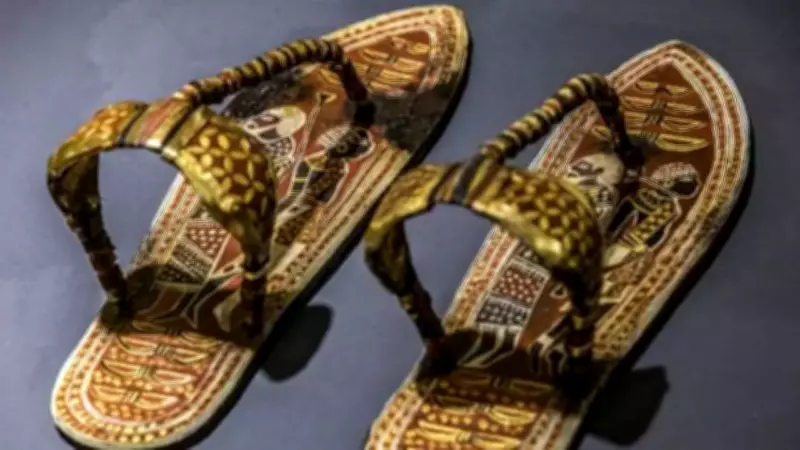
What makes these particular sandals extraordinary isn't merely their association with the famous pharaoh, but the intricate details preserved on their soles. The insoles feature detailed depictions of King Tut's defeated enemies, symbolically positioned so that the pharaoh would walk over them, thereby establishing his superiority and dominance even in the afterlife.
These ceremonial sandals were constructed from wood and covered with a decorative veneer of bark, green leather, and gold foil applied over a base layer of white paint. In the arch area, artisans depicted two bound captives intertwined with lotus and papyrus plants, traditional Egyptian symbols of unification.
Each sandal contains eight bow weapons strategically placed—four near the toes and four at the heel. Additionally, the strap itself is shaped as a bow, bringing the total number of bows to nine. In ancient Egyptian symbolism, the Nine Bows collectively represented all the traditional enemies of Egypt, making this footwear a powerful political statement of royal authority.
Measurements and Discovery Details
According to Howard Carter's original object documentation, the sandals measure 11.2 by 3.6 inches, approximately equivalent to a modern US men's size 11.5. They were discovered lying beneath a basket within the tomb, though archaeologists note that many objects had been moved or looted in antiquity, making it uncertain whether this was their original placement.
The sandals are currently displayed at the Egyptian Museum in Cairo, where their information card explains that the bound captives symbolize King Tut's power, and that the Nine Bows are "situated so that the king's feet step on them, reifying the trampling of Egypt's enemies by the monarch."
The Life and Reign of Tutankhamun
Tutankhamun was the 11th pharaoh of Egypt's 18th dynasty, born as Tutankhaten around 1341 BC. He ascended to the throne at the remarkably young age of eight or nine during the 14th century BC. His father, Akhenaten, was known as a revolutionary pharaoh who attempted to transform Egyptian religion, while the identity of his biological mother remains unknown to historians.
During his reign, Tutankhamun married his half-sister, Queen Ankhesenamun. The couple tragically had twin daughters who were stillborn; their fetuses were preserved in jars and buried within the pharaoh's tomb. The final resting place of King Tut's wife remains undiscovered, though historical records suggest she may have eventually married an official named Ay, who later became pharaoh himself.
Health Challenges and Mysterious Death
A comprehensive 2010 study of the king's remains, published in the Journal of the American Medical Association (JAMA), revealed that Tutankhamun suffered from multiple health conditions. These included malaria and Kohler disease, a rare bone disorder affecting the foot. The discovery of numerous walking canes within his tomb suggests the young pharaoh may have experienced significant difficulty with mobility.

King Tut died approximately a decade after ascending to the throne, and the exact circumstances of his death remain hotly debated among scholars. Theories range from assassination plots to hunting accidents, with no definitive conclusion reached despite extensive research.
Modern Display and Ongoing Mysteries
It wasn't until 2025 that the complete contents of King Tut's tomb were put on permanent display in a museum near the Great Pyramid of Khufu at Giza. When archaeologists first discovered the pharaoh's mummy, they found him wearing bright gold sandals with matching gold toe covers. However, researchers remain uncertain whether the other footwear discovered in the tomb was actually worn by the king during his lifetime or created specifically for burial purposes.
While Tutankhamun's magnificent possessions continue to draw visitors from around the world, his mummy remains at rest in the Valley of the Kings near modern-day Luxor, precisely where Howard Carter and his team made their historic discovery over a century ago. These sandals, with their powerful symbolism of royal authority, serve as a tangible connection to an ancient world where even footwear could communicate messages of power and dominance that resonate across millennia.
