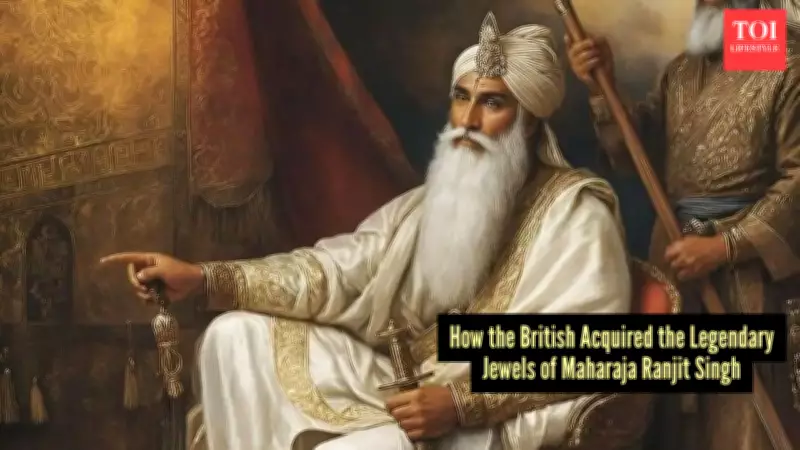
The Legendary Treasures of Maharaja Ranjit Singh
History often remembers the thieves while forgetting the receipts of their plunder. When discussing the fabled wealth of the Indian subcontinent, one name invariably dominates the narrative: Maharaja Ranjit Singh. The visionary founder of the 19th-century Sikh Empire did not merely establish a formidable kingdom; he accumulated a treasury in Lahore so magnificent it left rival emperors in awe. Within that heavily fortified Toshakhana, two extraordinary gemstones reigned supreme, embodying both imperial power and colonial tragedy.
The Mountain of Light: Koh-i-Noor's Turbulent Journey
You are undoubtedly familiar with its name. The Koh-i-Noor, originally an immense, uncut 793-carat diamond mined in the Golconda region, has witnessed more regime changes than a modern democracy. This legendary stone passed through the hands of the Delhi Sultanate to the Mughal Emperors, who famously embedded it into Shah Jahan's Peacock Throne. Subsequently, the Persian conqueror Nader Shah seized it, and it eventually found its way to the Afghan Durrani Empire.
How did the Sikh Maharaja acquire this priceless gem? In 1813, the exiled Afghan King, Shah Shujah Durrani, arrived in Lahore desperately seeking refuge. Ranjit Singh extended his hospitality and protection, and in return, secured the Koh-i-Noor. Historical accounts vary, with some suggesting it was a political shakedown rather than a gracious gift exchange. Ranjit Singh, however, did not merely lock the diamond away. He understood the power of spectacle. Evaluated by Amritsar's finest jewelers as "beyond all computation," the Maharaja would strap the stone to his turban or an armlet and parade on his elephant, allowing his subjects to witness the legend firsthand. When not displayed, the diamond was safeguarded under heavy guard at Gobindgarh Fort.

The Not-So-Ruby 'Tribute to the World'
Then there was the Timur Ruby, historically known as the Khiraj-i-Alam. Here lies a fascinating geological twist: it is not actually a ruby. In 1851, geologists officially reclassified the unfaceted, 352.54-carat stone as a red spinel, as historical jewelers often struggled to distinguish between the two deep-red gems. Named after the Turco-Mongol conqueror Timur, who allegedly looted it from Delhi in 1398, this stone serves as a sparkling guestbook of royalty. Several of its illustrious owners—including Mughal Emperors Jahangir, Shah Jahan, and Farrukhsiyar, along with Nader Shah—had their names inscribed directly onto the gem. Since the Afghan Durrani dynasty kept their most prized loot together, Ranjit Singh acquired the Timur Ruby in the same 1813 deal with Shah Shujah.
The Ultimate Colonial Heist
The fate of these treasures took a dark turn in 1839. A day before Ranjit Singh's death, his courtiers debated the future of the Koh-i-Noor. The Maharaja reportedly gestured that he wished to donate the priceless stone to the Jagannath Temple in Puri. However, the British East India Company had other intentions. Following the Maharaja's demise, the Sikh Empire descended into instability, culminating in the Second Anglo-Sikh War. By 1849, the British had conquered Punjab.
They cornered Ranjit Singh's youngest son, the 10-year-old Maharaja Duleep Singh, and compelled him to sign the Last Treaty of Lahore. Embedded within the treaty was a non-negotiable clause: surrender the Koh-i-Noor to Queen Victoria. Both the Koh-i-Noor and the Timur Ruby were seized as spoils of war. By 1851, the British proudly displayed them at the Great Exhibition in London.
Modern-Day Controversies and Claims
Today, the Koh-i-Noor is securely housed in the Tower of London, set into the Crown of Queen Elizabeth The Queen Mother. The Timur Ruby remains part of the private Royal Collection, fashioned into a necklace. Despite the United Kingdom's firm grip on these stones, ownership remains a fiercely contested global debate. India, Pakistan, and Afghanistan have all persistently demanded their repatriation, arguing that these artifacts represent cultural heritage wrongfully taken during colonial rule. Some treasures, it seems, never lose their gravitational pull, continuing to symbolize historical injustices and unresolved legacies of empire.