Kolkata Gallery Pioneers Scientific Authentication of Bengal Art with Raman Technology
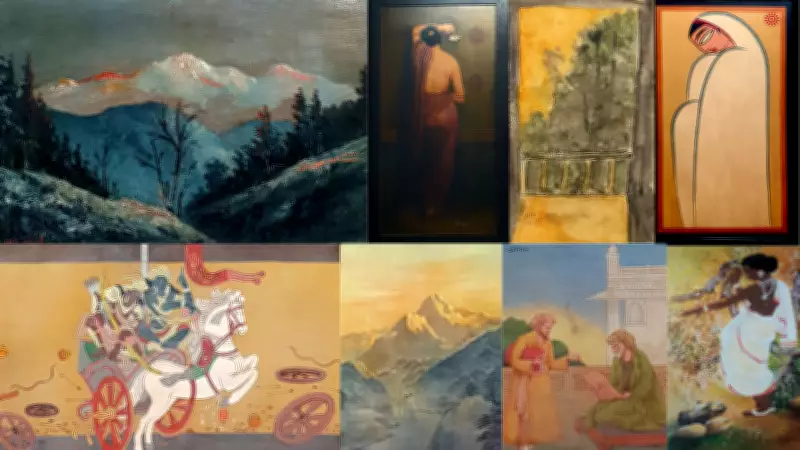
In a groundbreaking move to address the proliferation of counterfeit artworks, a Kolkata-based gallery has launched a pioneering exhibition that employs advanced scientific techniques to verify the authenticity of paintings by some of Bengal's most revered artists. The Chitrakoot Art Gallery has unveiled an exhibition featuring 23 masterpieces, each authenticated using Raman Fingerprint Technology (RaFiTech), a cutting-edge method developed in collaboration with researchers from the Indian Institute of Science Education and Research (IISER) Kolkata.
Revolutionizing Art Authentication with Non-Invasive Science
For many years, the authentication of artworks in India has primarily relied on subjective expert opinions, provenance documentation, or stylistic evaluations—approaches that often lead to contentious debates and uncertainties. The new RaFiTech method offers a robust scientific alternative by analyzing the chemical composition of pigments without causing any damage to the artwork. This innovative technique utilizes Raman spectroscopy to direct a focused laser beam onto specific points of a painting, where pigment molecules scatter light into unique patterns known as Raman wave numbers.
These patterns act as chemical fingerprints, which are then meticulously compared against global pigment databases that record the historical timelines of pigment manufacturing and usage. According to Professor Soumyajit Roy from IISER Kolkata's EFAML Materials Science Centre, this technology can accurately distinguish pigments used across different decades or even centuries, providing a reliable means to verify authenticity.

Exhibition Highlights and Key Artists
The exhibition, curated by Prabhas Kejriwal, is currently on display at the Chitrakoot Art Gallery located at Presidency Court on Gariahat Road and will remain open until March 27. It features authenticated works by eminent Bengal artists, including Rabindranath Tagore, Abanindranath Tagore, Gaganendranath Tagore, Nandalal Bose, Jamini Roy, Hemen Mazumdar, J. P. Gangooly, Ganesh Pyne, and Debiprasad Roy. Each piece has undergone rigorous verification through RaFiTech, ensuring that visitors can view these masterpieces with confidence in their genuineness.
Prakash Kejriwal, a distinguished art connoisseur and owner of Chitrakoot Art Gallery, emphasized the significance of this technological advancement. He stated, "In the art market, authenticity has often rested on subjective judgments. RaFiTech introduces an objective scientific method that enhances trust and transparency." The research team behind this innovation has already secured seven patents, positioning it as one of India's most sophisticated contributions to art authentication.
Detecting Forgeries and Enhancing Market Confidence
RaFiTech not only verifies authenticity but also plays a crucial role in identifying potential forgeries. By detecting inconsistencies in pigment usage—such as the presence of pigments manufactured after an artist's lifetime—the technology can flag artworks that may be counterfeit. Trisha Chakraborty, an IISER researcher involved with the RaFiTech laboratory, explained that the method allows for comparative analysis of pigment profiles across multiple works attributed to the same artist. "If two paintings do not share key pigment signatures typical of that artist's palette, it suggests that at least one of them may not be genuine," she noted.
Art experts believe that this development could significantly transform India's art market, where disputes over authenticity have frequently eroded confidence among collectors, investors, and cultural institutions. By integrating art historical knowledge with precise scientific analysis, the Chitrakoot exhibition offers a unique opportunity to witness how modern technology is safeguarding the legacy of Bengal's celebrated artists while fostering greater trust within the art community.