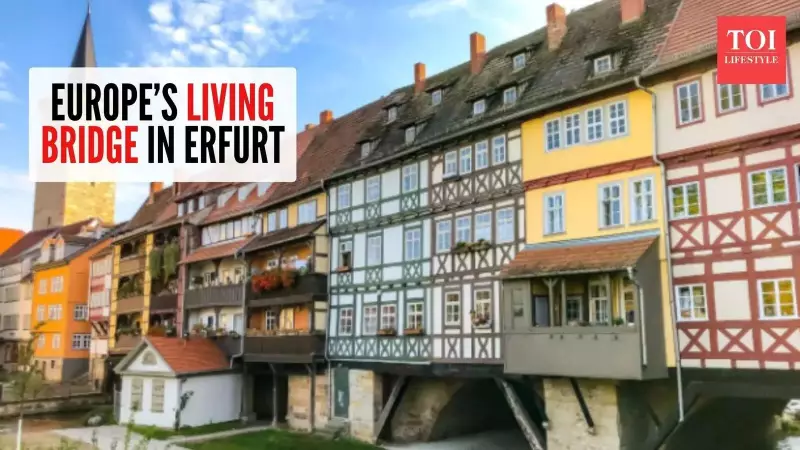
In the historic city of Erfurt, Germany, a remarkable bridge serves a purpose far beyond mere river crossing. The Krämerbrücke, known as the Merchant's Bridge, supports an entire community of homes and businesses. This unique medieval structure represents one of Europe's rarest architectural treasures where daily life has continued uninterrupted for hundreds of years.
A Living Bridge in Central Germany
The Krämerbrücke occupies a central position in Erfurt, which serves as the capital of Thuringia in Germany's heartland. The bridge spans the Breitstrom, a branch of the Gera River. This strategic location once positioned the bridge along important medieval trade routes. Merchants naturally gravitated toward this spot, transforming what began as a simple crossing into a vibrant commercial and residential hub.
From Wood to Stone: Centuries of Adaptation
Historical records first mention the bridge in 1117 as a wooden construction. After suffering damage from multiple fires, authorities rebuilt the structure using stone in 1325. Rather than maintaining an empty bridge, enterprising merchants constructed half-timbered houses directly on the bridge surface. This innovative approach gradually created what essentially became a compact street suspended above the river. This architectural decision fundamentally shaped Erfurt's character for generations to come.

Architectural Features That Define Its Uniqueness
The Krämerbrücke measures approximately 120 meters in length and contains 32 narrow houses. These buildings connect directly wall-to-wall, forming an unbroken row of structures. What makes this bridge truly exceptional is its continuous habitation over centuries. While other European bridges once featured similar residential arrangements, most lost their houses to fires or urban modernization projects. The Krämerbrücke alone survived with its original character intact.
Evolution of Bridge Life Through Centuries
During medieval times, the bridge hosted goldsmiths, spice merchants, and textile traders. Today, those same spaces accommodate artisan workshops, art galleries, cozy cafés, and private residences. Local authorities strictly regulate rents to preserve the bridge's heritage character. No vehicle traffic disturbs the peaceful atmosphere. Only the sounds of footsteps, friendly conversations, and city life drift across this historic structure.
Balancing Preservation with Daily Living
Although designated as a protected heritage site, the Krämerbrücke functions as anything but a museum. Residents personalize their windows with decorations. Shopkeepers develop relationships with regular customers. Seasonal festivals illuminate the bridge multiple times each year. This careful balance between preservation and practicality maintains the bridge's human scale. It demonstrates how ancient structures can remain functional without sacrificing their historical essence.
Urban Planning Lessons From Medieval Times
This extraordinary bridge illustrates how medieval cities developed vertically and intensively rather than spreading outward. Space represented a precious commodity, and structures typically served multiple purposes simultaneously. The Krämerbrücke stands as a powerful lesson in intelligent design and community-oriented living that predates modern urban planning concepts by centuries.
The bridge continues to teach us valuable lessons about sustainable urban development and community preservation. Its survival through wars, fires, and modernization efforts speaks to both its structural integrity and its enduring importance to Erfurt's identity. Visitors today can experience not just a historical monument, but a living, breathing community that maintains traditions while adapting to contemporary life.