Slovak Author Lukáš Cabala Blends Bookselling and Writing in Borderless Creative Life
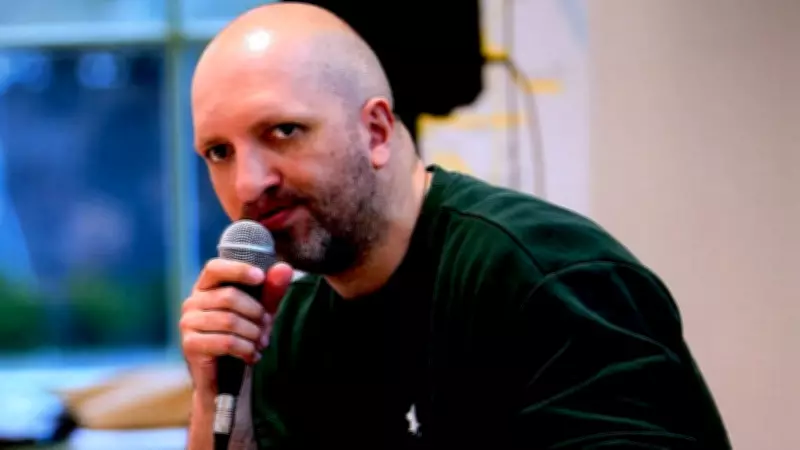
From his online bookstore in Slovakia to literary festivals across Europe, author Lukáš Cabala finds that selling stories and writing them fuel a single, borderless creative life. The 39-year-old award-winning Slovak writer, shortlisted for the 2025 European Union Prize for Literature, spends his days in Trenčín, a small city in western Slovakia, working with pre-owned books.
Two Interconnected Worlds: Bookseller and Writer
Cabala manages Čierne na Bielom (Black on White), the online secondhand bookstore he founded with his parents in 2011. When the shop closes, another world opens as he often writes late into the night. In this way, he lives two interconnected lives: one as a bookseller tending to literary memory, the other as a writer building new, dreamlike worlds from the quiet hours after work.
"For me, it's not so demanding," Cabala says. "My bookstore work is calm, it is mostly relaxing. I can think about writing while working. And I love meeting people. I have many book readings and events in different cities, and there are many impressions to draw from."

That daily immersion in secondhand books has profoundly shaped how Cabala thinks about literature and time. The work places him in constant contact with what readers continue to seek out and with what slowly disappears from circulation, giving him a unique perspective on literary survival.
Writing Through Intuition and Connection
Cabala's fiction unfolds through a small but connected body of work. His debut novella, Satori in Trenčín, is constructed as a palindrome, designed to be read both forward and backward. Set in a speculative version of a future Trenčín, it takes place in a world that closely resembles the real one while remaining slightly dislocated. The book was shortlisted for the Anasoft Litera Award and introduced Vincent, a character who would reappear in Cabala's later work.
Vincent returns in Spring in Yekaterinburg (Jar v Jekaterinburgu), published in 2021, where the setting shifts to a Siberian research station. Tasked with introducing ordinary people to science, Vincent works deep underground in a space defined by isolation and routine. As he begins a new book of his own, the people around him gradually enter the narrative, including local scientists studying permafrost, a guide named Yelena and a fellow countrywoman stuck on the road and unable to return home.
Cabala's work is often described as magic or poetic realism, though he resists the idea of the surreal as a calculated effect. "Definitely more intuitive," he says. "I write the story and patiently wait for the right moment, and it always appears."
Rooted in Trenčín, Open to the World
Despite growing international recognition, Cabala's rootedness in Trenčín remains central to his work. He sees no tension between the local and the continental. "I love being European, I love being international," he says. "It's deeply inspiring. My stories are sometimes local, but I have always been open and curious about the world and other cultures. There are no borders in my head, and there never were."
This openness extends to collaboration. His novel, Spomenieš si na Trenčín? (Will You Remember Trenčín?), was developed in close dialogue with paintings by Juraj Toman. "I had his paintings in my head, and I wanted the story to cooperate with and complement his painterly style," Cabala explains.
The Long View of Literary Survival
Running a secondhand bookstore has given Cabala a unique perspective on literary longevity. Sudden revivals, he notes, are rare. "It practically doesn't happen that a book suddenly comes back, with the exception of movie adaptations or the author's death, but even then, it usually doesn't last long."
"The most popular books in our bookshop remain the same," he says, naming:

- Jane Eyre by Charlotte Brontë
- The Name of the Rose by Umberto Eco
- Novels by Agatha Christie
Literary Influences and Recommendations
When asked to recommend a book that captures something essential about Slovakia for foreign readers, Cabala points to Boat Number Five by Monika Kompaníková. "It's a very popular book in Slovakia, and its storyline is truly original."
Among the writers who have influenced him most, Cabala names Julio Cortázar, the Argentine-French author best known for his formally inventive short stories and for the novel Hopscotch. On his nightstand is The Overstory by American novelist Richard Powers, which follows nine Americans whose unique experiences with trees draws them together to address the destruction of the wilderness.
If he could spend a single day inside the world of another novel, Cabala would choose The Beach (1966) by British author Alex Garland, in which a backpacker finds an idyllic and isolated beach untouched by tourism.
Through his dual roles as bookseller and writer, Lukáš Cabala continues to demonstrate how literary commerce and creation can fuel a rich, borderless creative life that transcends geographical and cultural boundaries while remaining deeply rooted in local experience.