The Sacred Night of Mahashivratri: More Than Rituals and Fasting
Every year, on the auspicious night of Mahashivratri, millions of devotees across the globe honor Lord Shiva and Goddess Parvati through prayer, fasting, and chanting. This sacred observance transcends mere religious ceremony, embodying a deep emotional and spiritual significance that resonates through the ages. At its heart, Mahashivratri commemorates the divine union of Shiva and Parvati, a marriage rooted in profound devotion and spiritual alignment.
The Foundation of Devotion: Parvati's Intentional Love
Hindu mythology reveals that Goddess Parvati's path to union with Shiva was not one of convenience or fleeting emotion. Instead, she embarked on years of intense tapasya—spiritual discipline and unwavering devotion—to earn Shiva's heart. Her love was deliberate and purposeful, a stark contrast to modern relationships often driven by instant gratification.
This narrative underscores a vital lesson for contemporary partnerships: strong marriages are built on inner readiness and emotional preparation. Devotion, in this context, does not imply blind sacrifice but signifies commitment with clarity and self-awareness. Psychologically, such devotion reflects emotional stability, enabling individuals to love without anxiety, manipulation, or desperation.

In today's context, a spiritually aligned marriage involves:
- Conscious and deliberate choice of partner
- Emotional preparedness for the partnership journey
- Prioritizing personal and mutual growth over ego
True devotion strengthens the self before uniting with another, creating a foundation for enduring bonds.
Loyalty Beyond Differences: Embracing Contrasting Energies
Shiva and Parvati represented contrasting energies—Shiva as the ascetic meditator, detached from worldly norms, and Parvati as the embodiment of warmth, fertility, and family life. Despite these differences, their loyalty remained unwavering, teaching that successful relationships thrive not on similarity but on respect and acceptance.
In modern marriages, conflicts often arise from perceived differences. The Shiva-Parvati union illustrates that loyalty is about embracing your partner's uniqueness and loving them wholeheartedly, without attempting to change their core essence. This acceptance fosters a environment where both individuals can flourish.
Emotional Strength and Maturity in Partnership
The divine couple's relationship exemplifies emotional maturity, free from power struggles, dominance, or insecurity. Many contemporary marriages suffer from unhealed ego, manifesting in conflicts over appreciation, apologies, and understanding.
Shiva and Parvati's union symbolizes that real strength in marriage stems from inner balance and emotional resilience. Key aspects include:
- The ability to apologize sincerely
- Listening without defensiveness
- Standing together during adversity
- Maintaining composure during disagreements
A marriage becomes truly auspicious not through rituals alone but through the emotional stability both partners contribute, creating a sanctuary of mutual support.
The Ardhanarishvara: Balancing Masculine and Feminine Energies
One of the most powerful representations of Shiva and Parvati's bond is the Ardhanarishvara, depicting them as one unified body with half masculine and half feminine energies. This philosophical and artistic symbol emphasizes harmony between contrasting traits.
Applied to modern relationships, this concept advocates for fluidity beyond rigid gender roles. A healthy partnership today balances energies where, for instance, a husband can be emotionally expressive, a wife can be decisive and ambitious, and both can equally lead and nurture the relationship. When masculine and feminine energies coexist respectfully, marriage transforms into a genuine partnership rather than a power structure.
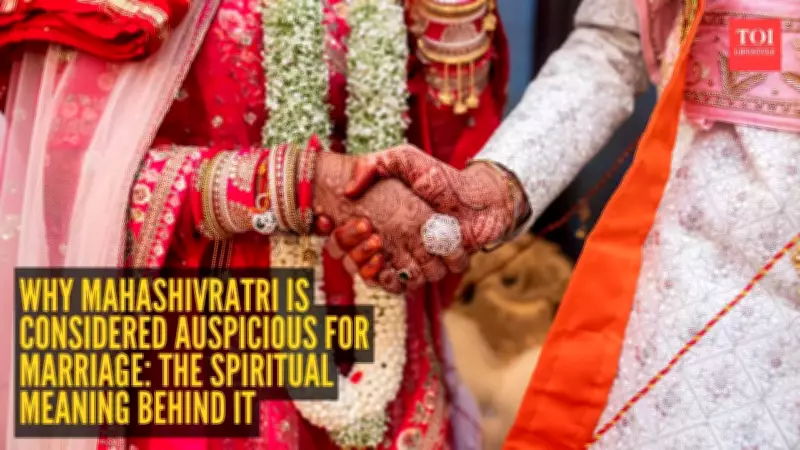
Why Mahashivratri is Considered Auspicious for Marriage
Mahashivratri is believed to be a time when cosmic energies are heightened, making it particularly auspicious for weddings, engagements, and prayers for a life partner. Unmarried women often fast on this day, seeking a partner embodying Shiva's qualities of strength, protection, wisdom, and emotional steadiness.

Beyond belief systems, there is a psychological dimension to these rituals. Rituals create intention, and when couples marry or pray together on Mahashivratri, they are setting a spiritual foundation for their union. Shared rituals strengthen emotional bonding, reinforce commitment, and enhance relationship satisfaction by creating shared memories and deeper connections.
The Deeper Meaning: Awakening and Conscious Partnership
Mahashivratri is often described as a night of awakening—a time to dissolve darkness and connect with higher consciousness. Similarly, marriage represents an awakening, requiring awareness of self and partner, willingness to shed ego, and commitment to balance and unity.
The divine union of Shiva and Parvati is not merely a mythological event but a timeless reminder that love flourishes when devotion meets equality, strength meets compassion, and individuality meets unity. On Mahashivratri, couples are encouraged to reflect not only on rituals but on their emotional foundation, recognizing that a truly auspicious marriage is defined not by the date on the calendar but by the daily intention to choose and cherish each other.