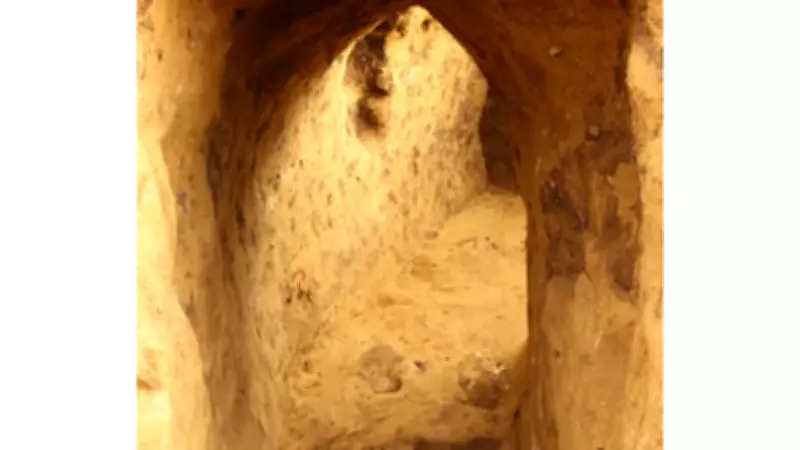
Medieval Tunnel System Unearthed Beneath Ancient Pagan Burial Ground in Germany
Archaeologists in Germany have made a remarkable discovery that has stunned experts and opened new avenues of inquiry into how different historical periods interacted with the same geographical landscape. During excavations near Reinstedt, researchers uncovered a narrow medieval tunnel system hidden directly beneath a much older pagan burial site dating back approximately 5,000 years.
Unprecedented Overlap of Historical Eras
The State Office for Heritage Management and Archaeology of Saxony-Anhalt announced this significant find in a January 29 press release. The discovery represents a rare instance where prehistoric and medieval activity intersect at a single location. While the burial complex originates from the Neolithic period, specifically associated with the Baalberge culture that flourished during the 4th millennium BC, the underground passage was constructed thousands of years later during the late Middle Ages.
Excavations were conducted as part of routine archaeological assessments preceding planned wind turbine construction, a standard procedure in Germany for major infrastructure projects. The site itself consists of a large ditch enclosure and several poorly preserved burials that were originally used for ritual and funerary purposes by the Baalberge culture.

From Suspected Grave to Medieval Tunnel
Initially, archaeologists believed they had encountered another grave when they discovered a trapezoidal pit with a stone slab at one end. However, further excavation revealed that this feature extended downward into the loess subsoil and was actually an erdstall—a narrow underground tunnel system typically dated to the late Middle Ages.
Erdstalls are found in various parts of Central Europe, but their precise purpose has long puzzled scholars. The Reinstedt tunnel contained several artifacts that confirmed its medieval origins and human construction, including late medieval pottery, an iron horseshoe, animal remains, numerous stones, and traces of charcoal from what appears to have been a brief fire.
At the narrowest point of the entrance, archaeologists discovered larger stones deliberately stacked together, indicating that the tunnel had been intentionally sealed at some point in its history. These findings confirm that the structure was man-made, used for a period of time, and then deliberately closed off.
Deliberate Placement Raises Questions
The most intriguing aspect of this discovery is the deliberate placement of the medieval tunnel directly beneath the prehistoric burial site. Archaeologists emphasize that this positioning was unlikely to be accidental, raising important questions about medieval perceptions of ancient landscapes.
One theory suggests that the ancient earthworks from the Neolithic period were still visible during the Middle Ages and served as convenient landmarks for medieval builders. Another possibility involves cultural considerations: medieval Christian communities may have intentionally avoided disturbing pagan graves, making such sites discreet locations for constructing hidden structures.
The Enduring Mystery of Erdstalls
The function of erdstalls continues to be debated among scholars. Various theories propose that these underground passages may have served as temporary hiding places during times of conflict, storage spaces for valuable goods, or sites for ritual or cultic activities. The narrow dimensions of the Reinstedt tunnel, combined with limited evidence of long-term occupation, support the idea that it was used for short-term or episodic purposes rather than permanent habitation.
This discovery not only adds another piece to the puzzle of erdstall function but also provides valuable insights into how medieval communities interacted with and repurposed ancient landscapes. The deliberate construction of a medieval tunnel beneath a 5,000-year-old burial site suggests a complex relationship between different historical eras that archaeologists are only beginning to understand.

As research continues at the Reinstedt site, archaeologists hope to uncover more clues about why medieval builders chose this specific location and what purpose the tunnel served for the community that created it. The discovery stands as a testament to the layered nature of human history, where different civilizations leave their marks on the same landscapes across millennia.