Mumbai Exhibition Unfolds India's Past Through Centuries-Old Chairs
At first glance, the display might resemble a conventional furniture exhibition. However, upon closer inspection, 'A History of India Through Chairs' emerges as a profound and meticulous examination of the subcontinent's past, using objects that have long been overlooked as mere functional items.
From Warehouse to Historical Archive
Opened this Saturday and running until March 8th at the House of Mahendra Doshi in Wadala, Mumbai, the exhibition approaches seating not as decorative elements but as tangible evidence of historical transitions. Conceptualized by Vivek Gandhi and curated alongside his father Anand Gandhi and uncle Chiki Doshi, the show draws from a lifetime of intimate familiarity with these objects.
"Growing up around these pieces and hearing stories about royal families and different eras... I was already of the opinion that this is not just furniture, but art and history," Vivek explains. He spent his childhood navigating warehouses stacked with chairs, playing hide-and-seek among them. Under the exhibition design of Architect Supriya Gandhi from The Workshop Architects, these pieces are thoughtfully repositioned at the intersection of art, memory, and historical documentation.

Chairs as Silent Witnesses to Eras
The exhibition's central proposition treats chairs as archives that record transitions often absent from written documents. One striking example is a Rosewood Indo-Portuguese chair featuring an Ashoka emblem crudely inserted into its headrest. The emblem is carved from teak, a material that contrasts sharply with the refined rosewood craftsmanship surrounding it.
"The entire area for the emblem has been chiselled roughly and crudely," Vivek notes. This rough chiselling reveals a physical erasure and replacement—a colonial or religious symbol removed to assert a post-independence identity. Faded government inventory codes on the back suggest the chair's later life in a bureaucratic office, where multiple regimes quietly coexist within a single object.
The Curatorial Journey: Intuition Meets Detective Work
The selection process for the exhibition was a blend of intuition and meticulous research. From a holding of over 3,000 chairs, the curators initially selected 500 based on visual intrigue. This was followed by painstaking investigation using:
- Old auction catalogues
- Hand-drawn sketches from the 1980s and 1990s
- Specialist texts on Indian vernacular furniture
This research helped locate each chair within its specific era and geographical context, creating a comprehensive historical map.
Mapping Changing Ideas of Power and Community
Together, the chairs illustrate evolving concepts of power and social interaction in India. Pre-colonial India favored communal seating arrangements like baithaks and charpais, where conversations and meals were shared.
"It was more communal... less 'one individual per chair,' which is how the Europeans did it," Vivek observes. Hierarchy still existed but was encoded subtly through the "head" versus the "foot" of a seat or a raised platform. The arrival of European forms altered this spatial grammar, introducing individual chairs aligned with tables and formal posture, which created a more rigid ordering of space where authority began to sit alone.
Cultural Hybridity in Colonial Furniture
Colonial administrators brought furniture prototypes, but Indian craftsmen infused them with local soul, creating hybrid forms where indigenous aesthetics seeped into borrowed typologies. Portuguese-era chairs feature grape and wine motifs rendered with distinct Indian sensibilities, while climate considerations shaped the furniture's anatomy.
European Oak gave way to Teak, Mahogany, and Rosewood—timbers that enabled thinner legs and greater durability in humid conditions. To combat the heat, rattan (cane) replaced heavy upholstery, enabling ventilation in plantation and campaign chairs, demonstrating adaptive innovation.

Ethical Restoration and Preservation
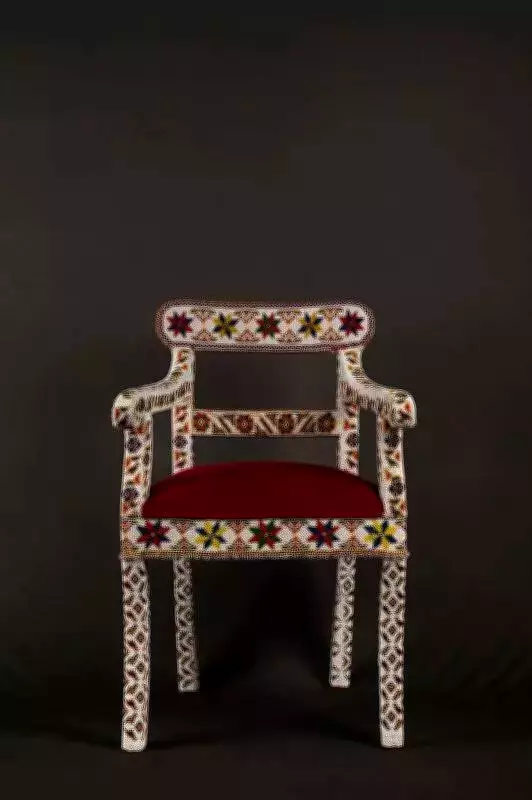
Restoration posed significant ethical questions for the curators. While many chairs retain their nicks and watermarks to preserve the "patina of usage," others demanded extraordinary revival efforts. One remarkable example is a chair purchased 30 years ago in tatters, covered in tiny, 1mm ceramic motifs.
Restoring it required six months of searching before a collective in Gujarat agreed to undertake the work, led by a 78-year-old artisan who was the only craftsman willing to handle the intricate, irregular handmade beads. The result is not perfection but continuity—a testament to preserving historical integrity.
History at Eye Level
What ultimately makes the exhibition resonate is its refusal to monumentalize these objects. These chairs were sat on, moved, altered, and repurposed. They witnessed transitions from church to office, from colony to nation, and from community to individual.
In reading India through chairs, the exhibition reminds us that history often resides at eye level, directly beneath our weight, waiting to be noticed in the everyday objects that surround us.