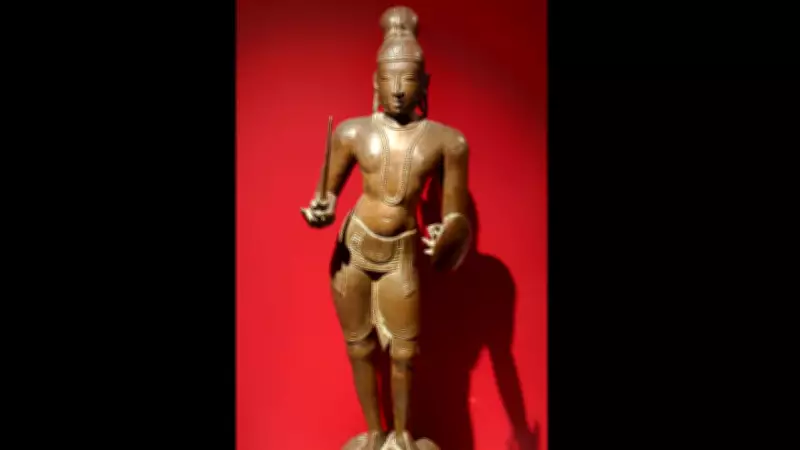
Oxford's Ashmolean Museum Returns Stolen 16th-Century Bronze Idol to India
In a significant development for cultural heritage preservation, the University of Oxford's Ashmolean Museum of Art and Archaeology in the United Kingdom has officially returned a stolen 16th-century bronze statue to India. This repatriation follows meticulous research into the object's provenance and close coordination with Indian authorities, marking another step in the global effort to restore looted artifacts to their rightful homes.
The Handover Ceremony and Historical Significance
The formal handover of the statue depicting Saint Tirumangai Alvar took place on Tuesday at the Indian High Commission in London. An official release confirmed the transfer, highlighting the museum's commitment to ethical stewardship. A spokesperson for the Indian High Commission expressed gratitude for the Ashmolean Museum's partnership and decision to return the bronze icon, emphasizing that this action enables the object to resume its original purpose as an object of worship.
The spokesperson stated, "Enabling the return of the bronze statue to the Tamil Nadu temple demonstrates the museum's commendable moral clarity." This repatriation comes just days after the Smithsonian National Museum of Asian Art in the United States announced plans to restitute bronzes stolen from Alathur and Veeracholapuram temples in Tamil Nadu, indicating a growing international trend toward returning cultural artifacts.

Eight-Year Journey from Identification to Repatriation
The identification and recovery process for this bronze was a lengthy endeavor spanning nearly eight years. S Vijay Kumar, co-founder of the India Pride Project, revealed that the identification was made by matching the Ashmolean bronze with 1957 temple photographs preserved at the Institut Français de Pondichéry (IFP).
"The return of the bronze is an important step," said Vijay Kumar. "The evidence was shared with Tamil Nadu Idol Wing CID and Indian High Commission in London. The process from identification to repatriation approval took nearly eight years."
According to historical records, the idol was stolen from the Soundararaja Perumal Koil temple, located in a village in Thanjavur district, back in 1952. S Aaraamudhan, a priest at the temple, confirmed this theft and noted that seven more idols were stolen from the same temple and should be repatriated.
Provenance Research and Museum Cooperation
The Ashmolean Museum acquired the idol in 1967 through Sotheby's, where it was sold by private collector Dr J R Belmont. However, there is no documentation regarding how the bronze entered his collection originally. The breakthrough came in November 2019 when an independent French scholar alerted the museum to research indicating that a photograph of the bronze, taken in 1957 at the Soundararaja Perumal temple, had been identified in the IFP archives.
Although no formal claim had been made at that time, the Ashmolean Museum proactively wrote to the Indian High Commission on December 16, 2019, requesting further information including police records and expressing willingness to discuss possible return. This demonstrates the museum's responsible approach to addressing provenance concerns.
On February 11, 2020, a temple executive officer filed a police report noting that a modern replica had replaced the original bronze. Interestingly, no previous police or news reports of this specific theft had been recorded in India. Following this documentation, the Indian High Commissioner made a formal claim for the return of the bronze on March 3, 2020.
Broader Implications for Cultural Repatriation
Vijay Kumar emphasized the broader significance of this repatriation: "The Sundararaja Perumal temple has only fakes now, and this handover should fasten the returns of Vishnu icon from Kimbell Museum, Kaliya Krishna from Asian Art Museum and help trace the buyer of the Devi idol."
The IFP photographs reveal that several bronzes from the same temple are now located outside India, highlighting the scale of cultural theft that occurred. With the successful return of the Ashmolean bronze, advocates are calling for the repatriation of remaining bronzes currently housed in overseas museums and circulating in the art market.

This case establishes an important precedent for international museums to conduct thorough provenance research and collaborate with source countries to address historical injustices. The eight-year effort demonstrates both the challenges and possibilities of cultural repatriation in an era of increasing transparency and ethical accountability in the museum world.