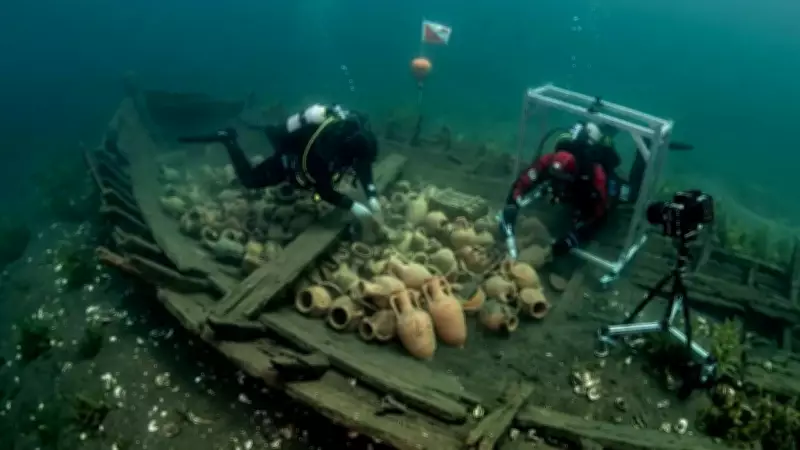
Swiss Lake Reveals Astonishing 2,000-Year-Old Roman Shipwreck
Archaeologists in Switzerland have made a groundbreaking discovery in Lake Neuchâtel, unearthing a remarkably well-preserved Roman shipwreck that dates back to the first century AD. This unexpected treasure trove provides unprecedented insights into ancient maritime trade and military logistics during the height of the Roman Empire.
Discovery Through Modern Technology
The identification of this significant archaeological site began in 2024 when high-definition drone photography captured the outlines of a ship hidden beneath layers of lacustrine sediment. Following this aerial discovery, the Cantonal Office of Archaeology (OARC) conducted a formal underwater excavation in March 2025.
A collaborative team of professional divers and maritime archaeologists meticulously documented the site using advanced 3D photogrammetry mapping techniques while carefully collecting fragile archaeological materials. The exceptional preservation of this "time capsule" is attributed to the specific lacustrine sediments that protected organic and metallic structures from oxygen exposure and deterioration for two millennia.

Unprecedented Artifact Collection
The archaeological excavation yielded an extraordinary collection of over 600 artifacts, with the most significant finds being hundreds of complete ceramic vessels and amphorae. Scientific analysis of clay composition and residue within these containers has confirmed they were used to transport olive oil from present-day Baetica in Spain.
The presence of these Mediterranean goods in a Swiss lake demonstrates the extensive geographical reach of Roman logistical systems, indicating that what was considered "liquid gold" from southern regions was available to residents and soldiers stationed in the northern Alpine territories. The large quantity and diverse forms of ceramics suggest a highly organized supply chain catering to Roman settlers and military personnel in the region.
Military Presence Revealed
One of the most significant aspects of this discovery is the presence of military equipment within the shipwreck, specifically two complete gladii—Roman short swords. According to archaeological analysis, these weapons indicate that what appears to be a civilian merchant vessel was likely accompanied by a military escort provided by an army legion.
During the first century AD, transporting valuable commodities like olive oil across vast territories faced threats from internal unrest and piracy. This find provides physical evidence of the Roman government's security apparatus protecting commercial interests and ensuring the safe transportation of economically vital goods throughout the empire.
Revealing Ancient Trade Networks
This shipwreck serves as a crucial link in understanding the "intermodal" transportation system of the Roman Empire, where goods moved through integrated sea, river, and land routes. Research indicates that Lake Neuchâtel played a significant role as an inland distribution point connecting the Rhone and Rhine Rivers.
Analysis of cargo placement and composition at this site will help researchers develop a clearer picture of how land and water routes were combined to support Roman activities north of the Alps. The discovery confirms that the Swiss plateau was not a remote outpost but rather a bustling corridor of international commercial activity, fully integrated into the broader Mediterranean economy.
Historical Significance
This remarkable discovery helps fill critical gaps in our understanding of how the Roman Empire maintained connections between the Mediterranean Sea and its northern frontiers beyond the Alps. The combination of civilian trade goods with military equipment provides unique evidence of how commercial and security interests intersected in ancient logistics.
The shipwreck represents one of the most complete and informative Roman-era finds in Swiss waters, offering researchers unprecedented opportunities to study ancient trade patterns, preservation techniques, and military-civilian relationships during a pivotal period of European history.