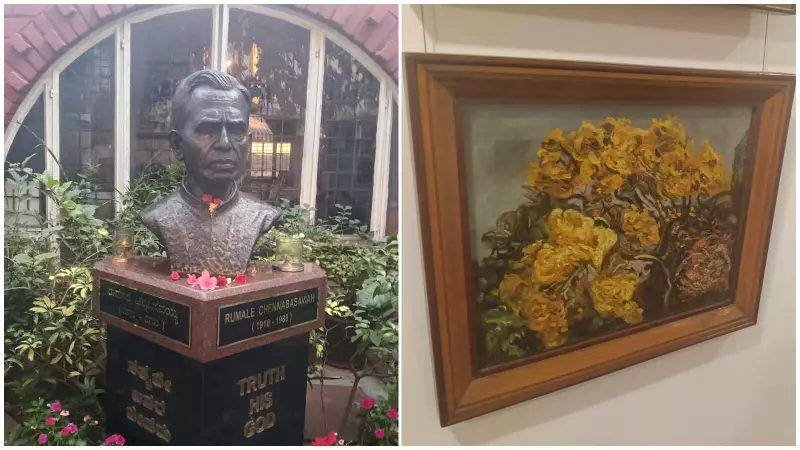
Nestled on a quiet lane in Bengaluru's Rajajinagar, a tranquil house holds a priceless artistic legacy. This is the Rumale Art House, the single largest repository of works by artist and freedom fighter Rumale Chennabasaviah, whose distinctive watercolours capture a bygone era of the city. Since 1973, this unique gallery has preserved the vision of a man who was instrumental in shaping Bengaluru's modern art scene.
The Artist and the Freedom Fighter
Rumale Chennabasaviah's journey was one of dual passions: art and nation. He discovered his artistic talent early, famously sketching a portrait of Jesus Christ as a child. He formally studied art in the 1920s at Bengaluru's Kalamandir School of Art and Mysuru's Chamarajendra Technical Institute. However, the call of the freedom struggle took precedence. He committed himself fully to the movement, actively participating in the Seva Dal and major campaigns like the Salt Satyagraha. His dedication led to prison terms in Bengaluru and Ahmednagar, where he was incarcerated at the same time as Jawaharlal Nehru.
It was only after exiting public life around 1962 that Chennabasaviah returned to his canvas with full vigour. The bulk of his prolific output was created in the subsequent decades, transforming his personal practice into a meditative act.
A Distinctive Style and a Bengaluru Legacy
For curator Sanjay Kabe, who has managed the art house since the artist's tragic death in a 1988 road accident, Rumale's work defies simple categorization. "He was influenced by Impressionism, the British watercolour school, masters like Turner, Constable, and Van Gogh," Kabe explains. "He wanted to do something similar, yet developed his own unique voice."
One technical hallmark was his method of mixing colours directly on the painting surface instead of on a palette. His subjects are distinctly Bangalorean, featuring familiar cityscapes like the plant life near the Karnataka High Court. He also documented rural landscapes destined to be submerged by dam projects, preserving them in paint before they vanished underwater.
Chennabasaviah was also a key connector in the art world. He was an associate of the famed Russian artist Svetoslav Roerich and played a role in encouraging Roerich to settle in Bengaluru. Despite personal austerity, he spared no expense on materials, using high-quality imported paper and paints to ensure longevity. The frames for his works were crafted by the same artisan who made frames for Roerich.
Spirituality and the Plein-Air Method
The art house also reflects Rumale's deep spirituality. A dedicated puja room holds portraits of his spiritual guides, Tapaswi Maharaj and Shivabalayogi, alongside paintings of temple interiors. A defining aspect of his practice was the 'plein-air' method—painting entirely on location, under the open sky. This approach, especially evident in his larger works depicting nature, lends an immediate, atmospheric quality to his art.
Preserving this delicate collection is a scientific endeavour. The gallery meticulously controls temperature and humidity with dehumidifiers, uses lighting within a strict lumen range, and avoids direct sunlight on the artworks. Regular inspections prevent any potential damage.
Today, the Rumale Art House stands as a quiet testament to a multifaceted life. It houses not just paintings, but personal portraits—including those of Sanjay Kabe and his sister as children, and their father Madhav (a close friend and fellow spiritualist of Rumale) in meditation. Located at 45th Cross Road, 3rd Block, Rajajinagar, it is open from 10:30 am to 5 pm all days except Tuesday. Admission is free, but visitors are advised to contact Sanjay Kabe at 95356 78111 prior to their visit.