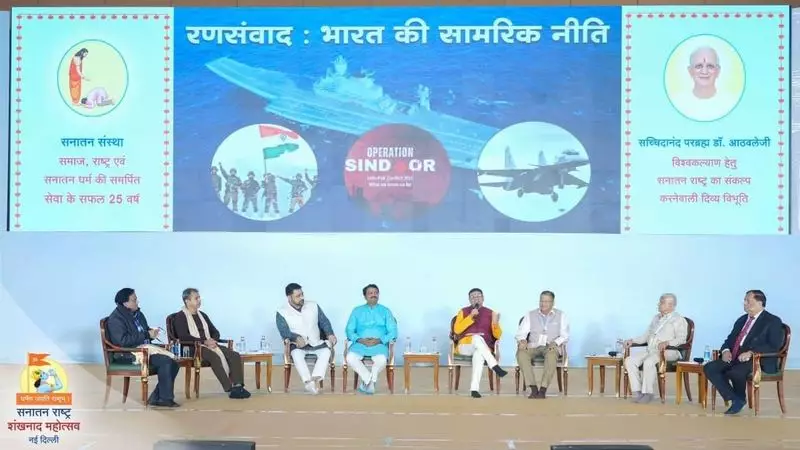
India's ancient Sanatan culture is witnessing a remarkable resurgence and gaining profound recognition on the global stage, according to Union Minister for Commerce and Industry, Consumer Affairs, Food and Public Distribution, and Textiles, Piyush Goyal. The minister made these significant observations during a recent address, underscoring the timeless relevance and universal appeal of India's civilizational ethos.
Global Embrace of Timeless Values
Piyush Goyal emphasized that the principles and values enshrined in Sanatan Dharma are now being acknowledged and adopted worldwide. He pointed out that this ancient wisdom, which has sustained Indian civilization for millennia, offers solutions to contemporary global challenges. The minister articulated that the world is increasingly looking towards India not just as an economic power, but as a repository of profound spiritual and philosophical knowledge.
The core tenets of Sanatan culture, which include sustainability, harmony with nature, holistic well-being, and respect for all life forms, are finding resonance in international discourse. Goyal noted that these ideas are no longer confined to philosophical texts but are influencing global conversations on environmental conservation, mental health, and ethical living.
Cultural Soft Power and Economic Implications
This growing recognition is not merely a cultural phenomenon but also translates into tangible soft power for India. The minister connected this cultural ascendancy to India's rising economic and geopolitical stature. As the world shows interest in yoga, Ayurveda, meditation, and Indian spiritual practices—all integral parts of the Sanatan tradition—it creates new avenues for cultural exchange, tourism, and wellness industries.
Goyal suggested that the global appreciation for this culture enhances India's brand value internationally. It builds a positive perception that can facilitate deeper diplomatic and trade relationships. The ethos of 'Vasudhaiva Kutumbakam' (the world is one family), a central Sanatan principle, aligns with the modern need for global cooperation and multilateralism.
A Legacy for the Modern World
The Union Minister's comments highlight a significant shift where India's ancient heritage is being viewed as a dynamic and relevant guide for the future. Sanatan culture, often described as eternal (Sanatan), is proving its adaptability and enduring value. Its emphasis on duty (dharma), righteous action, and the pursuit of truth provides a framework for personal and societal conduct that many across the world find compelling.
This recognition comes at a time when India is confidently asserting its civilizational identity on the world stage. The widespread celebration of International Yoga Day, the growing popularity of Indian vegetarian cuisine, and the incorporation of mindfulness practices in corporate settings worldwide are cited as practical examples of this global influence.
In conclusion, Piyush Goyal's statement marks an important acknowledgment of India's cultural capital. The worldwide recognition of Sanatan culture signifies a move towards a more inclusive and holistic global paradigm, one that draws from ancient wisdom to address modern complexities. It positions India not only as a rapidly developing nation but also as a custodian of timeless knowledge that has much to offer to humanity's collective progress.