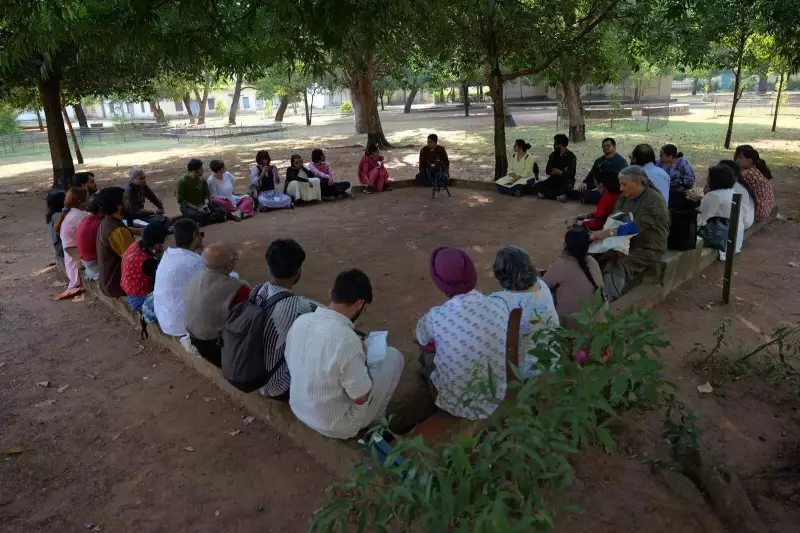
The recent prelude to the 'The City as a Museum' festival in Santiniketan was not a conventional opening but a deep, two-day immersion into its living fabric. Held on November 28 and 29, the event used the town's natural rhythms, architectural spaces, and community practices to demonstrate how learning, art, and daily life remain inseparably connected here.
Santiniketan: A Campus as a Living, Breathing Museum
The programme deliberately moved away from presenting Santiniketan as a static heritage zone. Instead, it framed the entire area as a living museum, where people, their practices, and the built environment are one. Participants engaged in walks, sketching sessions, music, and conversations across Uttarayan, the Ashrama, and Kala Bhavana. They learned to read the campus as a place where Rabindranath Tagore's ideals of integrating art, nature, and education continue to influence how structures are designed and inhabited.
Guided by architectural historian Saptarshi Sanyal and art historian Soumik Nandy Majumdar, a walk through the Udayan complex and Kala Bhavana revealed these spaces as "experiments with modernity." The leaders highlighted fluid architectural forms, surfaces responsive to light, murals embedded into daily life, and an overall design philosophy that treats the campus like a "nest"—rooted in its context, permeable, and always open.

Rediscovering the Familiar Through New Lenses
For many attendees, the experience felt like seeing a known place with fresh eyes. Management professional Kaveri Narang, visiting after 35 years, described it as "transformative." She noted that the walks unveiled the creative impulses behind buildings she once saw merely as structures. She observed how sunlight, mud, foliage, and movement shaped buildings like Konarak and Shamoli, and how art—from Nandalal Bose's frescoes to Ramkinkar Baij's sculpture of Gandhi—exists openly within the landscape, not as isolated museum artifacts.
Educator Ishi Bhatia, a regular at previous festival editions, observed that shifting the venue from Kolkata to Birbhum significantly widened the perspective. "It moved the festival from the idea of 'city as epicentre' to a broader map of modernity," she remarked.
Trails of Terracotta and the Rhythms of Everyday Life
Beyond the university campus, the "Pora Matir Khata" trail, led by scholar-artist Bihan Das, took participants to villages like Surul, Ilambazar, and Moukhira. Here, terracotta temples were presented not as postcard-perfect heritage sites but as community-sustained spaces, continuously shaped by rituals, local repairs, and collective memory. Das pointed out that Bengal's heritage narrative often focuses on Kolkata, Murshidabad, or Bishnupur, while countless smaller shrines survive through dedicated local stewardship. The group interpreted these temples as "notebooks in baked earth," recording the additions and care of generations.
Back in the ashram area, the session "Ashrom Prangoner Jibon Japoner Golpo," led by pedagogues Avik Ghosh, Partha Chakraborty, and musician Amit Kumar Dey, immersed attendees in the sounds and textures of Santiniketan's daily life. This included classes held under trees, the ringing of bells, seasonal rituals, and the quiet tempo of everyday routines that define the place.
Expanding the Idea of a 'City' Before Kolkata's Main Event
For both Bihan Das and Ishi Bhatia, the Santiniketan chapter was crucial as it expanded the scope of what "City as a Museum" can encompass. It's not just about metropolitan centres but also includes ashram towns, clusters of terracotta temples, and campuses influenced by Pan-Asian ideas. Das stressed that conversations about design and conservation must treat local communities as co-authors. "A city-as-museum cannot just be a visual-art frame. It has to include people who keep these places alive," he emphasized.
Bhatia added that many of Bengal's most significant cultural experiments have unfolded outside major urban centres, even though they are frequently overlooked by mainstream cultural festivals. The Santiniketan prelude served as a vital reminder of this broader cultural geography.