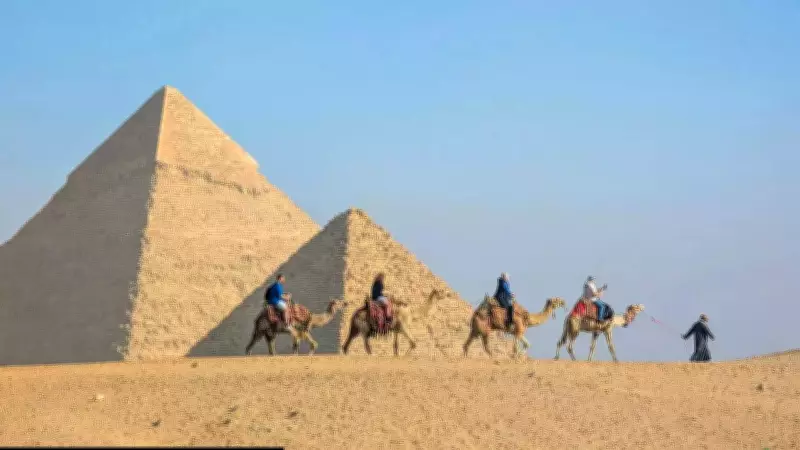
Satellite Radar Technology Uncovers Potential Hidden Structures Beneath Ancient Egyptian Pyramid
In March 2025, startling reports emerged from an Italy-based research group claiming to have identified significant underground features beneath the iconic Pyramid of Khafre on Egypt's Giza plateau. The team employed advanced satellite radar technology rather than traditional ground excavation methods, revealing what they interpret as extensive subterranean structures extending deep below the ancient monument.
Advanced Radar Imaging Reveals Subsurface Anomalies
The researchers utilized Synthetic Aperture Radar data collected from orbiting satellites, processing the information through sophisticated mathematical modeling to create composite images of subsurface density variations. Their analysis suggests the presence of vertical shafts and substantial chambers carved into the bedrock beneath the pyramid. These findings have not yet been verified through physical on-site investigation, placing them firmly within ongoing debates about remote sensing methodologies, data interpretation accuracy, and the complex geology of the Giza plateau.
Synthetic Aperture Radar technology operates by transmitting radar signals from satellites that reflect off the Earth's surface and are recorded for analysis. The processed data reveals patterns indicating variations in underground density and structure, providing researchers with what they describe as a non-invasive window into subsurface features.

Detailed Interpretation of Radar Data
According to the study titled "What Really Lies Beneath the Pyramids?", the research team believes their analysis reveals:
- Eight deep cylindrical shafts descending hundreds of meters into the limestone bedrock
- Two large cubic chambers at the lower extremities of these shafts
- Five vertical voids within the pyramid structure itself
It is crucial to emphasize that these conclusions represent interpretations of radar patterns rather than confirmed physical discoveries through direct archaeological investigation. The team's methodology relies entirely on remote sensing data processed through computational models.
Mixed Reactions from Academic and Online Communities
The announcement generated significant online interest, particularly within alternative history circles where videos and commentary circulated rapidly across social media platforms. However, the academic response has been considerably more measured and cautious.
Egyptologists and archaeological experts have highlighted several important considerations:
- Satellite radar imagery interpretation presents substantial complexity
- Image processing algorithms may create shapes resembling artificial structures without confirming their material composition
- Without complementary ground-penetrating surveys, drilling, or excavation, establishing the true nature of subsurface features remains challenging
Geological Context and Natural Formations
The Giza plateau's geological composition adds another layer of complexity to these findings. The limestone bedrock naturally contains cavities, fissures, and voids that have been documented through previous explorations and geophysical surveys. Some researchers suggest the radar signatures could represent these natural formations rather than engineered structures.
This distinction carries significant archaeological implications, as geological voids commonly occur in limestone terrain. The current study has not yet clearly differentiated between natural geological features and potential artificial constructions, leaving this fundamental question unresolved.
Speculative Connections to Ancient Mythology
Beyond the technical debate, some commentators have drawn speculative connections between the proposed underground structures and ancient Egyptian concepts of the Duat—the underworld realm described in funerary texts. Others have suggested possible links to prehistoric Anatolian sites associated with the Taş Tepeler tradition.

These associations remain purely speculative at present, with no archaeological evidence currently connecting the Giza plateau to these earlier cultures. The radar study adds another dimension to ongoing discussions about Khafre's pyramid but does not provide definitive answers.
Methodological Considerations and Future Research
The research highlights both the potential and limitations of remote sensing technologies in archaeology. While satellite radar offers non-invasive methods for investigating sensitive archaeological sites, its findings require careful interpretation and validation through traditional archaeological methods.
The debate surrounding these discoveries underscores the importance of multidisciplinary approaches combining remote sensing, geological analysis, and archaeological excavation to properly understand subsurface features at ancient sites. As technology advances, such methodologies may become increasingly valuable for exploring protected heritage sites without causing physical disturbance.