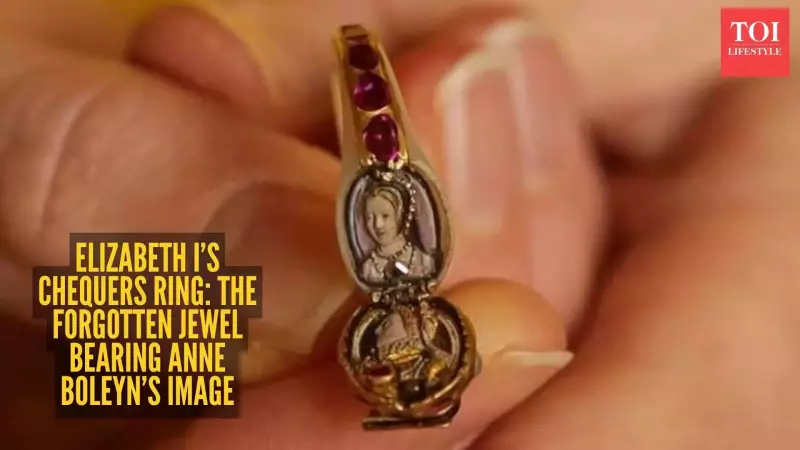
In the annals of British history, the Tudor dynasty continues to fascinate with its tales of power, passion, and intrigue. While the stories of monarchs like Henry VIII and Elizabeth I are well-known, a tangible piece of their intimate world survives, shrouded in mystery. This is the tale of the Chequers Ring, a supremely rare 16th-century jewel that offers a silent, poignant connection between a legendary queen and her ill-fated mother.
A Ring Close to the Heart of a Queen
Crafted around 1570, this exquisite piece is made of gold, mother-of-pearl, rubies, and diamonds. Historically, it is one of the most personal objects belonging to Queen Elizabeth I. The ring's significance is underscored by the fact that it was on her finger at her deathbed in 1603, even as her official coronation ring was cut off before her passing. This indicates it held immense private value for the Virgin Queen.
Today, the ring resides not in a public museum but in a place of political power: Chequers, the UK Prime Minister's official country residence. It is from this location that the jewel derives its modern name—the Chequers Ring. As the personal property of the Chequers Trust, it is rarely displayed, adding to its enigmatic aura.

The Enigmatic Portrait: A Mother's Secret Image?
The ring's design features an enamel portrait of Queen Elizabeth I herself. However, the true mystery lies in a second, smaller portrait hidden within the bezel, positioned above the queen's image. For years, historians debated the identity of this mysterious woman.
Some theories suggested a connection to Elizabeth's stepmother, Jane Seymour. Yet, compelling evidence points towards a far more emotionally charged figure: Anne Boleyn, Elizabeth's own mother. Anne was executed on the orders of King Henry VIII when Elizabeth was just three years old, a traumatic event the queen rarely discussed publicly.
Art historians note that the details in the miniature—the French hood, specific jewellery hallmarks, and the light hair shade—closely match known portraits of Anne Boleyn. The presence of a phoenix emblem, a symbol used by Elizabeth but not the Seymour family, further weakens the stepmother theory. This suggests the ring was a deeply private tribute, a way for Elizabeth to keep a part of her mother literally close to her heart throughout her tumultuous life.
Why the Secrecy Endures
The decision to keep the ring away from public view at Chequers seems to honour the secret Elizabeth herself maintained for a lifetime. Anne Boleyn remains a figure of immense religious and political controversy in British history. By concealing the portrait, Elizabeth may have been navigating the perilous waters of her own legitimacy and the complex legacy of her mother's execution.
Possessing this ring, with its hidden maternal image, would have been an act of profound personal remembrance. It represents a silent, defiant act of daughterly love, preserved in gold and enamel. The ring's current secluded existence continues this tradition of privacy, making it one of history's most intimate and unresolved royal narratives.
Thus, the Chequers Ring is more than a fabulous piece of Tudor jewellery. It is a historical artifact loaded with unspoken emotion, connecting two of England's most famous queens across a chasm of tragedy and silence. Its story is a reminder that the most powerful truths are often those kept closest, hidden in plain sight for centuries.