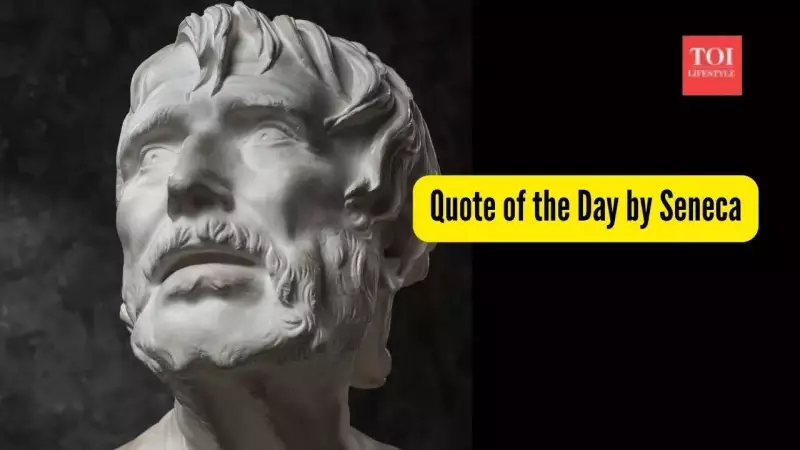
The Resurgence of Seneca's Stoic Philosophy in Modern Times
In recent years, the ancient philosophy of Stoicism, particularly as articulated by the Roman philosopher Seneca, has experienced a remarkable revival. This school of thought, which emphasizes detachment from and acceptance of life's inevitable fluctuations, offers surprisingly relevant guidance for contemporary challenges.
Who Was Seneca the Younger?
Lucius Annaeus Seneca, known as Seneca the Younger, was born around 4 BCE in Corduba, Spain, into a wealthy family. His father, Seneca the Elder, was a renowned teacher of rhetoric, and young Seneca received extensive education in Rome, studying grammar, public speaking, and various philosophical traditions.
Early health struggles with asthma and bronchitis prompted Seneca to explore Stoicism as a means of coping with physical limitations. This personal experience with suffering would later inform his practical approach to philosophy.

A Turbulent Political Career
Seneca navigated the treacherous waters of Roman politics with notable success initially. Under Emperor Caligula, he served as senator and quaestor. However, his fortunes changed dramatically when Emperor Claudius, based on false accusations of an affair with his niece Julia Livilla, exiled Seneca to Corsica for eight years beginning in 41 CE.
This period of exile proved surprisingly productive. Seneca composed some of his earliest surviving works during this time, including tragedies and consolations that would establish his literary reputation.
Returning to Rome in 49 CE at the behest of Agrippina, who appointed him tutor to her son Nero, Seneca eventually became one of the young emperor's primary advisors alongside Burrus, prefect of the guard. Their early leadership brought significant reforms and relative peace to Rome.
A Stoic Death
As Nero's reign grew increasingly tyrannical, Seneca attempted to retire around 62 CE. His efforts proved futile when, in 65 CE, Nero falsely implicated him in a conspiracy and ordered his suicide. Seneca met this fate with remarkable composure, first drinking poison and then, when the poison acted slowly, opening his veins in a steam-filled room to hasten death. His final moments demonstrated the Stoic principles he had championed throughout his life.
The Core Principles of Stoic Philosophy
Stoicism originated in Greece around 300 BCE with Zeno of Citium, but Seneca adapted its principles for practical Roman application. The philosophy distinguishes between what we can control (our thoughts, judgments, and responses) and what we cannot (external events, other people's actions, and circumstances).
Stoics identified virtue, wisdom, courage, justice, and moderation as the only true goods, while considering wealth, health, and fame as "indifferent" since they remain outside our complete control. Happiness, according to this worldview, emerges from within through disciplined attention to our controllable responses.
Seneca's Practical Applications
Unlike purely theoretical philosophers, Seneca focused on making Stoicism accessible and applicable to everyday life. His essays provide timeless guidance:
- "On the Shortness of Life" argues that time represents our most precious resource and warns against wasting it on trivial concerns or unnecessary worries.
- "On Anger" teaches readers to employ reason as a tool for managing emotional responses, noting that anger typically harms the angry person more than its intended target.
- His concept of the "dichotomy of control" encourages acceptance of external events while taking full responsibility for internal reactions.
Remarkably candid about his own imperfections despite his wealth and political power, Seneca advocated for simple living and humane treatment of others, including slaves. His 124 "Letters to Lucilius" function as ancient advice columns, offering concise lessons on friendship, mortality, and ethical living.
Stoicism's Modern Relevance
Seneca's philosophy resonates powerfully in today's world of constant connectivity, economic pressures, and global uncertainties. Several factors explain this contemporary appeal:

- Time Management: In an era of endless scrolling and perceived time scarcity, Seneca's emphasis on valuing time feels particularly urgent.
- Mental Health: Modern figures like Tim Ferriss and Ryan Holiday have popularized Stoic practices through works like "The Daily Stoic," applying ancient wisdom to contemporary productivity and wellness challenges.
- Therapeutic Applications: Cognitive Behavioral Therapy (CBT) incorporates Stoic techniques for reframing thoughts and reducing anxiety, essentially modernizing Seneca's psychological insights.
- Professional and Athletic Performance: Executives study Stoicism for stress management, while athletes apply its principles to develop mental resilience.
During the COVID-19 pandemic, Seneca's observation that "We suffer more in imagination than in reality" gained particular traction, offering comfort amid widespread uncertainty.
The Stoic Perspective on Friendship
One of Seneca's most profound contributions concerns the nature of true friendship. He famously wrote: "But when you are looking on anyone as a friend when you do not trust him as you trust yourself, you are making a grave mistake, and have failed to grasp sufficiently the full force of true friendship."
This passage illuminates the Stoic philosophy of relationships, emphasizing that genuine friendship requires complete and mutual trust equivalent to self-trust. According to Seneca, partial or conditional trust cannot sustain authentic friendship, making trustworthiness the primary criterion for evaluating potential friends.
These insights offer valuable guidance for navigating modern relationships in both personal and professional contexts, reminding us that quality connections depend on foundational trust rather than superficial compatibility.
Enduring Legacy
Seneca's unique contribution lies in transforming Stoicism from abstract theory into practical life guidance. He viewed philosophy not as an intellectual exercise but as medicine for the soul—a perspective that continues to attract those seeking meaning and resilience in challenging times.
As contemporary society grapples with information overload, social fragmentation, and existential anxieties, Seneca's two-thousand-year-old wisdom provides surprisingly fresh tools for cultivating inner peace, purposeful living, and authentic relationships.