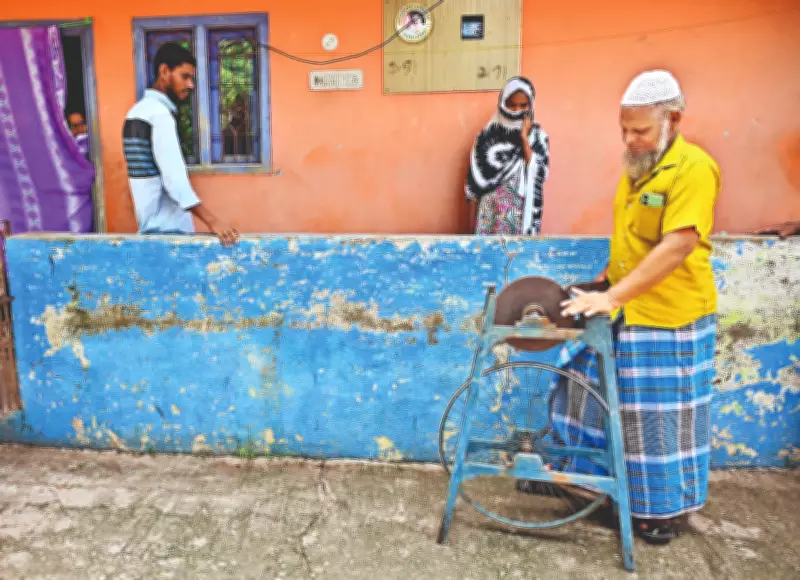
The Vanishing Art: Tamil Nadu's Knife Sharpeners Struggle in a Digital Age
Harichandrapuram, a small village located approximately 70 kilometers from Chennai in Tiruvallur district, is famously known as the village of knife sharpeners, or saanakkaaran in Tamil. This Urdu-speaking, Muslim-majority hamlet is home to around 800 families, with more than half of its residents engaged in the age-old profession of knife sharpening. The men of Harichandrapuram embark on extensive journeys across Tamil Nadu, traveling hundreds of kilometers by train and bus in search of customers, carrying their heavy tools and hopes for a livelihood.
A Life on the Pavement
Kareemullah K is one such artisan. While he maintains a humble hut in Harichandrapuram, his nights are predominantly spent on pavements in various towns and cities. With his 15-kilogram iron sharpening wheel and megaphone tucked under his legs, and a sack of clothes serving as his pillow, Kareemullah navigates a precarious existence. The 33-year-old traverses between Chennai, Coimbatore, and Erode, walking several kilometers each day in pursuit of work.
"I don't ever really sleep," confesses Kareemullah. "I have to stay alert for footsteps or a patrol van. The police question or threaten me because of the number of knives I carry. Sometimes, I am attacked by people who want to steal knives. I used to be scared, but now I see it as part of the job." There are days when he goes without food, subsisting on just a glass of water before attempting to rest.

At dawn, Kareemullah resumes his journey, calling out "saana kathi, saana kathi" (shining knives), hoping someone will open their gate. Just a few years ago, knife sharpeners like him were a common and cherished sight across Tamil Nadu, often fascinating children playing on the streets. Today, in a rapidly evolving world where nearly every service is accessible online, these traditional artisans fight for survival.
A Community in Transition
"Harichandrapuram is one of the few known knife-sharpener villages in Tamil Nadu. There may be more community clusters we don't know about, as no research or survey has been done on the community," explains Kombai Anwar, a heritage educator and researcher specializing in Muslim history.
Kareemullah highlights the educational challenges faced by the community: "The nearest school is almost 15 kilometers away, so most of us don't study. Like me, many cannot leave this trade because it is all we know." He learned the craft from his uncle, a common practice where most boys inherit the trade while girls are often married off early.
However, change is slowly emerging. "Now the younger generation is stepping out for better jobs as clerks and sales executives. A few women are studying, are more educated than the men, and are taking up receptionist and administrative roles, which is a good sign since the trade is on the decline," Kareemullah adds.
Generational Craftsmanship and Economic Hardships
Shahjahan M, another resident, makes a grueling four-hour commute to Chennai daily to sharpen knives, scissors, sickles, and cleavers. "We have been living in this village for more than 100 years," he says. "Initially, our forefathers did ammi kal kuththura velai (chiselling pits into hand-grinding stones) for a living and moved to knife sharpening after people began buying electric grinders. This is a generational trade. I learned the craft from my father, who learned it from his father."
Shahjahan charges ₹40 for steel knives and ₹20 for iron ones, but notes, "You might think that's fair, but the bigger the house, the harder they bargain." With a tired smile, he reveals that most sharpeners earn about ₹5,000 a month. The physical toll is severe; repeatedly lifting the heavy wheel on and off his bike has left him with chronic back pain that persists despite various remedies.

Kareemullah reports that trade has halved, attributing the decline to people purchasing kitchen sharpening stones online. "But those can't match what we do. After cutting vegetables six or seven times, the knives go blunt again. The sharpness we give lasts longer. It's a technique. Now, my only customers are regulars and sometimes senior citizens who understand the craft," he laments.
Cultural Preservation and Historical Roots
The plight of knife sharpeners has found resonance in various cultural mediums:
- In children's literature: Actor R Amarendran addresses the vanishing livelihood in his book Salim: The Knife Sharpener. "The idea is to ensure the next generation doesn't forget them," says Amarendran. "These trades speak of resilience, of people who travelled from town to town keeping kitchens running. When such stories fade, we lose a part of our history."
- In Malayalam cinema: The 2023 film Chaana, directed by and starring Bheeman Raghu, and shot partly in Kanyakumari, centers on a knife sharpener named Kanakaraj and his daughter as they struggle to survive.
- In Tamil cinema: Actor Vadivelu portrayed a knife sharpener in Eera Nilam (2003), directed by Bharathiraja, adding a comedic touch to the character's village travels.
Anthropologists note a lack of research on knife-sharpening communities. Kombai Anwar explains that they have long been part of artisanal and semi-nomadic trade networks. "Though this trade isn't tied to any single caste or religion, such hereditary craftsmanship was historically viewed as 'lowly'," says Anwar.
M P Damodaran, head of the Department of Anthropology at the University of Madras, traces the community's roots to Muslim blacksmith groups within older craft systems organized by material rather than religion. "Hindus typically worked with wood, Christians with stone, Muslims with metal, and certain dalit groups with leather," he states. "The division wasn't religious to begin with. Hindus largely worked with wood for temple construction. Many Christians came from masonry and construction castes, so their skills with stone continued after conversion. Muslims, on the other hand, were often metalworkers as Islamic traders introduced advanced metal tools and techniques from West Asia, influencing local craftsmanship."
As urbanization and industrial tools gradually replaced traditional blacksmithing, many of these metalworking families adapted by transitioning to knife sharpening and repair work, carrying their ancestral skills into a new, mobile form of labor. Today, they stand as a testament to a fading heritage, battling modernity's relentless march.