The Living Symbol of India's Journey: The Tricolour's Dual Ceremonies
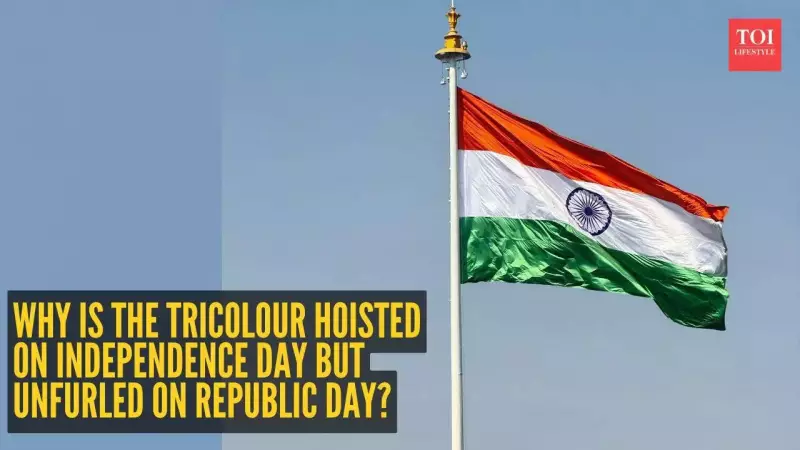
India's revered Tricolour transcends mere fabric, standing as a vibrant, living emblem of the nation's extraordinary journey from colonial subjugation to sovereign democracy. This sacred symbol takes center stage annually during two monumental occasions that define the Indian calendar: August 15, celebrated as Independence Day, and January 26, observed as Republic Day. While both days evoke profound patriotic fervor, the ceremonies involving the national flag differ significantly in their execution and underlying symbolism, each carrying deep historical meaning that resonates with 1.4 billion citizens.
The Historic Distinction: Hoisting Versus Unfurling
On Independence Day, the Prime Minister of India performs the solemn act of hoisting the flag at Delhi's iconic Red Fort. This ceremony involves raising the Tricolour from the bottom of the flagpole to its summit, perfectly synchronized with the stirring notes of the national anthem, 'Jana Gana Mana'. In contrast, Republic Day witnesses the President of India unfurling the flag at Kartavya Path in New Delhi. Here, the flag rests already at the pole's apex, bundled and often adorned with flowers, before being gracefully opened to the breeze. These are not arbitrary traditions but carefully preserved rituals steeped in historical context and national pride.
Independence Day: The Hoisting That Symbolizes Liberation
Picture August 15, 1947: India finally shattered the chains of two centuries of British colonial rule. The hoisting ceremony masterfully captures that electrifying moment of ascension—from oppression to hard-won liberty. At the historic Red Fort, the Prime Minister, a tradition inaugurated by Jawaharlal Nehru and continued by every successor, pulls the flag upward from the pole's base. This upward climb powerfully honors the immense sacrifices of countless freedom fighters—from Mahatma Gandhi's peaceful marches and Bhagat Singh's defiant courage to the contributions of innumerable unsung heroes.

For millions of Indians watching live broadcasts from bustling cities to remote villages, this act evokes raw, personal pride. The hoisting symbolizes a collective achievement, declaring "We earned this sovereignty." It's a ritual so deeply ingrained that schoolchildren across the nation practice it annually, with countless flags waving proudly in unison, connecting generations to that foundational moment of freedom.
Republic Day: The Unfurling That Celebrates Constitutional Maturity
Fast-forward to January 26, 1950: India formally adopted its Constitution, transforming into a sovereign democratic republic. The unfurling ceremony reflects this political maturity—it is not about a struggle won, but about the revelation of a foundational blueprint for governance. The flag, already positioned at the top of the pole and often wrapped in floral tributes, is unveiled by the President of India. Currently, this duty is performed by President Draupadi Murmu, who pulls a cord to release a cascade of petals as the Tricolour gracefully unfurls along Kartavya Path.
This ceremonial reveal symbolizes the unveiling of India's core democratic ideals: justice, liberty, equality, and fraternity for all citizens. The unfurling is followed by the grand Republic Day parade, a spectacular display of the nation's cultural diversity, military prowess, and technological achievements, collectively celebrating the strength and unity of the republic.
Decoding the Deeper Symbolism
The distinction between hoisting and unfurling carries layered philosophical meaning. Hoisting the flag represents the literal birth of the nation-state in 1947. Starting from a low position and climbing upward, it visually mirrors India's arduous fight rising from subjugation to independence. Conversely, unfurling the flag signifies the maturity of Indian democracy established in 1950. The flag begins already aloft, and its opening honors the constitutional framework meticulously crafted by Dr. B.R. Ambedkar and the Constituent Assembly, already in place and guiding the nation.

Furthermore, the actors in these ceremonies are symbolically significant: the Prime Minister, as the people's elected leader, hoists the flag on Independence Day, evoking the mass struggle of the populace. The President, as the constitutional head of state, unfurls the flag on Republic Day, embodying the authority and spirit of the Constitution itself. Both ceremonies stir profound desh bhakti (patriotism) but do so in uniquely complementary ways.
Relevance in 2026 and Beyond: Unity in Tradition
As the nation approaches the 77th Republic Day in January 2026, these time-honored rituals remind citizens that Independence Day marked the dawn of a free nation, while Republic Day constructed its enduring democratic house. In an era often marked by divisive narratives, the Tricolour stands as a powerful unifier. The ceremonies encourage every Indian to hoist personal flags of hope and unfurl commitments to equality and justice.
For those inspired to display the national flag at homes or community events, it is crucial to adhere to the Flag Code of India 2002. This includes ensuring the saffron band is positioned at the top and treating the flag with the utmost respect it deserves, avoiding any form of dishonor.
This Republic Day, take a moment to reflect on how the Constitution of India shapes your daily life and rights. Consider also sharing your most cherished memories of this national celebration, as these personal stories weave into the larger tapestry of India's democratic journey.