Renovation Row at Varanasi's Manikarnika Ghat: Life and Death Continue Amid Controversy
At Varanasi's Manikarnika Ghat, the eternal flames of funeral pyres burn on. They have burned for centuries. The sacred cremation ground sits next to the recently revamped Kashi Vishwanath Temple. Now, it awaits its own transformation. This transformation has sparked a major political controversy.
The Heart of the Controversy
Opposition parties have launched a fierce attack on the Yogi Adityanath government. They allege the destruction of a statue of Rani Ahilyabai Holkar. This happened during a beautification exercise at the ghat. The Congress and Samajwadi Party call it another blow to Varanasi's ancient heritage by the BJP regime.
Chief Minister Yogi Adityanath responded strongly. After offering prayers at Kashi Vishwanath Temple, he claimed conspiracies are being hatched. These conspiracies aim to obstruct his government's development projects. He stated it was necessary to present the correct facts to the public.

Official Clarifications and Protests
District officials provided clarifications. Additional District Magistrate Alok Kumar confirmed a statue was broken during renovation work. He said a probe was ordered to determine whose statue it was.
District Magistrate Satyendra Kumar offered more details. He explained that idols carved on the walls of a mani (platform) were damaged. Other artwork was secured by the Department of Culture. It will be reinstalled later in its original form.
Minister Ravindra Jaiswal described a mani as a platform for sitting, meditation, or yoga. He stated the contractor did not notice the idols. The government has taken note, and the idols are safe.
Despite these assurances, protests erupted. The Pal community, which claims deep association with Holkar, demonstrated at the cremation site. They protested the alleged demolition of the structure honoring the revered queen.
The Renovation Project: Scope and Purpose
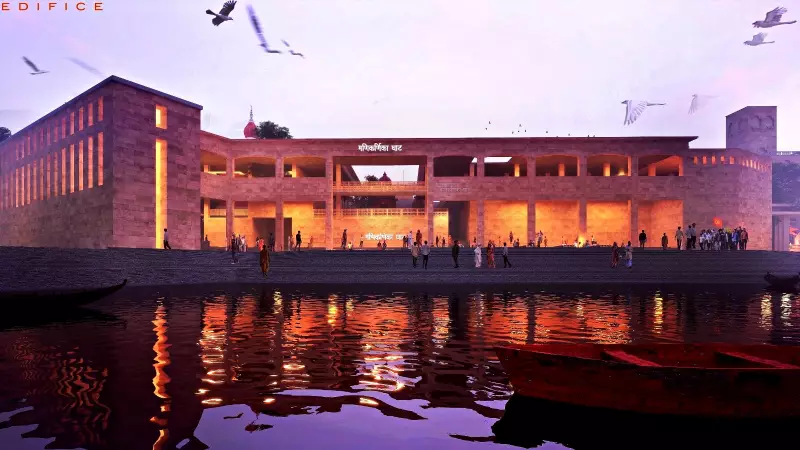
The renovation work at Manikarnika Ghat is substantial. It covers an area of 90,000 square feet. The project cost is Rs 20 crore. A West Bengal firm funds it as part of its Corporate Social Responsibility. Work began in 2023.
The plan aims to create a more organized, dignified, and humane environment for mourners. It includes several key facilities:
- Visitor restrooms and changing rooms for women
- A designated mundan (head-shaving) area
- Covered seating and waiting arrangements
- Docking points for boats bringing bodies
- Two renovated sections for lighting pyres (18 open-air platforms and 19 on the first floor)
- A ramp connecting the two floors for easier body transport
- A registration mechanism to expedite the process
- Nineteen 25-meter chimneys to address ash pollution complaints
The project also involves clearing passages to the ghat. Currently, mourners often walk 700 meters through narrow lanes. The government assures no construction will occur along these passages. No structures will be demolished there.
Local Voices and Daily Realities
Local residents express mixed views. Many highlight the urgent need for renovation. Vinay Tiwari, attending a relative's final rites, pointed out critical issues. "There is no proper waiting area for families," he said. "Because of the heavy rush, they often wait hours."
Manikarnika is one of Varanasi's 84 ghats. It is considered among the oldest and most sacred cremation grounds in Hinduism. More than a hundred bodies arrive daily. Cremations continue day and night.
Given the immense pressure, cremations happen in the open area and on the terrace of the main building. Dinesh Yadav, who runs a firewood shop nearby, described monsoon challenges. "Cremations in the open have to be halted," he said. "The bodies awaiting their turn just keep lying in the lanes."
Santosh Pandey, a tea shop owner living close to the crematorium, faces ash pollution. "When cremations are carried out on the first floor, ash regularly enters our houses," he explained. "We can't leave our doors or windows open."

Historical Context and Political Reactions
The controversy touches deep historical nerves. Rani Ahilyabai Holkar is revered for funding the rebuilding of the Kashi Vishwanath Temple in the 18th century. The temple was destroyed by Mughal ruler Aurangzeb.
BJP Varanasi MLA Neelkant Tiwari defended the renovation. He stated the reconstruction of ancient manis is important. They are symbols of Kashi's beauty. He clarified the damage was not intentional. It resulted from vibrations during construction activity.
Opposition leaders remained unconvinced. Congress president Mallikarjun Kharge accused Prime Minister Narendra Modi of using bulldozers at the ghat. He linked it to earlier demolitions during the Kashi Vishwanath Temple Corridor construction.
SP president Akhilesh Yadav said no true devotee could tolerate the insult to Holkar's statue. He criticized the disrespect shown towards Kashi's Sanatani heritage.
The Dom Community's Role
The Dom community traditionally conducts cremation rites at the ghat. They act as its caretakers. Members say the reconstruction began at the request of the late Jagdish Chaudhary, the titular "Dom Raja."
Chaudhary was a proposer when PM Modi filed his nomination from Varanasi in 2019. He reportedly flagged the lack of basic facilities at the ghat to the Prime Minister.
Vishwanath Chaudhary, a relative, highlighted ongoing problems. "There are no proper toilets, changing rooms for women, or adequate seating," he stated. "My uncle also pointed out the absence of clear regulations for shops, adding to families' difficulties."
Progress and Challenges
Construction resumed around two months ago after a rain-induced halt. About 20% of the work is now complete. The project is expected to finish by September this year.
Varanasi Mayor Ashok Kumar Tiwari noted a recent helpful decision. Authorities waived boat fares for those bringing bodies to the ghat. This measure assists grieving families.
Memories of the Kashi Vishwanath Temple Corridor construction remain fresh. That project displaced many families settled for centuries. Authorities now rush to reassure the public. They say no such displacement is planned for Manikarnika.
Academic Perspective
Dhruv Singh, a History Professor at Banaras Hindu University, offered a balanced view. He acknowledged change is inevitable in an expanding city like Varanasi. The historic core offers limited scope for development.
However, he emphasized a crucial point. "Preserving history and culture is equally important," Singh stated. "It is not separate from development; they must go hand in hand."
As the renovation continues, Manikarnika Ghat remains a place of constant activity. Funeral pyres burn. Mourners arrive. The debate over heritage versus modernization intensifies. Life, and death, go on as usual at this ancient site.