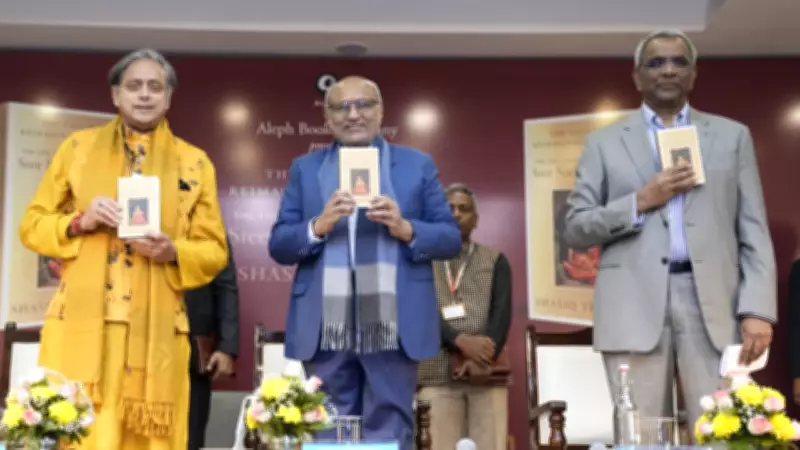
VP Radhakrishnan Decries Global Gap in Recording Indian Philosophers Like Narayana Guru
Vice President CP Radhakrishnan expressed deep concern on Thursday, lamenting that the profound contributions of Indian philosophers and social reformers, particularly Sree Narayana Guru, have not been adequately documented in international languages. This oversight, he emphasized, has created a significant gap in global academic discourse, limiting worldwide understanding of India's rich intellectual heritage.
Book Release Aims to Bridge Global Divide
Radhakrishnan made these remarks while releasing a book titled "The Sage Who Reimagined Hinduism" by Congress MP Shashi Tharoor. He highlighted that this publication is poised to take India's cultural and spiritual legacy to a global audience, serving as a crucial step in addressing the documentation shortfall. The Vice President noted the book's special significance, as it was first unveiled at the Sivagiri Mutt, the hermitage founded by Narayana Guru himself.
"A visit to the Mutt provides the inspiration to treat everyone with equality and dignity," Radhakrishnan stated, underscoring the enduring relevance of the Guru's teachings in fostering social harmony.

Narayana Guru's Revolutionary Message
Radhakrishnan elaborated on Narayana Guru's emergence as a spiritual guide during a period when caste divisions and social discrimination were deeply entrenched in Indian society. He praised the Guru's immortal message: "One Caste, One Religion, One God for Humankind." According to the Vice President, this was not merely a spiritual proclamation but a revolutionary call for equality, dignity, and universal brotherhood that challenged the status quo.
Tharoor on Guru's Limited Global Recognition
Shashi Tharoor, the author, echoed these sentiments, expressing regret that despite the universal resonance of Narayana Guru's message, he remains largely unknown outside Kerala. Tharoor provided historical context, describing 19th-century Kerala as a place where caste prejudices were so severe that Swami Vivekananda had famously labeled it a "lunatic asylum."
In such a challenging environment, Narayana Guru undertook bold social reforms that fundamentally shook up society. Tharoor credited these efforts with transforming Kerala into what is now regarded as the most progressive state in India, highlighting the lasting impact of the Guru's work on social justice and equality.
This event underscores a broader call for enhanced global documentation of Indian philosophical contributions, aiming to enrich international academic and cultural exchanges.