

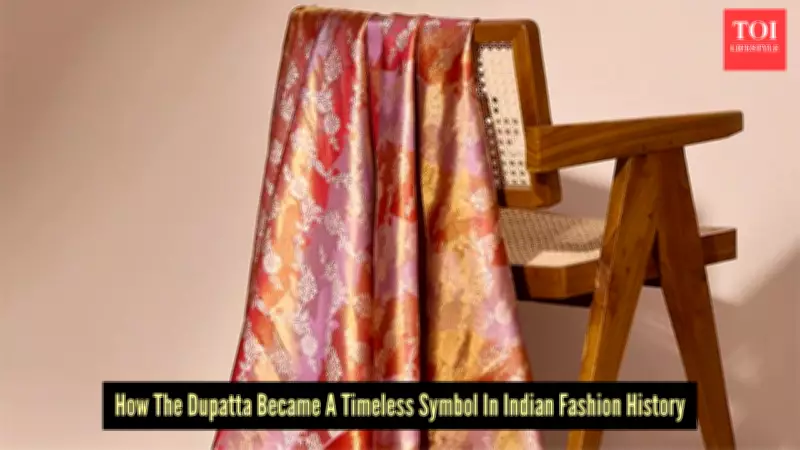
The Surprising 3,000-Year History of the Dupatta in Indian Fashion
Have you noticed the recent "Scandinavian Scarf" trend flooding social media platforms? This fashion involves taking a long, wide scarf, draping it across the shoulders, and casually tossing one end over the neck. For South Asians, this instantly rings a bell. The internet swiftly highlighted how this so-called innovative winter hack mirrors the centuries-old practice of draping dupattas. This online discussion, however, unveils a deeper narrative. We frequently wear dupattas—from elaborate festive lehengas to simple office kurtas—yet seldom ponder their origins. The true history is a remarkably intricate tale spanning 3,000 years, woven with threads of ancient trade, royal influence, and significant patriarchal undertones.
It Wasn't Always a "Woman's" Garment
Let's journey back over three millennia to the Indus Valley Civilization. The famed "Priest-King" sculpture provides visual evidence, showcasing a distinct chaddar-like cloth draped over the shoulder. The term "dupatta" itself derives from Sanskrit: Du (two) and Patta (strip of cloth). During the Vedic period, it was known as an uttariya. Interestingly, it was a completely unisex, unstitched cloak worn by both men and women for protection against the elements and to uphold modesty. In those times, society placed greater emphasis on the manner of folding and draping the fabric rather than the material itself.
The Mughal Era Transformed the Dupatta
For centuries, the dupatta remained a highly practical garment. The arrival of the Mughals, however, ushered in a dramatic luxury transformation. Influenced by Persian aesthetics, the royal courts introduced opulent fabrics such as rich silks, plush velvets, and intricate brocades. Women of nobility, spanning both Hindu and Muslim communities, utilized the dupatta to adhere to the purdah system of modesty. Yet, they defiantly refused to remain inconspicuous. Instead, they elevated the fabric into the most striking element of their attire, adorning it with pearls, precious stones, heavy embroidery, and elaborate zari work using gold and silver threads. Thus, the dupatta evolved from a basic cover-up into a masterpiece of wearable art.

The Heavy Burden of 'Izzat'
Discussing the dupatta necessitates examining its complex relationship with gender norms. For generations, this simple cloth became synonymous with a family's izzat, or honor. Society employed it to perpetuate a specific "good woman" stereotype, where covering the head or chest was not merely a stylistic choice but a demanded demonstration of a woman's purity, dignity, and respect for elders. Fortunately, contemporary urban fashion has rewritten this narrative. While the dupatta is still draped over the head as a gesture of respect in temples, mosques, and gurdwaras, outside these sacred spaces, it has largely transitioned. No longer a compulsory modesty tool, it now serves as an optional medium for personal style expression.
A Wearable Map of Indian Weaves
As the dupatta spread across the Indian subcontinent, local artisans imbued it with regional identities. Today, exploring different dupatta styles is akin to reading a map of India's rich craftsmanship. Consider the following regional specialties:

- Punjab's Phulkari: Characterized by bold, geometric floral threads.
- Varanasi's Banarasi: Renowned for luxurious gold and silver zari weaves.
- Gujarat and Rajasthan's Bandhani: Featuring precise dotted tie-dye patterns.
- Lucknow's Chikankari: Offering elegant, textured white-on-white embroidery.
- Andhra Pradesh's Kalamkari: Showcasing hand-painted or block-printed cottons with detailed mythological motifs.
Enter Bollywood and the Wind Machines
By the late 20th century, Bollywood redefined the dupatta's cultural significance. For those who grew up in the 1990s, the imagery is iconic: directors famously utilized sheer chiffon dupattas, employing massive wind machines to create dramatic, billowing effects on screen. This transformed the dupatta into the ultimate symbol of cinematic romance and a glamorous, essential accessory. This brings us full circle to the "Scandinavian Scarf" debate. While it is frustrating to witness global fashion appropriating an ancient tradition without acknowledging its roots, perhaps the controversy served a positive purpose. It reminded us that the dupatta hanging in our closets is not merely a matching accessory but a 3,000-year-old survivor of cultural evolution.





