

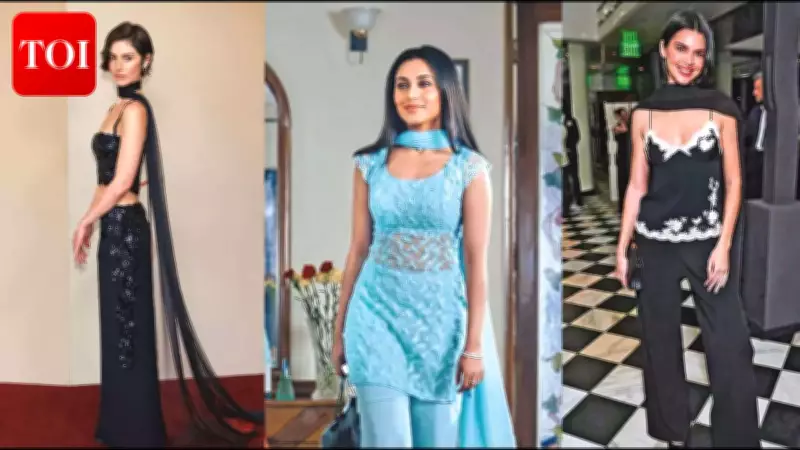
Hollywood's Scarf Trend Echoes Bollywood's Iconic Dupatta Style
Kendall Jenner recently made a striking appearance at a Dior pre-Oscars party, wearing a black camisole paired with a long, flowing scarf. The ensemble immediately drew attention for its uncanny resemblance to the classic Indian dupatta, a staple of traditional salwar-suit outfits. The internet was quick to highlight this similarity, sparking widespread discussion about cultural influences in global fashion.
Celebrities Embrace Scarf-Styled Outfits at Academy Awards
Following Jenner's appearance, numerous other celebrities were spotted adopting similar scarf-draped looks during the Academy Awards festivities. Bella Hadid, Gracie Abrams, and Lux Pascal all showcased outfits that featured scarves styled in ways that evoked the elegant drape of an Indian dupatta. For viewers familiar with Bollywood cinema, these moments felt instantly recognizable, reminiscent of iconic scenes featuring stars like Kareena Kapoor, Kajol, Rani Mukerji, and Aishwarya Rai Bachchan gracefully wearing dupattas in song sequences and dramatic narratives.
Is Hollywood Borrowing from Bollywood?
While it might be tempting to conclude that Hollywood is directly borrowing from Bollywood, the reality is more nuanced and layered. The pairing of scarves with dresses actually draws from multiple fashion histories that have evolved independently yet converged in contemporary style.

In Western fashion, the use of scarves as elegant accessories dates back to mid-century Hollywood, where icons like Audrey Hepburn and Grace Kelly popularized silk scarves paired with clean, tailored silhouettes. This look was later embraced and refined by luxury fashion houses such as Dior and Hermès, becoming synonymous with understated sophistication.
In Indian fashion, the dupatta-and-dress combination became a defining aesthetic of Bollywood in the late 1990s and early 2000s. Recently, this style has resurfaced on social media platforms like TikTok under the label "Scandinavian scarves," with many users noting its striking similarity to traditional dupatta draping techniques.
Celebrity stylist Chandni Sareen offers insight into this overlap: "Fashion constantly borrows, overlaps, and reinterprets. The dupatta has been worn in countless ways across India for generations, while scarf styling with outfits has long existed in Western fashion traditions."
Global Influence of Indian Fashion Elements
It comes as no surprise that Bollywood's distinctive styling has traveled far beyond India's borders. Global stylists have increasingly absorbed elements of Indian visual culture, incorporating these references into their fashion choices for international celebrities. Indian textiles, intricate embroidery, and unique draping techniques have significantly influenced numerous global trends, even when this influence is not always explicitly acknowledged.
Namrata Singh Dhakarey, an editorial and celebrity stylist, emphasizes this point: "Indian textiles, embroidery and draping have shaped many trends – even when the influence isn't always acknowledged."
Y2K Revival with a Bollywood Twist
Part of the current scarf trend is rooted in the broader Y2K fashion revival, which has brought back camisoles and slip dresses often paired with breezy scarves. This look was prominently featured in popular culture during the late 1990s and early 2000s, seen on characters portrayed by Jennifer Aniston and Lisa Kudrow in Friends, Miley Cyrus in Hannah Montana, and Isla Fisher in Confessions of a Shopaholic.
For Western audiences, this style evokes feelings of vintage nostalgia. However, for Indian viewers, the silhouette recalls something more specific – the character Poo, played by Kareena Kapoor in the Bollywood film Kabhi Khushi Kabhie Gham, who famously styled a dupatta over everything from traditional salwar suits to modern bralettes.
Celebrity fashion stylist Madhuri Singh notes: "The Y2K revival has brought back scarf styling that closely resembles the dupatta drape. But scarf dresses have also existed in Western fashion for decades, making it difficult to say Hollywood is simply copying India."

The Enduring Appeal of Effortless Style
The current styling mirrors the classic '90s dupatta drape that was commonly worn by previous generations in India. This look was characterized by its unfussy and effortless nature, where the dupatta was simply considered an integral part of the outfit rather than a separate accessory. It is this very ease and natural elegance that makes the style resonate so strongly in contemporary fashion.
Nishtha Parwani, a celebrity fashion stylist, reflects on this phenomenon: "Seeing it now on Gracie Abrams feels quietly nostalgic – like a slice of everyday Indian dressing slipping into global street style."
The convergence of these fashion traditions highlights how global style evolves through cultural exchange and reinterpretation, creating looks that feel both familiar and fresh to diverse audiences worldwide.





