

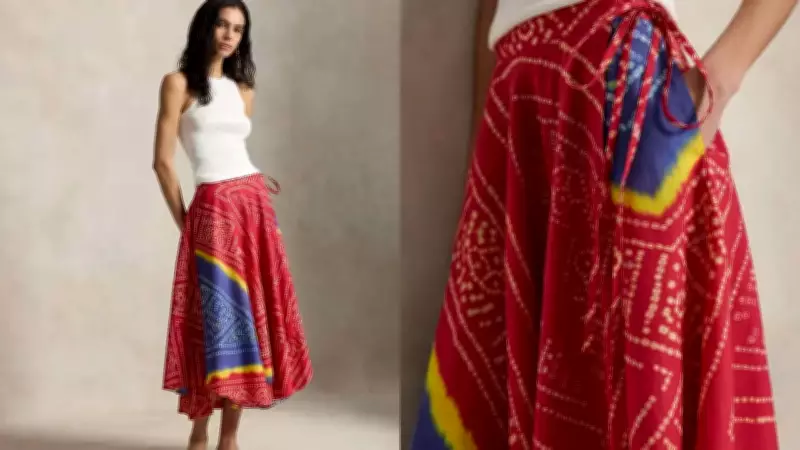
Ralph Lauren's Bandhani Skirt Ignites Global Debate on Cultural Appropriation
In the high-stakes world of luxury fashion, the line between inspiration and appropriation often blurs, creating tensions as gripping as a cinematic thriller. As global brands increasingly draw from diverse cultures, the question arises: when does homage cross into exploitation? This debate has recently flared up around Ralph Lauren, a renowned fashion house, following the launch of a controversial skirt that has sparked outrage among Indian communities worldwide.
The Controversial Skirt: A Case of Misappropriation?
Ralph Lauren introduced a 'Print Cotton Wrap Skirt' under its Polo line, priced at Rs44,800. Marketed with a 'Tie-Dye Multi' color scheme, the brand described it as 'beautifully draped' and featuring a 'vibrant design inspired by traditional Bandhini tie-dye techniques and motifs.' However, this description did little to quell the storm of criticism that ensued. Digital creator Radha Patel, of Indian origin, took to Instagram to voice her concerns, highlighting that the skirt uses printed fabric rather than authentic Bandhani craftsmanship. She argued that the cost of the material should not exceed Rs2,000-3,000 per meter, making the final price tag exorbitant. Patel emphasized that the brand should have credited the inspiration explicitly, such as labeling it 'India-inspired Bandhani.'
Online reactions echoed her sentiments, with one user quipping, 'That looks like if bandhani print was made with a bad AI slop prompt.' Another added, 'The audacity to copy another country's culture and mess it up so badly.' Many pointed out the injustice of turning traditional art into fast fashion without compensating the artisans, with one comment stating, 'It’s high time the art and design of India should be given due credit.'

Bandhani: A Timeless Art Form
Bandhani is an ancient textile art involving tying and dyeing fabric to create intricate patterns, with roots tracing back to the Indus Valley Civilization around 4000 BCE. Today, it thrives in regions like Gujarat and Rajasthan, with production hubs in Anjar, Mandvi, Pethapur, Udaipur, Porbandar, Rajkot, Jaipur, Bikaner, and Jetpur. This technique is applied to various fabrics, including georgette, silk, cotton, and chiffon, showcasing India's rich cultural heritage. The controversy underscores how such traditional crafts are often commodified without proper acknowledgment or fair economic benefits to the communities that preserve them.
A Pattern of Appropriation in Luxury Fashion
This incident is not isolated in the fashion industry. Ralph Lauren itself faced previous scrutiny when models wore dome-shaped bell earrings resembling Indian jhumkas at its Fall 2026 runway show during Paris Fashion Week. Other luxury giants have also been implicated: Prada released T-strap sandals inspired by Kolhapuri chappals, only admitting the influence after public backlash. In July 2025, Dior was criticized for a $200,000 ivory and gold houndstooth coat featuring traditional Indian mukaish embroidery from Lucknow, failing to credit the 12 artisans who spent 34 days crafting it.
As India's global influence grows—shaping not only geopolitics but also soft power—its cultural assets are increasingly tapped by international brands. However, this 'inspiration' often lacks the necessary credit and respect, leading to calls for greater accountability. The fashion world must navigate this delicate balance, ensuring that cultural exchanges are ethical and mutually beneficial, rather than exploitative.
The ongoing debate highlights a critical issue in contemporary fashion: while cultural diversity can fuel creativity, it must be approached with sensitivity and integrity. Brands like Ralph Lauren are urged to move beyond superficial nods and engage in meaningful collaborations that honor and uplift the origins of their inspirations.

