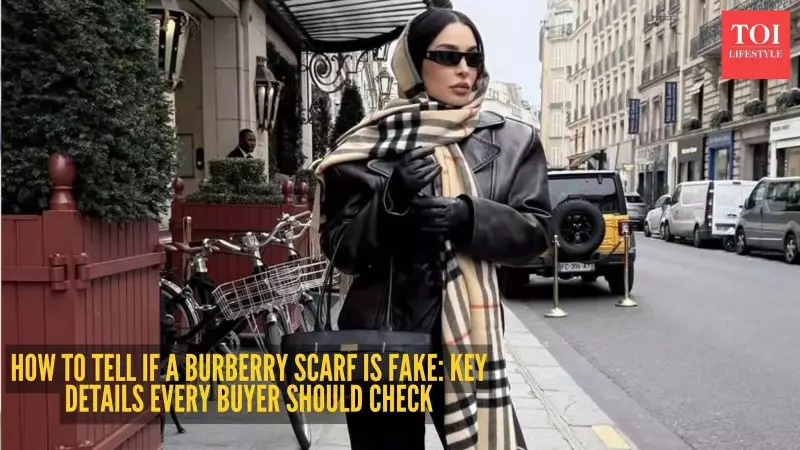
The classic camel, black, and red tartan pattern stands as one of winter's most recognizable accessories. Burberry's Nova Check has evolved far beyond a simple design. It now represents a powerful symbol of heritage luxury. People drape it over trench coats or knot it loosely around jumpers to signal their taste. However, iconic status attracts countless imitations. The market overflows with "first copies" and "super-fakes" claiming to match the original. If you're hunting through vintage shops or online platforms for that perfect winter piece, you must know what distinguishes the real from the fake. Authenticating luxury fashion requires forensic attention to tiny details, not just general impressions. Here is your comprehensive guide to ensuring your cashmere investment is genuine.
The Nova Check: Why Precision Matters Absolutely
The pattern itself often provides the first clue. Burberry builds its reputation on exacting standards, where symmetry is mandatory, not optional. Fold the scarf lengthways. The iconic Nova Check should mirror itself perfectly. If the lines appear disjointed or chaotic, you should immediately return it to the rack. Examine the finer details closely. On an authentic piece, these details are razor-sharp and distinctly perpendicular. Fakes frequently reveal themselves through "bleeding" dye or jagged, uneven edges that lack a crisp, high-definition finish. Also, check the pattern alignment at the edges. In genuine designs, the pattern doesn't just "run off" randomly. It follows the weave structure, typically with black stripes running horizontally to meet the fringe.
The Label Test: Spotting the 'Kickstand' R
Once the pattern passes visual inspection, move to the label. Counterfeiters often get lazy here. The woven brand label holds the authentication's "secret handshake": the font. Focus specifically on the capital 'R' in BURBERRY. On a real scarf, the right leg of the 'R' kicks outward at the end, resembling a bicycle kickstand. This subtle curl is crucial. On fake scarves, that leg usually drops straight down or lacks the distinct curve. Additionally, inspect the stitching. The label should be secured neatly, often with just two threads at the top corners or perfectly even stitching on all four sides. Walk away if you see messy, continuous thread or uneven spacing.

The Fabric Feel: Cashmere Density and the 'Halo' Effect
Authentic Burberry scarves typically use 100% cashmere, unless stated otherwise. Cashmere behaves very differently from the viscose or low-grade wool blends common in dupes. Perform a tactile test first. The fabric should feel dense and substantial, not thin or flimsy. It should not scratch your skin. Then, hold the scarf up to a light source. High-quality cashmere exhibits a "halo" effect, a fine, fuzzy haze of fibers on the surface. Fakes often reflect light differently, appearing flat, shiny, or overly slick due to synthetic content.
Finishing Touches: Tassels and the Vintage 'S'
Finally, inspect the extremities carefully. The fringe on a genuine piece is meticulously constructed. Think of tightly twisted coils that resemble sealed ropes, not loose threads. They do not unravel, and they are always cut to a uniform length. If the fringe looks ragged, uneven, or simply sliced with scissors, it's a fake. Also, don't be alarmed if you discover a gem labelled "Burberrys." Before 1999, the brand used an 's' at the end of its name. A vintage scarf with "Burberrys" made in Scotland could be a rare authentic find. However, if a modern-looking label tries to use the old name, or vice versa, you're definitely looking at a counterfeit.
In today's world of fast fashion, purchasing a true heritage piece represents a significant investment. Take your time to inspect every detail meticulously. True luxury always reveals itself in the fine print.