

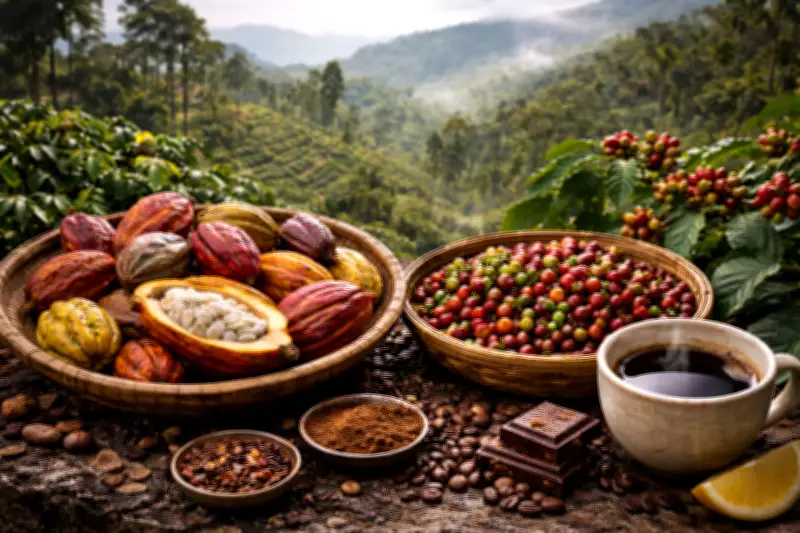
The Deep Roots of Coffee and Cocoa in India's Southern Hills
Long before modern café culture swept through India's urban centers, the verdant hills of the south were already steeped in the rich aromas of roasting beans. Coffee and cocoa, two crops with origins far from Indian shores, found a welcoming home here through a complex interplay of faith, commerce, and colonial experimentation. Their journey from foreign imports to integral components of India's agricultural and cultural landscape is a testament to adaptation and tradition.
The Pioneering Journey of Coffee in India
The story of Indian coffee begins in the 1600s with Baba Budan, a Sufi saint who returned from Yemen with seven precious coffee beans concealed in his robe. He planted these beans on the slopes of Chikmagalur in present-day Karnataka, initiating India's first encounter with what would eventually become a beloved morning ritual across the nation.
Under British colonial administration, those initial seven beans multiplied into extensive plantations that transformed entire regions. The misty hills of Coorg, Wayanad, and the Nilgiris became carpeted with coffee bushes thriving under the protective shade of silver oak trees, creating landscapes where the air carried distinct notes of wet foliage and roasting potential.

Over generations, coffee transcended its colonial origins to become deeply embedded in daily life. From the strong decoction filtered through traditional steel devices in Tamil households to the steaming cups served in historic Bengaluru cafés, coffee quietly wove itself into the fabric of Indian society.
Today, India stands among the world's leading coffee producers, celebrated particularly for its shade-grown, environmentally sustainable beans. Cultivated slowly beneath forest canopies, these beans develop unique flavor profiles—slightly sweet, subtly smoky, and imbued with the essence of monsoon rains—that reflect their terroir.
The Quiet Arrival and Rise of Cocoa
Cocoa's introduction to India occurred more quietly in the early twentieth century, when British agriculturalists sought complementary crops to grow alongside established coffee and spice plantations. Kerala's warm, humid climate proved ideal for cocoa cultivation.
Farmers began integrating cocoa trees beneath existing coconut and areca nut canopies, allowing the crop to flourish in filtered sunlight. For many decades, Indian cocoa primarily supplied the industrial chocolate manufacturing sector, with little attention to artisanal quality.
Recently, however, a transformation has been unfolding across Kerala, Andhra Pradesh, and Karnataka. Small-scale farmers have begun applying meticulous care to fermentation and drying processes, treating cocoa with the same reverence accorded to fine wine or specialty coffee. They trace each batch to its specific farm of origin, creating traceable, high-quality beans.
These carefully cultivated beans now form the foundation of India's burgeoning craft chocolate movement, appearing in handcrafted bars enhanced with traditional ingredients like jaggery, pepper, or sea salt. What was once a secondary crop grown almost invisibly has emerged as the heart of India's artisanal chocolate renaissance.
Converging Paths: Shared Soil and Shared Stories
Though coffee and cocoa originated on opposite sides of the globe, they now share remarkably similar ecological niches in India. Both thrive under shaded conditions, depend on monsoon rains, and flourish in the region's characteristic red soil. Both require patient cultivation and skilled hands throughout their production cycles.
More significantly, both have evolved from colonial commodities into emblems of Indian agricultural craftsmanship and entrepreneurial spirit. Today, their stories sometimes literally blend in the same cup—as in mocha beverages crafted from locally sourced beans, served in Bengaluru's specialty cafés or Kodagu homestays.
The relationship between growers and artisans has deepened considerably. Farmers who previously sold their harvests to anonymous bulk buyers now collaborate directly with specialty roasters and chocolatiers, transforming commercial transactions into creative partnerships that elevate quality and recognition.

Cocoa and coffee did not merely arrive in India's hills; they truly belonged. The monsoon air that once carried primarily the scent of spices like cardamom now also hums with the aromas of roasting beans and quiet, determined ambition. Somewhere between Chikmagalur's coffee estates and Idukki's cocoa farms, between a carefully pulled espresso and a square of complex dark chocolate, one can taste this remarkable narrative—the story of how two foreign beans found a permanent home, and how India gradually, gracefully made them entirely its own.
