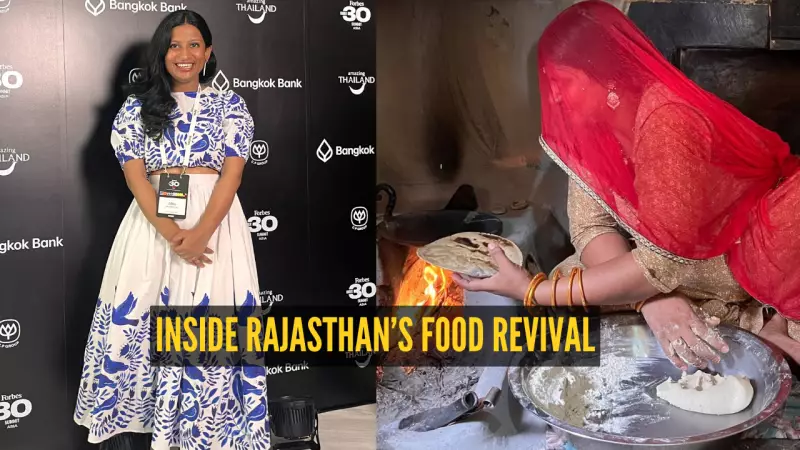
What began as casual documentation of rural Rajasthan's arts and crafts seven years ago has transformed into a monumental culinary preservation movement, earning Jaipur-based Dipali a coveted spot on the Forbes 30 Under 30 Asia list. Her unexpected journey into food anthropology started not with ambition, but with simple curiosity about the meals shared during her fieldwork.
The Accidental Discovery That Changed Everything
While working with folk musicians and weavers in villages like Manpura Macheri, just 45 minutes from Jaipur, Dipali noticed a puzzling pattern. Households consistently served what they considered "special" dishes - aloo-chhole, puri, kheer, festive rice dishes, and aloo parathas - to honor their city guest. Yet something didn't add up for someone who grew up in a Marwari household where rice was occasional and mostly sweet.
The turning point came during a sweltering June day when Dipali politely declined the elaborate spread. She noticed the host's son quietly eating chhach-roti - fermented leftover rotis soaked in bilona buttermilk with onions and mint. When she asked to try it, the woman resisted, calling it "labourers' food" not meant for city guests.

"That moment hit me like a punch," Dipali recalls. "This is what we do to everything that is ours - we make it inferior, and make the outside world aspirational." She recognized the same pattern in urban homes where traditional bajre ka khichda had been replaced by restaurant noodles and ghee-heavy festive foods by pizza.
Building The Kindness Meal Movement
What started as questions about "everyday food" evolved into a full-fledged cultural mission. Dipali began asking grandparents about forgotten dishes and discovered that some foods were so stigmatized that people hesitated to admit eating them at all.
In 2022, she hosted a one-off dinner called The Kindness Meal - a five-course menu mapped to the five senses showcasing Rajasthan's regional produce as art. What was meant to be a single event instead became the seed of a growing movement.
As she traveled deeper into Rajasthan's diverse regions - Shekhawati, Ganganagar, Hanumangarh, Sirohi, Jalor, and villages bordering Pakistan - her purpose crystallized. She discovered that Rajasthan's cuisine was never singular, despite the world's fixation on dal-bati and ker-sangri.
Her documentation revealed extraordinary regional specialties: water chestnut pickles in Dholpur, Sindhi-influenced cooling seeds used in Ramadan halwas, and the cactus-like succulent Thor ki Paatdi whose tangy flowers made extraordinary pickles and joint-pain remedies. Some ingredients, like the walnut-like seeds of bandar ki roti, had been reduced to childhood memories.
Preserving Rajasthan's Culinary Legacy
Today, Dipali has systematically mapped Rajasthan into nine cultural zones based on geography, vegetation, and language. Her team has documented 65 rare ingredients and over 10,000 recipes, building a digital repository that will list ingredients, their histories, and linked recipes while crucially bringing visitors to the communities themselves.
"Recipes online don't tell you that kumatiya has to be soaked overnight, or that its water must be drained four times," she explains. "But when you cook in someone's home, you understand the wisdom behind it."
Her immersive experiences include food walks exploring Muslim cuisine in Jaipur, journeys to Jain and Baniya kitchens, foraging trails for desert greens, and village stays where guests eat only what the host family eats - all designed to collapse the distance between people and their food heritage.
The Fight Against Culinary Homogenization
For Dipali, the real threat isn't modernization but homogenization. "When five people from five different cultures realize quinoa salad is their go-to dinner, you know something has been lost," she states.
Her Forbes 30 Under 30 recognition represents not just personal achievement but a spotlight on India's fragile, magnificent culinary diversity. "Every region is a country in itself," she emphasizes. "If we don't protect our everyday food, we lose who we are."

Through seven years of dedicated work, Dipali has transformed from an arts professional into a culinary guardian, proving that the most powerful movements often begin with simple curiosity about the stories simmering in everyday meals.