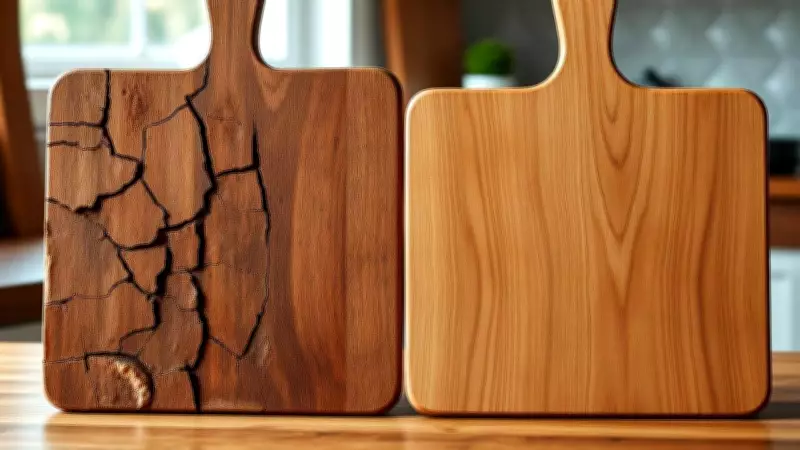
The Enduring Appeal and Hidden Challenges of Wooden Cutting Boards
A solid wood cutting board gracing your countertop is more than just a kitchen tool; it embodies durability, gentleness on expensive chef knives, and a touch of natural beauty. However, this timeless piece can quickly become a source of frustration if neglected, as fine cracks develop at the edges or subtle tremors are felt during slicing. Many attribute such damage to natural wear or poor wood quality, but the true culprit lies in a physical mechanism activated during washing and drying cycles.
The Mechanism Behind Wood Fiber Separation
Wood is composed of microscopic tubes that facilitate water transport, and even after crafting into a board, its cells retain moisture-absorbing abilities. The constant cycle of absorbing humidity from the air and releasing it upon drying leads to gradual fiber separation. When soaked in soapy water, wooden fibers swell like sponges, then evaporate during drying. The issue arises because wood is not isotropic; its surface dries faster than the dense core, creating significant mechanical tension. This stress triggers crack formation and a phenomenon known as cupping.
A study published in the journal Building and Environment tested various wood species under repeated wet-dry conditions, revealing that this process imposes considerable structural stress. The research indicates that thicker boards are more durable than thin ones, but even the most solid wood will degrade with continuous water movement. Each drying cycle separates wood cells, and once cracks form, they trap food particles and moisture, compromising hygiene.

Why Wood Outperforms Plastic in Hygiene Tests
Despite maintenance needs, professional chefs often prefer wood for reasons beyond aesthetics. The debate over wood being less hygienic than "non-porous" plastic is ongoing, but wood's natural properties give it an edge. According to the study Hygienic Evaluation of Wooden Cutting Boards, wood reduces bacterial populations effectively; experiments showed significant decreases in common bacteria like E. coli on wooden surfaces quickly, partly due to moisture regulation creating a hostile environment for microbes.
In contrast, plastic boards develop deep cuts that harbor bacteria and lack natural antibacterial traits. For wood to remain hygienic, smoothness and impermeability are crucial; once dry and cracked, it loses these qualities as cracks are too deep for regular sanitizing.
How to Safely Re-Hydrate Your Wooden Cutting Board
Re-hydration doesn't mean cutting back on cleaning but adopting protective measures against drying. The most effective method involves using mineral oil or a wax and food-grade oil blend, allowing the wood to absorb nutrients for long-term integrity. Start by thoroughly cleaning and drying the board, then apply ample oil and let it soak overnight. If it appears dry or patchy the next day, reapply; monthly applications ensure water resistance.
By understanding the biological and physical needs of wooden tools, you can extend their lifespan by decades. This minor trade-off—spending a little time oiling—yields a more hygienic, knife-friendly, and durable kitchen surface.