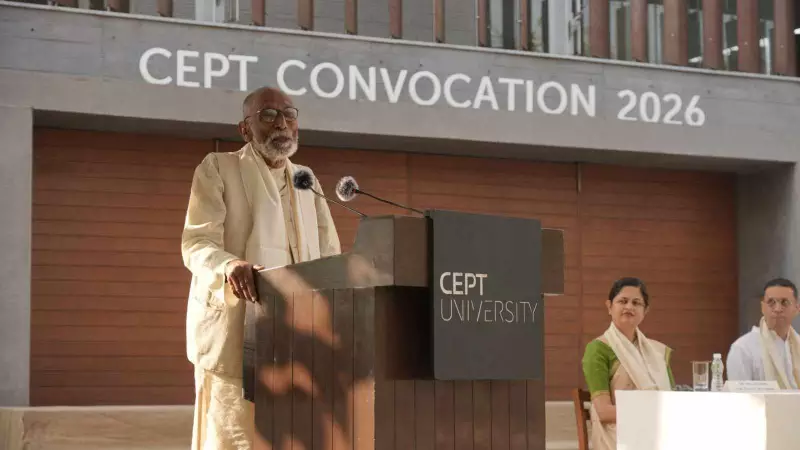
Public architecture forms lasting memories that people cherish deeply. This was the core message from Prof Ashoke Chatterjee, former executive director of the National Institute of Design (NID). He spoke at the 20th convocation of CEPT University in Ahmedabad on Saturday.
Design Must Show Care for Future Generations
Chatterjee stressed that design and architecture fundamentally revolve around caring. He urged the new graduates to surpass the efforts of his own generation. "At the end of the day, design and architecture has to be about caring," he said. "So you have to care, and do better than what my generation has done for you."
Architecture's Emotive Power in Public Spaces
The professor highlighted how public architecture evokes strong emotional connections. It endures in collective memory as something precious. He shared personal experiences to illustrate this point.

The Ashoka Hotel Color Controversy
Chatterjee recalled his work with the India Tourism Development Corporation (ITDC) in the early 1970s. The ITDC believed design would attract travelers to India. Its trademark was The Ashoka Hotel in Delhi.
"The Ashoka Hotel was built long before ITDC was established," he noted. "It was a strange building, iconic in its own way. Everybody loved to hate it."
When management experts suggested changing the hotel's color, cranes arrived for whitewashing. This sparked public outcry. "The whole city said… don't touch that building. Let it be pink, don't touch it," Chatterjee remembered. "We realized that this pink color we thought the public disliked was actually precious."
Conservation Challenges at IIM Ahmedabad
In 2008, Chatterjee joined the building committee of the Indian Institute of Management Ahmedabad. He found the business school acting as trustee for the Louis Kahn campus, a world-class architectural expression.
"IIM was not set up for conservation of architecture," he observed. "But it was stuck with this task. I don't know any other example of the investment IIM made in trying to preserve, protect and take forward the legacy of Louis Kahn."
The Gandhi Ashram Development Dilemma
Chatterjee turned to the Gandhi Ashram, describing it as a sacred space. Plans to develop it as a world-class tourist destination raised concerns about preserving its sanctity.
He contrasted this with the 2017 demolition of Delhi's Hall of Nations. "Bulldozers were brought in stealthily at night," he said. "A building recognized by the Museum of Modern Art as a masterpiece was leveled."
Regarding the ashram, he noted, "We were getting advice which had nothing to do with Gandhiji's ethos. It was a concept of world-class progress."
A Personal Midnight Experience at Hridaykunj
Chatterjee shared a poignant memory from December 31, 1999. He went to Gandhi Ashram at midnight, expecting some activity. Instead, he found himself alone at Hridaykunj.
"There was nobody else there, even the chowkidaar," he recalled. "Just the sense of history, of this place, of the humanity and decency it represented."
During that quiet moment, news played on a radio about a plane hijacking to Kandahar. The tension made him reflect on Washington burning after Martin Luther King Jr.'s assassination. An American journalist had written about Washington needing to remember Mahatma Gandhi as the "Taj Mahal of humanity" of love and peace.
CEPT University Celebrates Student Achievements
During the convocation proceedings, CEPT University President Prof Barjor Mehta announced degree awards for 589 students. This included 1 PhD, 392 postgraduate students, and 196 undergraduate students. Additionally, 45 students received medals for special achievements.
The event highlighted how educational institutions nurture future professionals who will shape our built environment. Chatterjee's words served as both inspiration and caution for these emerging designers and architects.