Have you ever spotted a group of crows congregating noisily around a dead bird and wondered what was happening? This common sight, often poetically called a 'crow funeral,' is a captivating behaviour displayed by corvids, a family that includes crows, ravens, magpies, and jays. Far from a simple act of grief, scientists now understand this ritual as a sophisticated survival strategy rooted in the remarkable intelligence and social bonds of these birds.
What Exactly Happens During a Crow Gathering?
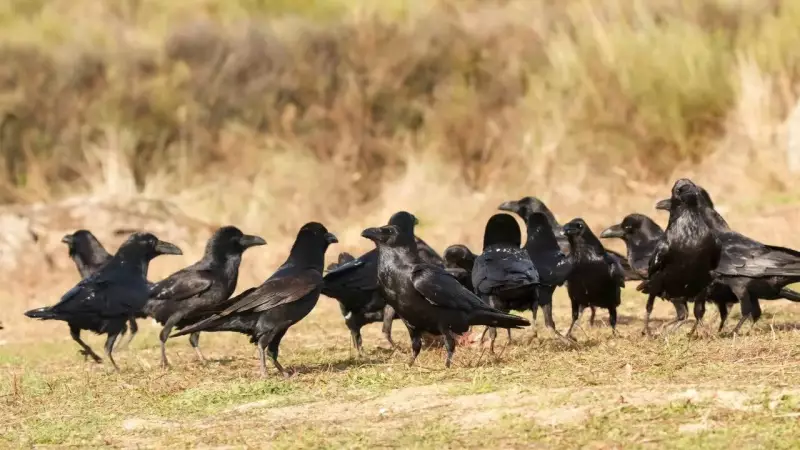
The event is triggered when a crow discovers the body of another crow. The finder typically lets out a series of loud alarm calls or scolds to signal danger. This call acts as a powerful summons, quickly assembling other crows from the vicinity. The gathered group then engages in a loud, raucous assembly that can last for 15 to 20 minutes or even longer.
During this time, the birds call incessantly while intently observing their surroundings. After this period of intense vocalisation and environmental scrutiny, the group usually disperses. This specific behaviour is consistently observed in both wild and urban crow populations. Crucially, crows do not react this way to dead birds of other species, like pigeons, highlighting that the response is uniquely tied to their own kind.

Is It Mourning or a Survival Lesson?
While it's tempting to view this as an avian form of mourning, researchers caution against such human comparisons. The field studying death-related behaviours in these birds is known as corvid thanatology. Evidence suggests the crows' response is more about information processing than emotion. Brain imaging studies have shown that seeing a dead crow stimulates areas of the brain linked to decision-making and memory, indicating a cognitive, not automatic, reaction.
One of the strongest explanations comes from research led by ornithologist Kaeli Swift and her colleagues at the University of Washington. Their work, noted on PubMed, indicates that these gatherings serve critical functions in social learning and danger assessment. The crows rarely touch the dead body, focusing instead on alarm calls and recruiting others, which points to a motivation driven by threat response rather than feeding or social bonding.
The Long-Term Impact: Learning and Remembering Threats
The implications of these 'funerals' extend far beyond the immediate gathering. Crows demonstrate an impressive ability to learn and remember associated risks. Following such an event, they become more wary when foraging near the location of the death. In famous experiments, some crows even learned to recognise specific human individuals (identified by masks) present at a death scene and subsequently acted aggressively toward them.
This behaviour offers clear evolutionary advantages. By gathering and vocalising at a death site, crows effectively sound a community alarm about potential threats. They share vital information about location-based hazards and teach younger, less experienced birds what dangers to avoid. This collective intelligence contributes to higher survival rates within their social groups.
Ultimately, the so-called crow funeral is a powerful reminder of the complexity of animal behaviour. It underscores that intelligence and sophisticated social strategies are not solely human traits. These rituals, grounded in information gathering, threat assessment, and communal learning, reveal just how adeptly birds like crows navigate and interpret the challenges of their world.