5 Legendary Asian Landmarks Named After Animals
Across Asia, many famous landmarks get their names from animals. These names often come from local legends, the shape of the landscape, or the wildlife living there. These places have become icons because the animals they are named after are central to their stories. Here are five truly iconic landmarks in Asia that carry animal names, each famous for its cultural, geographical, or conservation importance.
Tiger’s Nest Monastery (Paro Taktsang), Bhutan
Perched dramatically on a sheer cliff about 900 meters above the Paro Valley, Tiger’s Nest Monastery stands as Bhutan's most recognizable landmark. It is also one of the most spiritual sites in the Himalayas. The monastery's name comes from a powerful legend in Bhutanese Buddhism. According to the story, Guru Padmasambhava flew to this site on the back of a tigress. He meditated in a cave that now forms the heart of the complex.
The trek to Tiger’s Nest is considered very challenging. Hikers pass through pine forests adorned with prayer flags. Beyond its physical beauty, the monastery symbolizes the deep connection between Bhutanese spirituality, nature, and animals. Today, Tiger’s Nest Monastery ranks among the world's most photographed landmarks.

Tiger Hill, Darjeeling, India
Tiger Hill is one of India's most famous viewpoints. It is an essential stop for anyone visiting Darjeeling. Situated at an altitude of over 2,500 meters, Tiger Hill is renowned for its stunning sunrise views. During sunrise, the snow-clad peaks of Kanchenjunga glow with a golden hue. On exceptionally clear mornings, visitors can even spot Mount Everest in the distance.
Over the decades, this viewpoint has become synonymous with Darjeeling itself. It draws thousands of visitors each year. More than just a scenic lookout, Tiger Hill has grown into a cultural landmark of the eastern Himalayas.
Komodo National Park, Indonesia
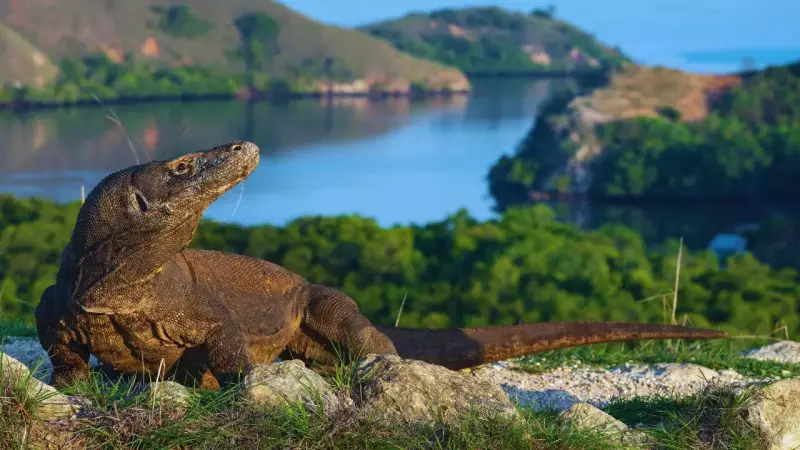
Komodo National Park stands as one of Asia's most important wildlife destinations. It is also a globally recognized conservation site. The park takes its name from the Komodo dragon, the world's largest living lizard. This ancient species can grow over three meters long and weigh more than 70 kilograms.
Komodo National Park protects the only natural habitat of the Komodo dragon. Declared a UNESCO World Heritage Site, the park spans several rugged islands and surrounding marine areas. This makes it equally famous for its rich underwater biodiversity.
Elephant Rock (Jabal AlFil), AlUla, Saudi Arabia
Elephant Rock, known locally as Jabal AlFil, is one of West Asia's most iconic natural sights. It majestically rises from the desert dunes in AlUla. Over millions of years, wind and water carved the sandstone formation. It now resembles an elephant with its trunk touching the ground, hence the name.
In an area famous for ancient Nabataean tombs and archaeological marvels, Elephant Rock serves as a beacon in Saudi Arabia's growing tourism industry.
Monkey Forest (Sacred Monkey Forest Sanctuary), Bali, Indonesia
The Sacred Monkey Forest Sanctuary, located in Ubud, Bali, is one of Bali's most popular and unique sites. This forest is home to several long-tailed macaques, which give the forest its name. However, Monkey Forest is more than just an animal park.
The forest holds great religious significance for the Balinese people. Temples within the Monkey Forest are important points of worship. The macaques are seen as sentinels guarding this sacred area.