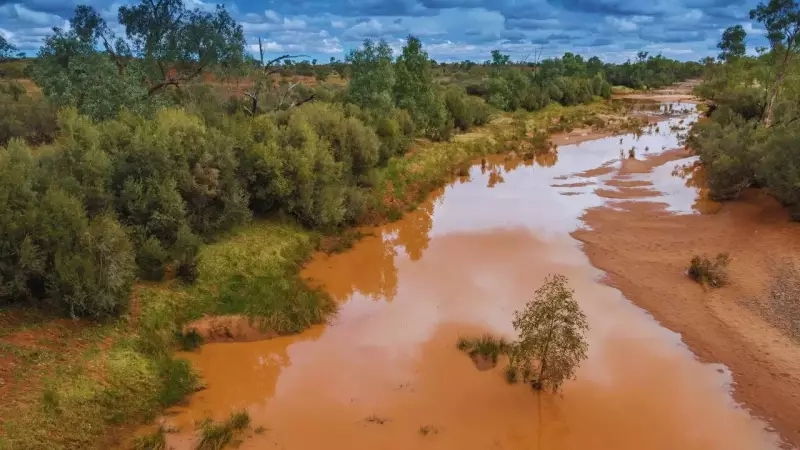
Deep within Australia's arid interior lies a river that challenges everything we know about waterways. For most of the year, the Finke River appears as nothing more than a sandy track dotted with occasional waterholes. Yet, geologists proclaim it as one of the planet's most extraordinary natural features, with an age that staggers the imagination.
A Geological Titan Defying Time
Flowing through the Northern Territory, the Finke River is estimated to be 300 to 400 million years old. This places its origins in a primordial era, long before dinosaurs walked the Earth around 230 million years ago. The river began its journey when Australia was part of the supercontinent Gondwana, alongside landmasses that would become India, Africa, and Antarctica.
Unlike permanent rivers, the Finke is ephemeral. It only flows after significant rainfall, often lying dormant and dry for extended periods. It originates in the MacDonnell Ranges west of Alice Springs and travels southeast, eventually disappearing into the sands of the Simpson Desert.

What Makes It So Ancient? The Antecedent River Theory
The claim of its extreme age is backed by compelling geological evidence. Scientists classify the Finke as an antecedent river. This means its course was established on a flat landscape before the surrounding MacDonnell Ranges uplifted around 300 million years ago. As the mountains rose, the river did not divert. Instead, it cut downward through the rising rock, carving spectacular gorges and maintaining its original path.
This process is visibly evident in places like Palm Valley, where the river has sliced through ancient sandstone, creating cliffs and crevices. This landscape is not just beautiful; it's a textbook example of the river's antiquity and persistence.
While the title of "world's oldest river" is debated—with contenders like the Nile and New River—the Finke's unique geological history and the evidence for its unchanged course make it a prime candidate.
More Than Rock: A Living Cultural Tapestry
The river's significance transcends geology. Known as Larapinta to the Western Arrernte people, the Traditional Custodians of this land, it is woven deeply into Aboriginal Dreaming stories, songlines, and cultural traditions. For tens of thousands of years, Indigenous communities have relied on its permanent waterholes for survival, navigation, and sacred ceremonies.
Thus, the Finke represents a dual timeline: a geological history spanning hundreds of millions of years and a human history stretching back tens of millennia. It is a living bridge between the deep past and present-day culture.
An Oasis of Life in the Desert
Despite the harsh, arid environment, the Finke River supports unique ecosystems. Its waterholes become crucial refuges for birds, reptiles, and mammals after floods. Palm Valley is famed for its Red Cabbage Palms, which grow hundreds of kilometres from their nearest relatives. Researchers believe these palms are relics of a wetter climate, preserved in the micro-environment of the river gorge.
A Lesson in Resilience and Perspective
The Finke River forces us to redefine what a river truly is. It demonstrates that a river's importance isn't solely defined by constant flow. The land remembers its course. In an era of climate change, the Finke stands as a testament to Earth's resilience, having survived continental shifts, mass extinctions, and the gradual drying of a continent.
Today, it faces modern threats from land degradation and tourism. Protecting it is about more than conserving water; it's about safeguarding a landscape that holds one of Earth's oldest stories. Often quiet and forgotten, the Finke River whispers secrets from a time before time, reminding us that the greatest narratives are sometimes written not in water, but in stone and memory.