China's Viral Hotpot Spa: A Bizarre Blend of Relaxation and Culinary Imagery
From its automotive prowess to its profound ancient heritage, China stands as one of the world's most developed nations with an exceptionally rich cultural tapestry. While the country has long captivated global tourists with attractions ranging from therapeutic hot springs to monumental historical wonders, a recent viral phenomenon has introduced an entirely unexpected dimension to Chinese tourism: the hotpot spa. This unconventional relaxation concept, featuring baths filled with chilli soup and milk, has left netizens worldwide both shocked and intrigued by its audacious approach to wellness.
The Hotpot Spa Experience: Yin-Yang Baths with Real Ingredients
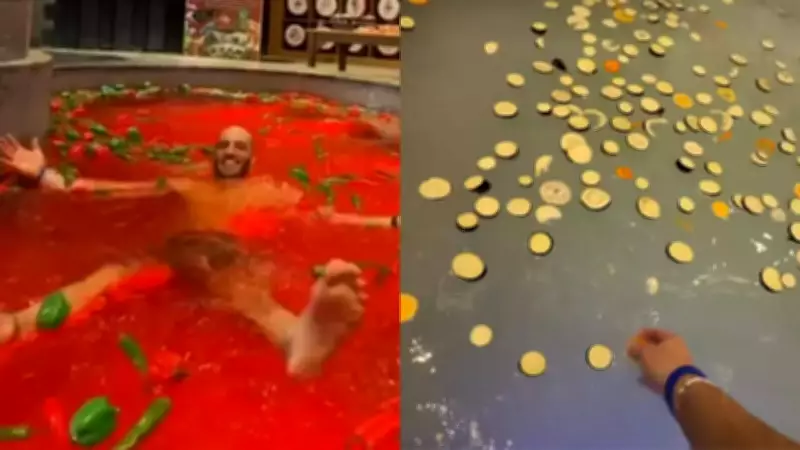
Could a hotpot spa genuinely serve as a form of relaxation? According to popular vlogger Jordan Egbert, whose Instagram video catapulted this attraction to viral fame, it's an absolute must-try experience. The footage showcases a distinctive spa located at the Maple Leaf Village Hot Spring Resort in Harbin, renowned as China's iconic ice city. The spa's design immediately captures attention with its yin-yang symbol (Taijitu) configuration.
One half of the circular bath contains vividly red-colored water, complete with authentic jalapenos and peppers floating visibly within. The contrasting half presents a milky, opaque bath infused with various vegetables including red dates and goji berries. Content creator 'counting.countries', who boasts 1.3 million followers, enthusiastically described the scene: "There is a hot pot spa in China, and it's the craziest thing I've seen. Not only is it filled with real Jalapenos and peppers, but the water is even red on one side, while the other is milky and filled with other vegetables, and that's just one of many spas here."

Remarkably, this unique experience comes at an accessible price point. The vlogger noted that visiting the spa costs merely $28, adding: "China's INSANE Hot Pot Spa. It only costs $28 to visit and there is so much to do in here!!"
Beyond the Hotpot: Maple Leaf Village's Array of Unique Attractions
The Maple Leaf Village Hot Spring Resort offers far more than just the headline-grabbing hotpot spa. Visitors can enjoy:
- A sensory pool filled with colorful Orbeez beads for floating and relaxation
- A traditional fish spa where tiny fish gently exfoliate dead skin from feet
- Various herbal and flower-infused pools designed for skin care benefits
- A dome sauna for heat therapy sessions
- Dedicated nap areas for post-spa relaxation
- An on-site food court for culinary refreshments
As the vlogger explained in his video, which has garnered over 101,000 views: "This spa is located in Harbin, China, which is also home to the world's largest ice festival, so, of course, there is an arctic spa indoors and a nice 103-degree hot tub outdoors among the snow."
Netizens React with Shock, Concern, and Excitement
The viral video has sparked intense reactions across social media platforms, with viewers expressing everything from horrified disbelief to enthusiastic curiosity. One female social media user commented: "As a woman, you would not catch me in jalapeno water. Ouch!" Another raised practical concerns: "Food sitting in water breeds bacteria." Yet many responded with adventurous excitement, with one declaring: "Oh my gosh, I have to go."
Harbin: China's Ice City with Expanding Tourism Vision
Harbin, the capital of Heilongjiang Province, has earned global recognition as China's ice city. Since its establishment in 1999, the Harbin Ice-Snow World has drawn millions of annual visitors by hosting the world's largest ice and snow festival. This spectacular event features breathtaking human-made creations including:

- Intricate ice sculptures of various themes and scales
- Majestic ice castles that glow with colorful illumination
- Rainbow-like ice structures that refract light beautifully
- Functional ice slides for playful interaction
All these artistic marvels are crafted from frozen ice harvested from the Songhua River. According to recent local government statistics, Harbin welcomed an astonishing over 90 million visits during the 2024 to 2025 winter season alone.
The festival's origins trace back to the Qing Dynasty, when Beijing's Manchu rulers formally designated ice activities as a national custom. Hu Shufang, a retired civil servant involved in planning the Ice-Snow World project, told The World of Chinese: "To Harbiners, the Ice and Snow Festival is arguably the second most important holiday after the Spring Festival. In the past, Harbin would grow quiet after dark, but it's now a sleepless city."
The introduction of innovative experiences like the hotpot spa demonstrates Harbin's strategic commitment to diversifying its tourism offerings beyond traditional winter attractions. This creative approach aims to sustain the city's booming tourism business while providing visitors with increasingly unique and memorable entertainment options throughout the year.