From Northeast Hills to Rajasthan's Aravallis: A Geographic Revelation
My childhood unfolded amidst the green, cloud-wrapped hills of Dima Hasao in Assam, Shillong, and Hoz in Arunachal Pradesh. In these Northeastern landscapes, hills aren't destinations you visit—they're the constant backdrop of daily existence. The layered greenery and perpetual mist created my foundational understanding of mountainous terrain, making me believe no other Indian range could possibly surprise my hill-seasoned eyes.
The Pushkar Revelation: Beyond Expectations
My first journey to Pushkar, Rajasthan, shattered those assumptions completely. While familiar with Rajasthan's desert landscapes from previous travels, Pushkar presented entirely new dimensions. I knew about the sacred pond, the Brahma temple, and the famous camel fair, but nobody had adequately described the Aravalli Range's profound presence.
My preconception painted the Aravallis as mere dry, rocky mounds with sporadic bushes—a stark contrast to the lush Northeast. Nature, however, prepared a humbling lesson in geographic diversity that would reshape my perspective.

The Spiritual Heart: Pushkar Lake at Dusk
Arriving in Pushkar as evening descended revealed a compact, vibrant town where narrow lanes overflowed with cafés, handicraft shops, and temples at every turn. The soundscape blended temple bells, scooter horns, and multilingual conversations into a chaotic yet energizing symphony quite different from my quieter hometowns.
At the town's center lies Pushkar Lake, the sacred pond that forms Pushkar's spiritual core. At dusk, priests performed aarti ceremonies while devotees lined the ghats. The water mirrored surrounding temple lights, creating an atmosphere both deeply spiritual and remarkably grounded. People prayed, chatted, fed pigeons, while visitors like myself captured moments through photographs and selfies.
"Religion here is woven into everyday life," explained a friendly babaji whose meditation I likely interrupted with my enthusiastic questions. This seamless integration of spirituality and daily existence marked my first cultural insight.
The Aerial Perspective: Savitri Mata Ropeway
The next morning's itinerary featured the Savitri Mata Pushkar Ropeway, renowned for offering panoramic town and hill views. As we drove toward the desert outskirts, passing occasional camels, I anticipated typical tourist viewpoints. The cable car ascent gradually revealed Pushkar shrinking below—buildings and pond receding into miniature.
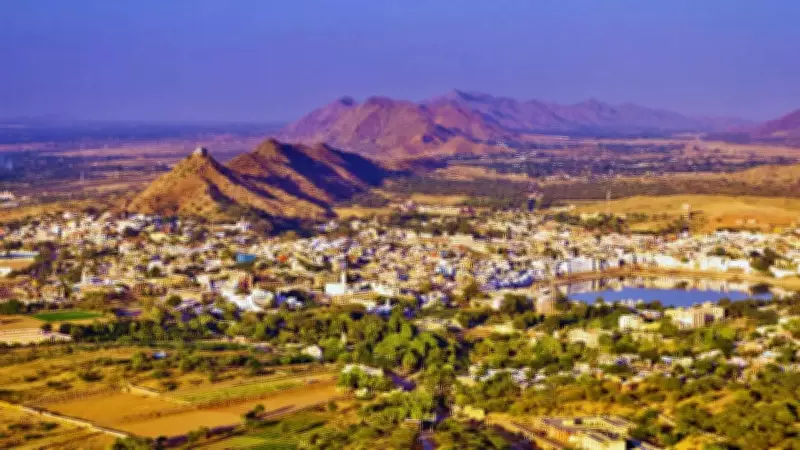
Then the Aravalli Range commanded attention. In person, these ancient formations differed dramatically from Northeastern mountains. Rather than soaring dramatically skyward, they stretched in long, low ridges across the landscape. The terrain appeared dry and rocky with scrub vegetation patches, colored in brown, beige, and muted green hues.
My immediate realization was geological: these hills are ancient. Later research confirmed the Aravallis rank among Earth's oldest mountain ranges at approximately 2 billion years. Their appearance reflected this antiquity—worn down by millennia rather than freshly formed.
Open Horizons: Desert Meets Ancient Hills
From the Savitri Mata Temple vantage point, the openness astonished me. Unlike Northeast mountains that create layered barriers, the Pushkar landscape expanded limitlessly. The Aravallis rolled outward, transitioning into desert stretching beyond visibility.
Below, Pushkar town revealed its organized layout—sacred pond centrally positioned, temple spires punctuating the skyline, bazaar roads bustling with activity. Camels moved slowly along outskirts, appearing almost surreal to someone accustomed to cattle and mithun. Here, decorated with colorful saddles, they represented both local economy and tourism.
The sunset that evening remains the most glorious I've witnessed. Hours spent on town outskirts rewarded me with breathtaking vistas that redefined scenic beauty.
Comparative Beauty: Different But Equal
I didn't find the Aravallis more beautiful than Northeast hills—nor should comparisons work that way. Instead, I discovered a distinct beauty thriving in dry terrain, ancient rock formations, and expansive skies. This beauty felt steady and open rather than lush and enclosing.

Throughout the day, the ropeway's aerial view of the Aravalli Range lingered in memory. Growing up in the Northeast, I sometimes perceived our region as distant from mainstream India. Travel dissolved that separation. Witnessing the Aravallis illuminated India's profound geographic diversity.
The hills of Assam and Arunachal Pradesh differ completely from Rajasthan's Aravallis in appearance, vegetation, and climate. Yet both remain deeply connected to surrounding communities, demonstrating how varied landscapes collectively shape India's rich cultural tapestry.