The Jindo Miracle: When South Korea's Ocean Parts Like a Biblical Tale
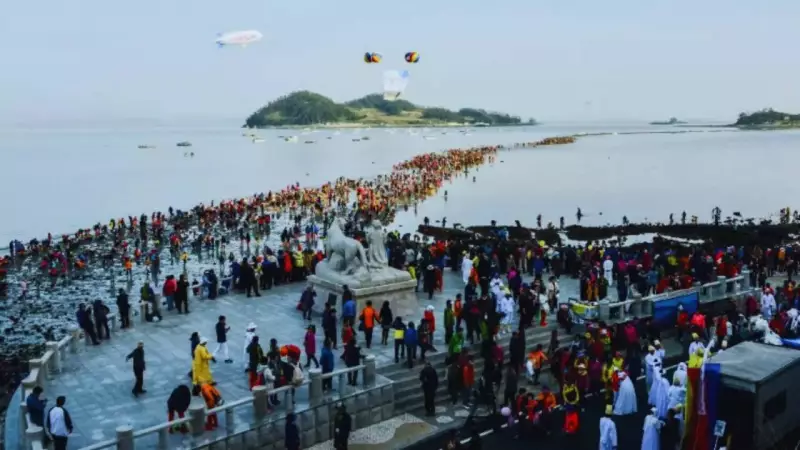
Twice annually, along the serene southwestern coastline of South Korea, nature stages a breathtaking spectacle so rare and precise that it draws parallels to one of humanity's oldest recorded miracles—the Biblical parting of the Red Sea. For a fleeting window of less than an hour, the waters between Jindo Island and its neighboring islets gradually retreat, unveiling a slender ribbon of wet sand and rock where moments earlier only the ocean existed. Villagers, pilgrims, and tourists alike tread this newly exposed route, walking on the seabed as if granted temporary permission by the sea itself.
Where Does This Natural Wonder Occur?
The Jindo Miracle unfolds in the waters between Jindo Island and the small islands of Modo and Seodo, situated off the southwest coast of South Korea in South Jeolla Province. Spanning approximately 2.8 kilometers in length and 40 meters in width, this stretch typically lies submerged. However, during dramatic tidal recessions, a solid pathway emerges across the seabed, briefly connecting the islands before the ocean silently reclaims it.
The Science Behind the Sea-Parting Phenomenon
Contrary to dramatic appearances, the sea does not literally "split." Instead, this event is triggered by significant tidal differences resulting from the precise alignment of the sun, moon, and Earth. During specific full and new moon phases in spring and summer, gravitational forces generate exceptionally low tides in this region. The unique topography of the Jindo coastline—featuring a shallow seabed, gentle slopes, and narrow channels—amplifies this effect.

As water flows out of the channel separating the islands, the seabed rises above the water level, forming a temporary land bridge. For 40 to 60 minutes, the sea recedes, leaving a muddy, shell-lined path across the water. When the tide reverses, water gradually refills the path, isolating the islands once more. This process is so exact that it occurs only two to three times each year.
A Legend Rooted in Local Folklore
Local legend enriches the phenomenon with myth. It is said that villagers once fled Jindo Island to escape tigers, inadvertently leaving behind an elderly woman named Bbyong. In her despair, she prayed fervently to the sea god Yongwang for reunion with her family. Yongwang responded, promising the sea would part on a specific day. When that day arrived, the villagers walked safely across the seabed, guided by the elderly woman's prayers.
From Local Secret to Global Attraction
Long a hidden gem known only to local fishing communities, the Jindo Miracle gained international recognition in the 1970s after being highlighted by the French ambassador to South Korea. Subsequently, the government began promoting it as a cultural and natural heritage event. Today, it is celebrated through the annual Jindo Sea-Parting Festival, timed with the tidal road's appearance. The festival features traditional music performances, folk dances, ceremonial offerings, and seafood banquets, transforming a scientific marvel into a vibrant cultural experience.
Visitors are encouraged to walk the route barefoot, exploring tidal pools that form along the path before the water returns. Timing is crucial, as the road disappears once the tide begins to rise. Safety officials closely monitor the process, ensuring participants depart before being trapped by incoming waters.
Best Times to Witness the Miracle
The optimal period to observe the Jindo Miracle typically falls between March and June, though dates vary annually based on lunar patterns. Tide schedules are announced well in advance, allowing travelers to plan their visits accordingly.
A Reminder of Nature's Precision
Beyond its visual splendor, the Jindo Miracle offers a profound glimpse into the cyclical rhythms governing our oceans. It serves as a reminder that, even in an age of satellite imaging and supercomputers, nature operates with a breathtaking precision that continues to awe and inspire.

For the residents of Jindo, this phenomenon transcends mere spectacle. It is a cherished tradition weaving together science, myth, and spirituality, passed down through generations with quiet pride. For those fortunate enough to witness it at the right moment, the experience of watching the tide recede and traversing a road that defies expectation feels like stepping into another world—if only for an hour.